TOP
South Africa

“Rhino Run-Around: a quest for the elusive armored beast”

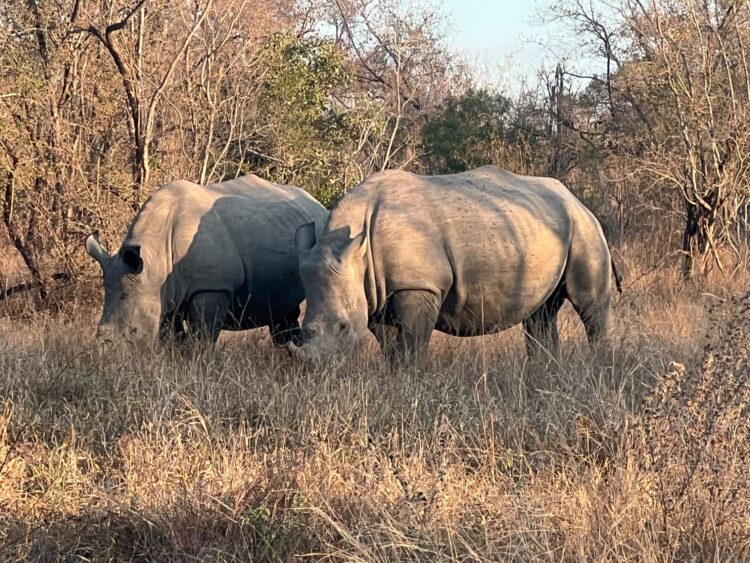
At last! All of the big 5 have been identified, except the Rhino. We were incredibly anxious to encounter a rhino- today was our last full day in the park, and our last chance to find the elusive armored beast before our departure.  Could we do it?!

There was dust in the air, there were bumps on the road, and the thick, green shrubbery would often hinder our efforts. It also seemed as if many other tourists on the roads were anxious to find the rhino too. Throughout the day we received many tips and Mr. David and Mr. Andrew, our expert guides drove around tirelessly until at last (after many false-alarm rocks and trees) we spotted two White rhinos in the brush! There was much rejoicing.

In Africa, the sunset is not the end of the day, it’s the celebration of it. And so I wonder what the sunrise holds. Perhaps it’s not just the start of the day, but rather a promise of what’s to come. That’s the beauty of Africa. Maybe you’ll encounter the intensity of a pride of lions stalking their next buffalo meal or the jubilant puppy play of the wild dogs… whatever the case, South Africa does not disappoint.

White rhino, true grazers on grass, enjoy an evening meal and provide the very best evening entertainment after a long day of searching and learning.
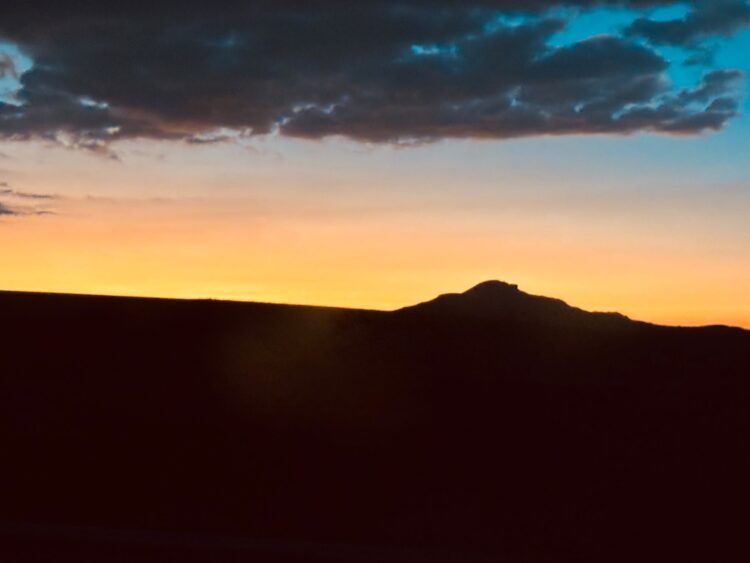
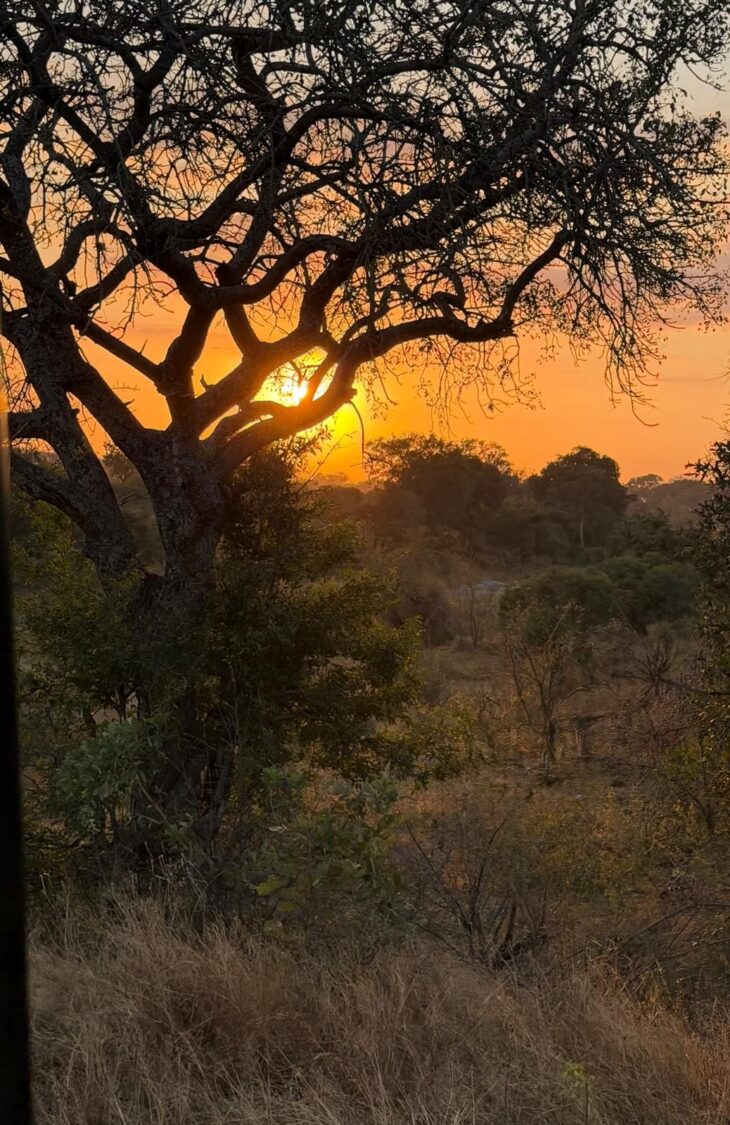
The spectacular South African sunset over Kruger National Park.
South Africa

“Learning to Listen”

Friday, July 24:

We started the day having seen two of the Big Five with high hopes for seeing a rhino, Cape buffalo, and lion in our remaining time in the park. But we have already been wowed by many other amazing African animals, so we were excited for whatever encounters we have while in Kruger! Each of us are simply trying to take it all in while processing with each other. Such an amazing opportunity all around. 


Half the group started the day at 5 am with a bush walk while the sun came up. We learned about animal tracks and poop while also being wowed by some wildlife sightings. We were so thankful to be guided by Pelsy (one of only about 15 female rangers in the park) and Lucky and to learn from their expertise. Pelsy started by sharing “We must allow the bush to communicate with us.” We hope we are good listeners!


The full group gathered together and packed to move to our next location in Kruger. Of course, riding through the scrub forest with passionate teachers takes a long time while we look for all the things we can absorb in the lowveld (the term for this low-lying, subtropical, semi-arid habitat).


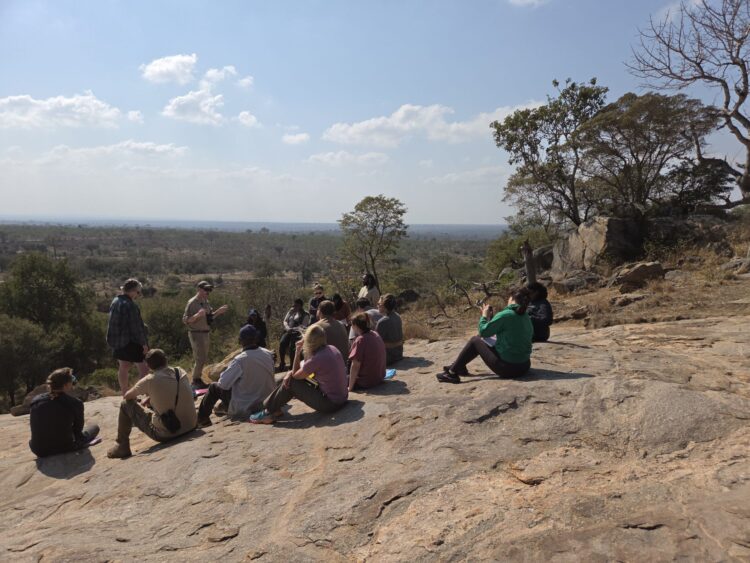
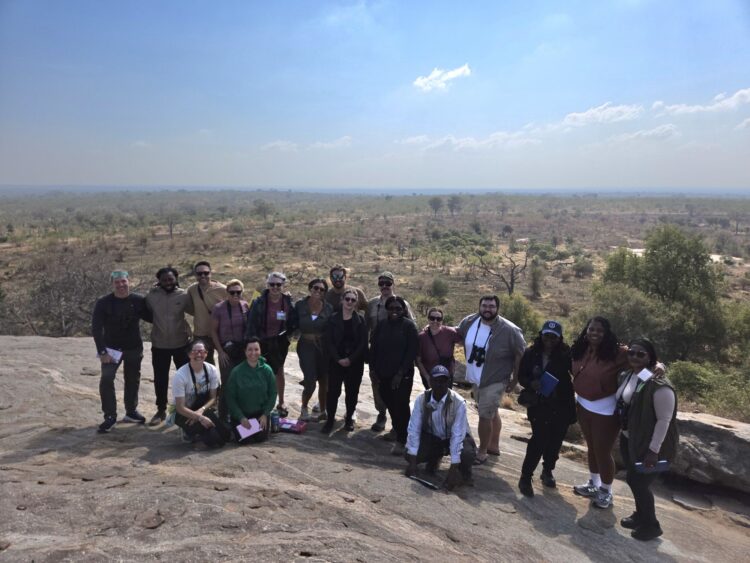
The vans climbed to the top of Mathekenyane Lookout where we took in a panoramic view of the park. Dr. Christian Kammerer delivered a geology lesson for us on top of this big granite rock. Of course, 30 seconds in, we spotted warthogs chasing impalas and we were all distracted for a few minutes. But then we focused and learned from his expertise.
After more driving and animal sightings (including, finally an African hoopoe!), we stopped at Afsaal for lunch and a lesson on the Little Five through an improv skit created by Sayrd.

Mathekenyane Hill Overlook


Back in the vans, traveling on, we were amazed by zebras running, giraffes eating, and a herd of Cape Buffalo resting in the bush! Number 3 for us of the Big 5!
After more driving and animal sightings (including, finally an African hoopoe!), we stopped at Afsaal for lunch and a lesson on the Little Five through an improv skit created by Sayrd.

Dr. Christian Kammerer teaches us about the geology of Kruger National Park


We arrived at Berg-en-Dal, our base for the next two nights, and got settled in to experience two more days of South African wildlife.


We are realizing that it isn’t about accomplishing a checklist of wildlife observations; but rather having an experience that will change us, make us better educators, and allow us to transfer knowledge and processes to our students.

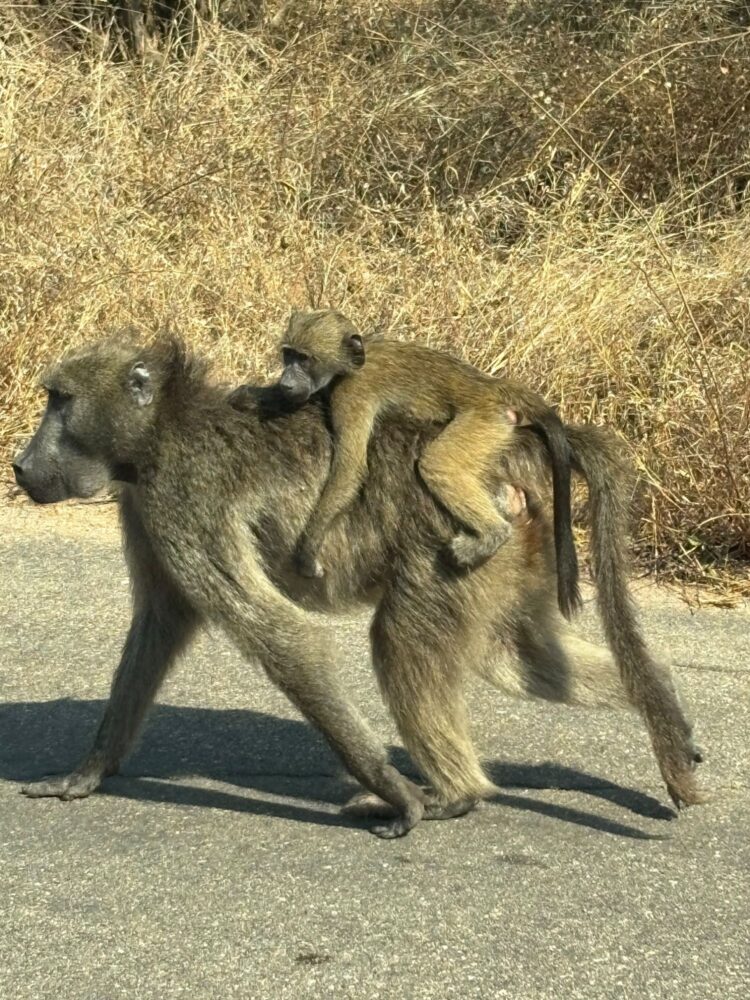
Baboon momma and baby
South Africa

“Our first full day in Kruger…”

Today was our first full day at Kruger National Park. Half of our group started the day off with a bush walk. We were excited to see the tracks (footprints) of animals that had been there overnight. The other half goes tomorrow and is eagerly anticipating their turn!

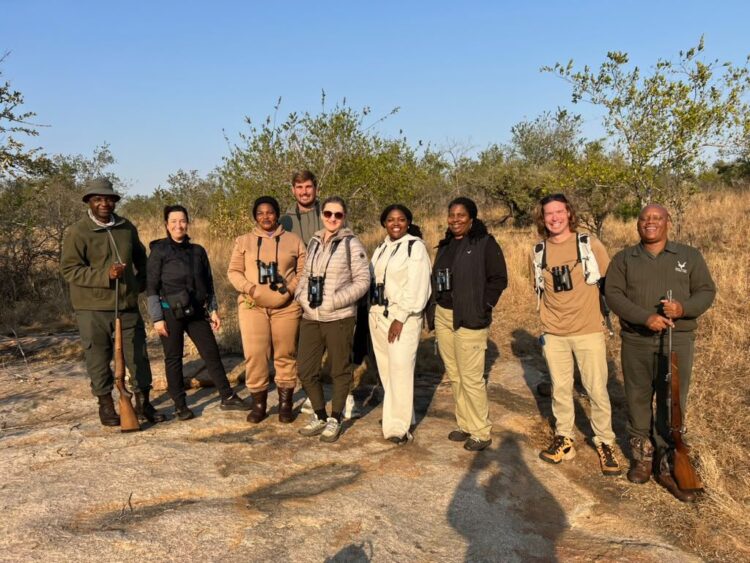
Bush walkers #1, left to right: Pansy, Eunice, AJ, Viola, Sierra, Tokitha, and Sayrd with Rangers Pilot (left) and Lucky (right)

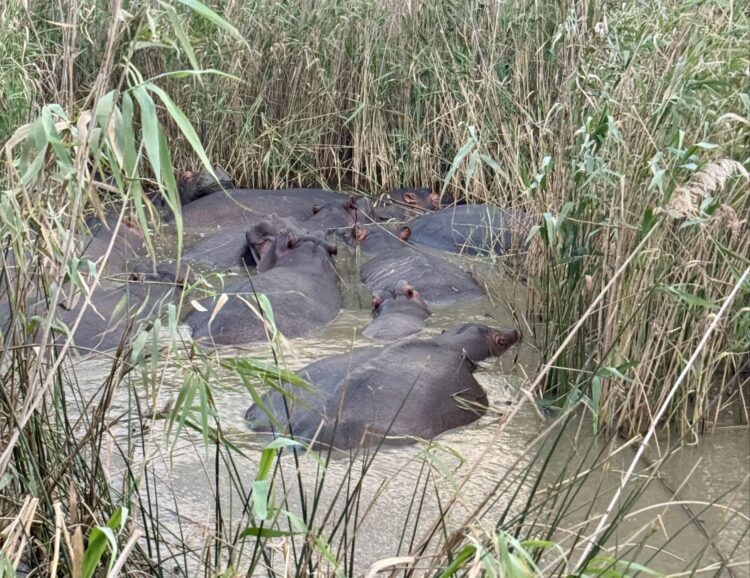
Some of the group members went out early and caught a gorgeous sunrise over the Sabie River! While eating breakfast, we saw several hippos and crocodiles on the river! One thing that immediately caught our attention was watching the hippo scatter-spray its dung, three times. Hippos use this behavior for a number of reasons: to mark their territory and communicate with other hippos, to help exclude parasites from their anus, and to break up large chunks of dung to expedite nutrient cycling in the environment. It was so exciting to see these creatures so close up! Check our reel on @ncmnsteachered on Instagram for a brief video (content warning!).

In the early afternoon, our whole group went to the Lake Panic Hide (an animal blind). We got the opportunity to observe crocodiles, hippos, the Egyptian Goose, a water monitor lizard (similar in size to an iguana), along with many other African animals in their natural habitats. It was exciting after we heard some splashing around the corner and turned to witness aggression between two crocodiles.

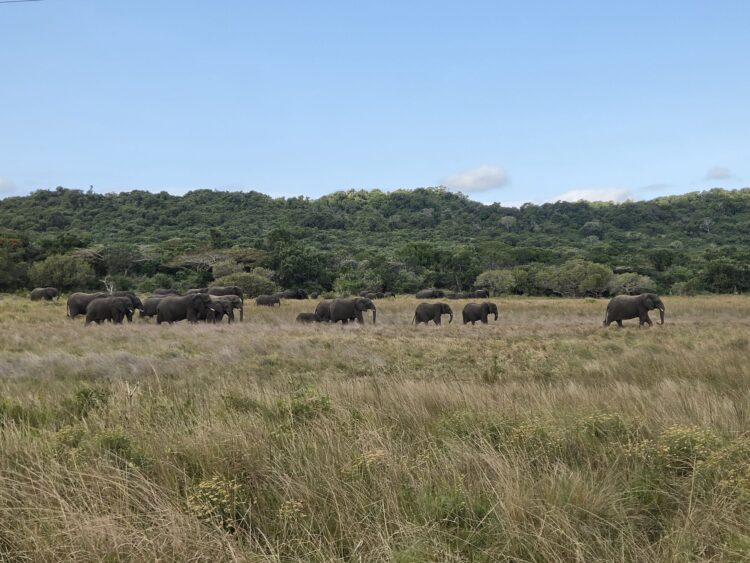
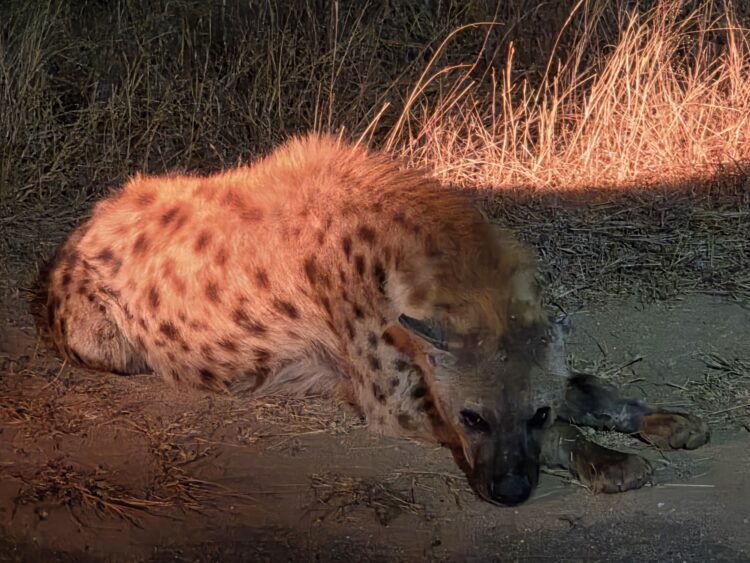
This evening we went on a sunset game drive and saw MANY creatures including: elephants (LOTS), giraffes, hyenas, bush babies, and a duiker (small antelope). During the drive, we learned how to distinguish between male and female giraffes. Male giraffes are typically larger and have thicker ossicorns, the horn-like structures in between their ears (that are usually bald because the hair has been rubbed off during aggressive encounters with other males). We felt like we were truly in South Africa today and have  deepened our appreciation and connection for the incredible biodiversity found at Kruger National Park. We can’t wait to see what adventures await us tomorrow!

Spotted hyena
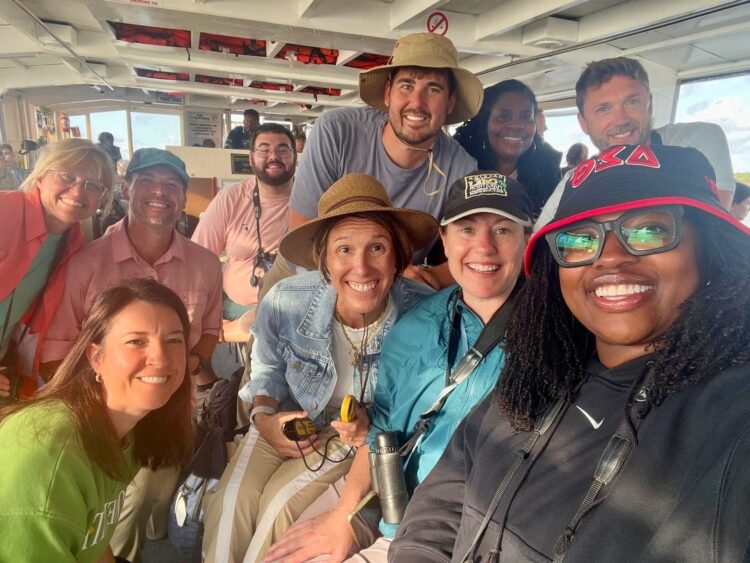
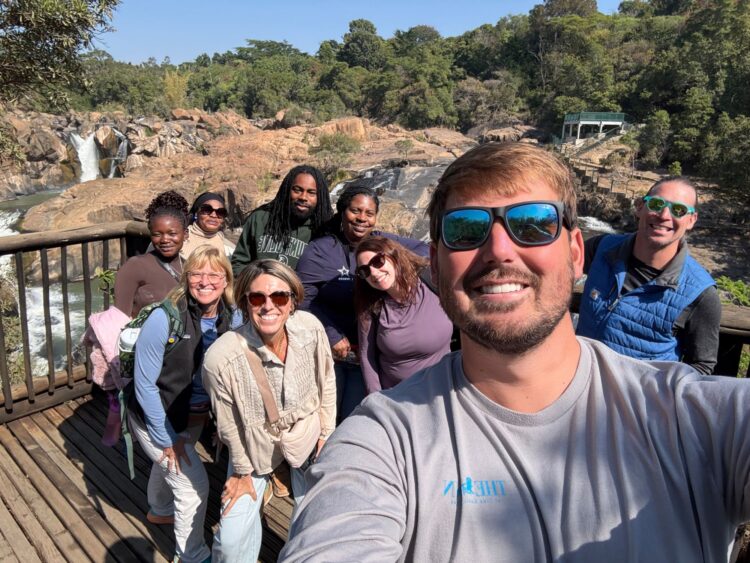
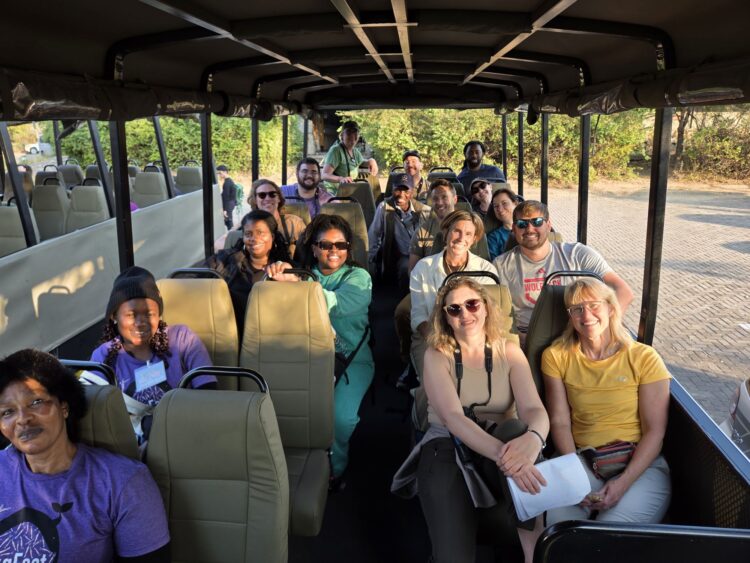
Game Drive crew
South Africa

“Our first safari adventure…”

Practice makes perfect with binoculars

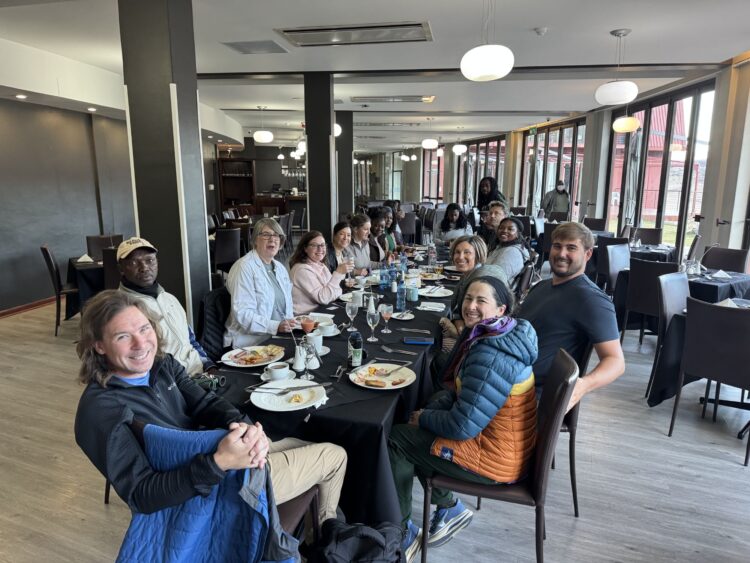
Day 2: Our first full day in South Africa began bright and early with a delicious breakfast together as a group before setting out on the seven-hour journey from Johannesburg to Kruger National Park. The drive gave us our first opportunity to see the beauty of the South African landscape while getting to know one another even better.


We stopped for lunch along the way, where we shared the haikus we had written and practiced using our binoculars in preparation for our safari. The excitement continued to build as we got back on the road, and before we even reached the park, we were greeted by a troop of baboons along the roadside—a reminder that wildlife is never too far away in South Africa.


Once inside Kruger National Park, the adventure truly began. We were incredibly fortunate to witness one of Africa’s most elusive animals—a leopard, during the golden hour. We watched in amazement as it gracefully walked through the bush, climbed a tree, and settled comfortably on a branch to rest. It was a breathtaking moment that many visitors wait years to experience.
Welcome to Kruger National Park!

Leopard sighting at dusk in Kruger National Park


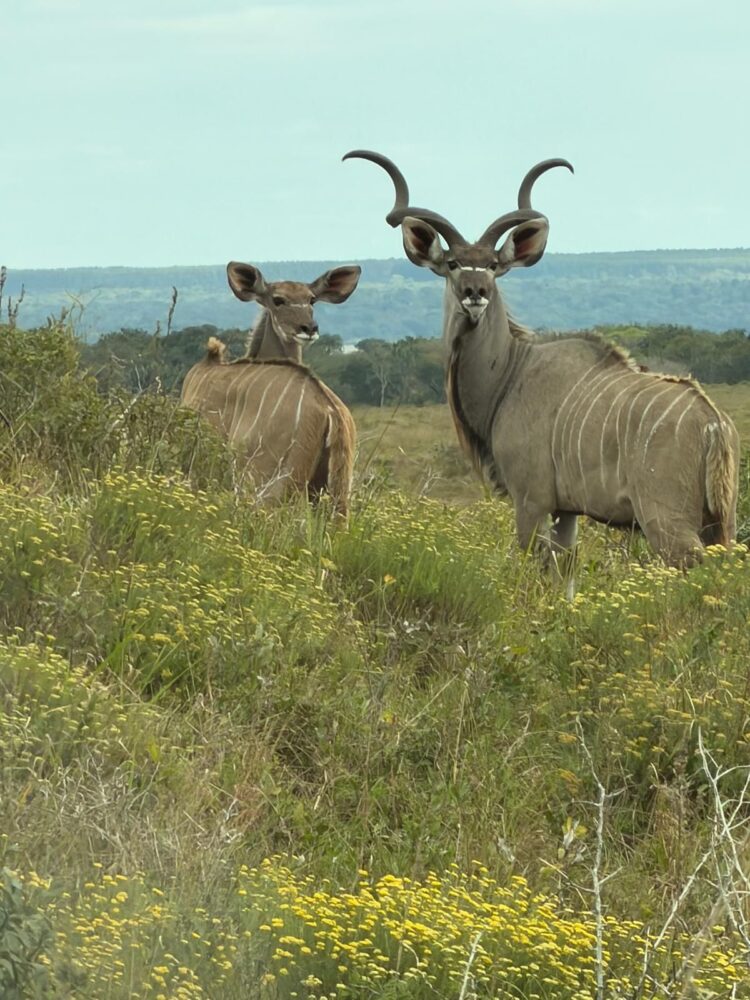
The wildlife sightings didn’t stop there. We encountered a large group of giraffes stretching their long necks to feed from the treetops, herds of zebras grazing across the landscape, a curious warthog, dozens of impala, a few kudu (a larger  antelope with giant ears), a few nyala (a striped antelope that prefers thicker brush habitat) and steenbok (a smaller, shy antelope), as well as a variety of beautiful birds that added vibrant color and song to the day.


As the sun began to set, we reflected on the unforgettable experiences we had shared before ending the evening with dinner together as a group. Our first safari exceeded every expectation and reminded us why South Africa is home to some of the most incredible wildlife on Earth. We can’t wait to see what tomorrow brings!

South Africa

“First Group Meeting”

Meet new friends and keep the old, one is silver and the other’s gold. A circle is round that never ends, that’s how long I’ll be your friend.

We have arrived! We have met our new friends, and we are ready to sleep and learn.

South Africa

“Up, up, and away…”

After a delay due to storms in Raleigh we are on the way to Atlanta, and then a sprint through the airport to catch our flight to Johannesburg… stay tuned!

We’ve brushed up on our common birds of South Africa and are excited to start seeing them once we land!

A group of educators carrying luggage stands as a group in the airport.
The North Carolina contingent of the Educators of Excellence Institute to South Africa

Update: We made the flight to Johannesburg!! South Africa, here we come!

July 21, quick evening update: We made it to South Africa! Our plane touched down at 7:19pm (we are 6 hours ahead of home). Now on to customs, hotel check-in, and our first group meeting with our friends and colleagues from South Africa. We can’t wait!
South Africa

“Sawubona! Hello! But also… I see you.”

Three people walk along a grassy trail through the rolling hills of South Africa

Sawubona- “I see you”

We greet you today with the traditional Zulu phrase Sawubona. This single word, often mistakenly interpreted as a simple hello, in reality has a meaning that is much more nuanced and which translates more accurately to “I see you, and by seeing you, I bring you into being.” The Zulu translation and the way these phrases are exchanged by community members in South Africa reflect a deeper cultural norm, that to greet and see someone each day acknowledges their value as a person– the sum of their experiences, their strengths and weaknesses, their past and their future, their spirit, their voice. Three common responses:

Yebo, sawubona, —“Yes, I see you too”,

Shiboka —“I exist for you”, or

Ngikhona — “I am here”

… all reflect that by giving each person our full attention and presence we bring them into existence and give them value, worth, and dignity.

In less than a week, an intrepid group of 11 NC educators and three Museum staff will travel to South Africa, where we will be joined by two South African teachers before embarking on a journey together with our South African guides, Andrew and David. We invite you to join us— to join us in seeing each and every person (and animals, rocks or fossils, plants or trees…), and appreciating them for who they are.

In particular, today, we see and acknowledge our educators as they prepare for this journey of mind, body, and spirit. They have survived another school year, impacted countless student lives by challenging them to learn and be the good they hope to see in the world, and they are getting ready to selflessly leave their comfort zones to travel far from home so that they can learn, and bring back and share with their students and communities when they return.

Here are some of the ways we’ve been getting ready:

Wendy has been treating her clothes with Permethrin to ward off ticks and mosquitoes that we might encounter while exploring.

A row of clothes hanging out to dry after being sprayed with insecticides.

“Before anything else, preparation is the key to success.” — Alexander Graham Bell

As Katie gets ready for her trip to South Africa, she’s also preparing for the start of a new school year. She’ll be missing the first four days with her new 8th graders, so she’s getting lesson plans ready and setting up her classroom before she leaves. Her bulletin board will feature some of the animals we’ll see and a map of her journey—something she looks forward to sharing with her students when she returns!

A bulletin board for an 8th grade class featuring African animals and a map of their teacher's journey.

Mrs. Katie Clemmons’ bulletin board is ready and waiting for her new students to arrive.

Yellowstone

“The Last Full Day”

Good morning from the Upper Geyser Basin!  Old Faithful has had impeccable timing during our stay.  We had an early start, and got the van loaded just in time to watch Old Faithful erupt.  We then took a walk around the basin.  Sarah gave us an informative talk on the seismic activity within the park while we waited for Daisy to erupt. We were able to watch Daisy, Sawmill, Tardy, Spasmodic, and Anemone all erupt in their own unique ways. It was special to watch because for the most part we were the only people out there so we were able to get close enough to see, to hear, and to feel the spray and the steam.

 After our walk we had the best breakfast of the trip at the General Store next to Old Faithful.  Then we were able to enjoy some individual time exploring the gift shops, the visitor center, and the Tribal Heritage Center on our own time. At the tribal heritage center we learned from Willy and Debbie Lamere (Shoshone) about traditional flintknapping and how to collect porcupine quills to make jewelry. 

Next stop, we hit the Fountain Paint Pots in the Lower Geyser Basin. This was a cool spot that showcased all four types of thermal features.  We got to see hot springs, mud pots, fumaroles, and geysers.

From there we headed back to Mammoth.  We made a stop beside the Gibbon River for our last picnic lunch in the field. Then we piled back in the van to continue.  We made a quick stop at the Obsidian Cliffs and Greg shared a little of the history of the area.

Just before getting back to Mammoth we stopped to have our last group meeting in the woods.  It was a peaceful time for us to share and reflect on this amazing experience.  We talked about how it has impacted us and how we plan to bring what we learned back home with us.  A few tears were shed (ok… maybe a lot of tears), core memories were cemented, and new friendships sealed.  This has been such an amazing experience.  I feel that I’ve rediscovered the person I wanted to be as a child. All of us are leaving feeling rejuvenated and reenergized. 

Yellowstone

“Grand Teton National Park”

Did you know? Teton translates to “breast”. So we are heading into the “Grand ____” (insert your own colloquial term) today. It really is a beautiful sight with a fault creating the separation of mountain and fields. 

The Tetons have not disappointed…a hike around Moose Lake revealed TWO moose and a calliope hummingbird (the smallest one in the US)! It had to be summoned by our Moose song that we chanted on the way in. 

Martin the Moose wandered off, but Bullwinkle decided he definitely IS the most majestic creature out here and moseyed to the water to not only get a snack from the bottom of the pond, but also give us his best “bend and snap”. 

A moose eating plants from the bottom of a pond
Moose feeding in water

An enlightening and emotional visit at the Mardy and Olaus Murie House taught us about the beginning of the Wilderness Act and how ANWR came to be. We were in awe of the fact that we have never heard of this great individual that made the preservation of millions of acres in Alaska possible. There is something to be said about being in the space where someone lived and you see their books, handmade quotes, artwork as you ponder how they were able to accomplish so very much. Listening to John Denver pay tribute to Mardy brought tears to our eyes. A walk to the Snake River, dipping our heads in cold waters, and a moose dance has us all feeling nostalgic and inspired to educate and protect the natural world around us. 

The clear Snake River surrounded by green grass and blue skies
Channel of the Snake River

On that note get up on your feet and chant with us. You make your own moves, but spread your fingers and hold your hands by your head whenever you say moose. 

🎶 He was great big moose 

Who likes drink a lot of juice,

He drinks his juice with care,

He got some in his hair,

Now he’s sticky everywhere,

He’s a great big moose,

On the loooooooooosssseee!🎶

a group of teachers posing as moose in front of the Grand Teton mountain range
Teachers posing as moose in front of the Tetons

Yellowstone

“Geyser Basins and Amphibians ”

We started the day with a wonderful buffet style breakfast at the historic Lake Hotel, overlooking Yellowstone Lake.

Afterwards, we hiked on the shores of Yellowstone Lake, taking time to journal and absorb our surroundings. We observed several species of ducks, White Pelicans, Wilson’s Snipe, and Sandhill Cranes. During this time, we saw and learned about the Yellowstone Sand Verbena. This plant species is endemic to the park, only found on the shores of this very lake. It is thought to survive the alpine conditions due to geothermal heating from the hydrothermal features in and around the lake. It is highly protected so if you see it- observe from a distance. 

Yellowstone Lake

Shortly after our morning walk on the lake, we went to talk with some park rangers about invasive aquatic species in Yellowstone. They talked to use about the importance of cleaning and drying the boats as they enter the park to prevent the further spread of things like zebra mussels and golden mussels. When we were done we went to play in some water to check for some frogs. We found a boreal chorus frog and a Columbia spotted frog. We also found a surprise, a western tiger salamander!!! (This is especially exciting as they are the only species of salamander found here, compared to the North Carolina salamander hot spot we are used to).

Western tiger salamander

This afternoon, we visited the West Thumb Geyser Basin, Continental Divide, Old Faithful, and the Grand Prismatic. The thermal hot springs of the Geyser Basin were incredible. We saw dark teal-blue pools of water becoming yellow, burnt orange, and brown as water flowed over the light tan crust and into Yellowstone Lake. Using a laser thermometer from a safe distance, we observed a temperature range between 81.5-151 degrees Fahrenheit in these bodies of water. We also saw two snakes, which is rare in Yellowstone. As we left the Geyser Basin, we made our way to the Continental Divide, where Isa Lake sends water towards the Atlantic and Pacific Oceans. We got to experience an Old Faithful eruption with “thousands of our closest friends”, as Melissa would say.  To end our day with a gorgeous overlook of Grand Prismatic and an expert topic on bioprospecting from Jacob.

Group photo at west thumb geyser basin