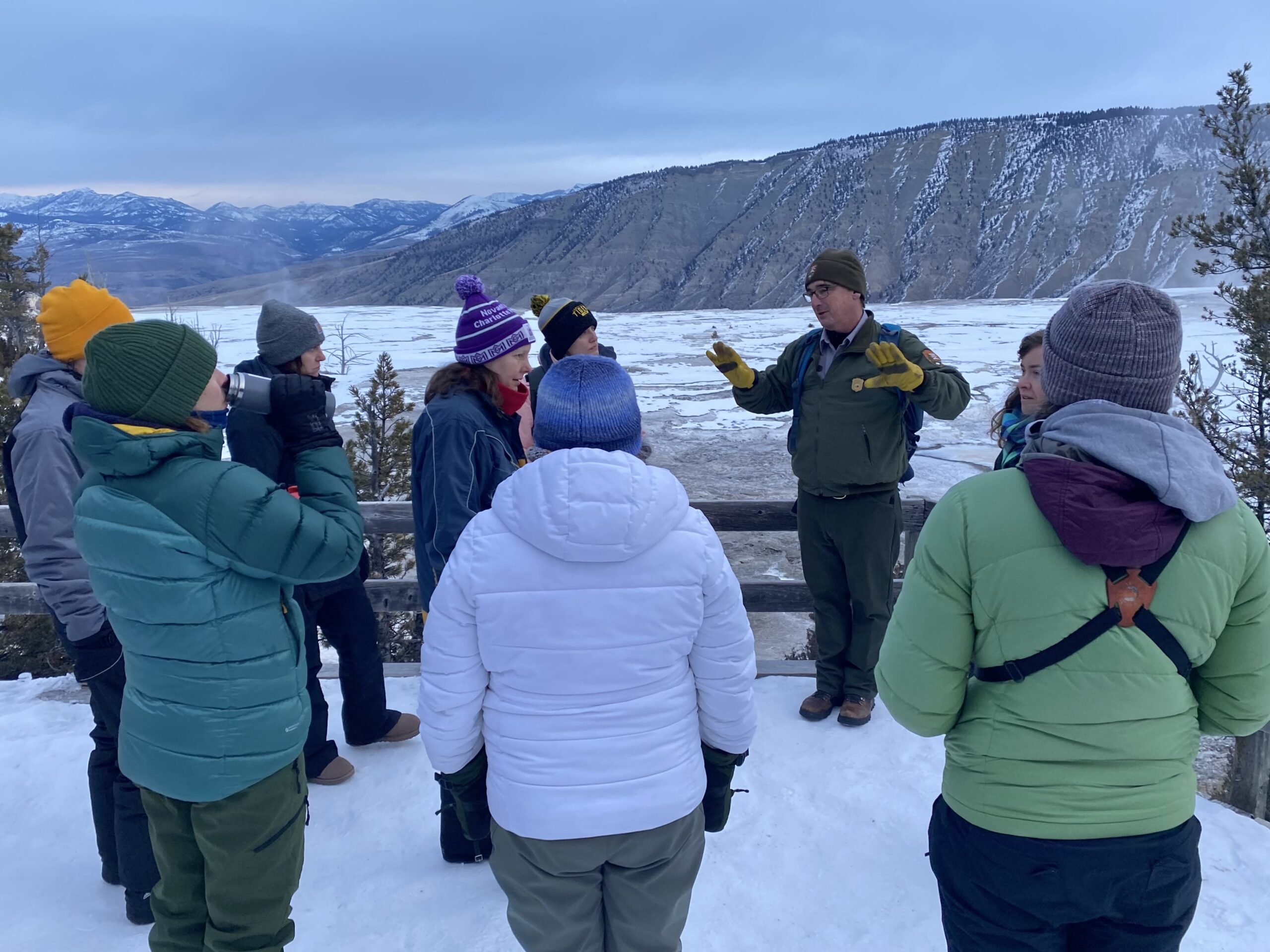
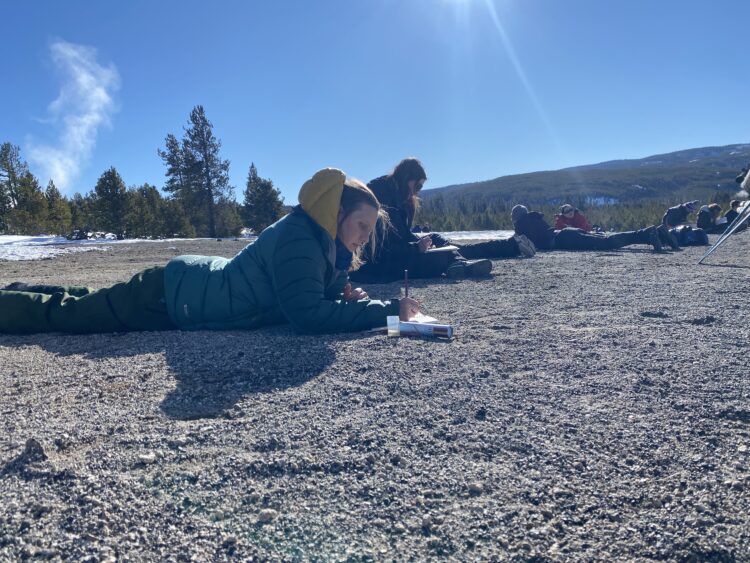
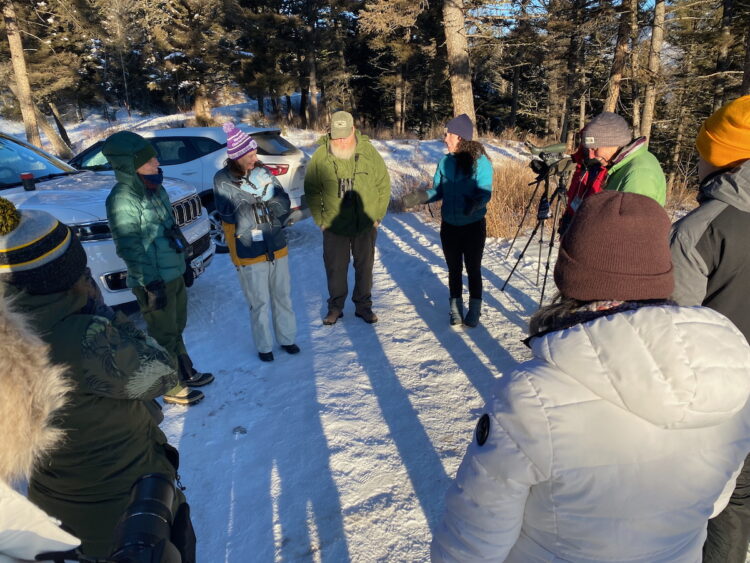
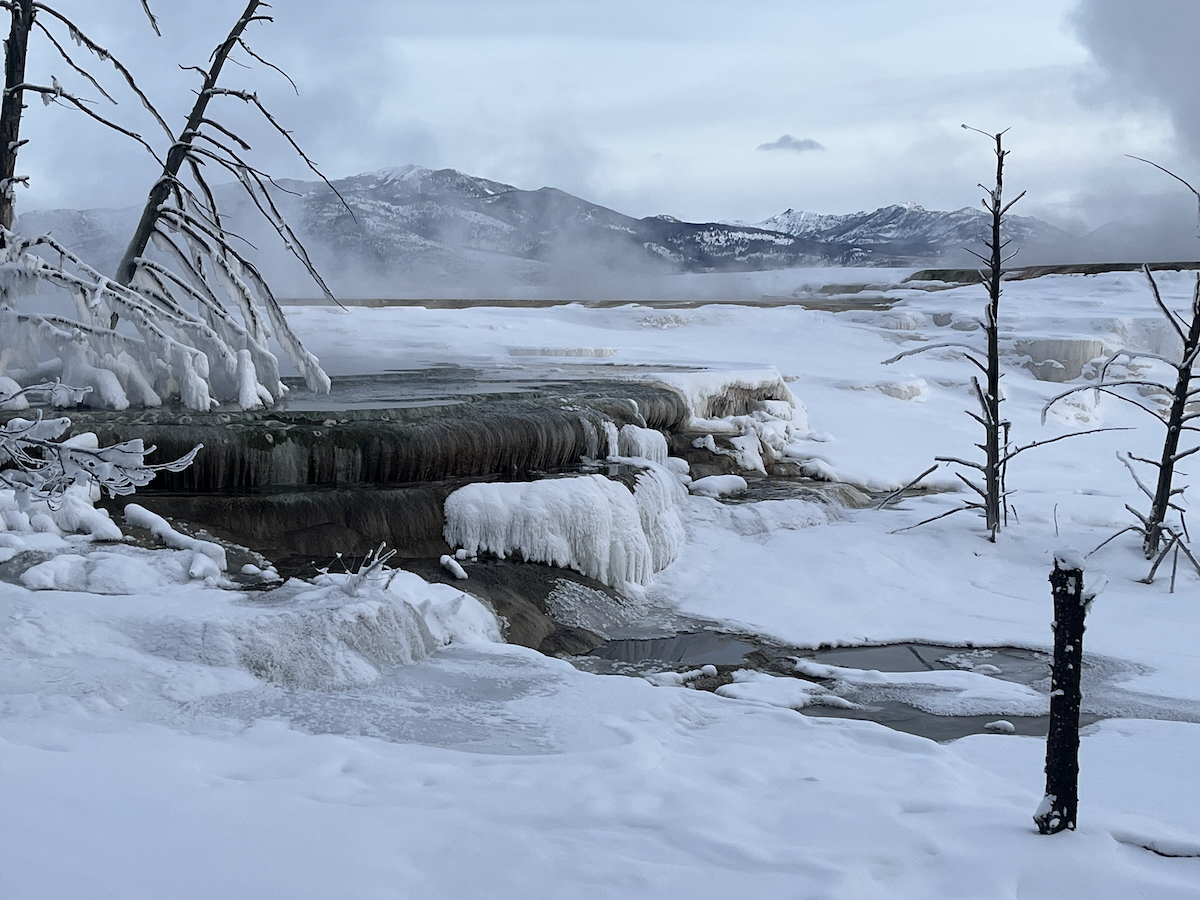
Can you believe it? This was our last morning waking up to a sky covered in stars, looking out the car windows eagerly looking for wildlife, and losing feeling in our fingers and toes. We spent our last morning as students of Ranger Mike at the Mammoth Terraces. Just like our students, we got distracted easily when Melissa spotted a Northern pygmy-owl. It was hard to focus with the excitement of the owl sighting, but we were able to record the temperature and pH of the hot spring under Ranger Mike’s guidance. It was a great educational experience to end our journey.
Learning about the Mammoth Terraces with Ranger Mike.
We waved goodbye to Yellowstone as we made our way back to the hostel to pack up and head to the airport. The drive to the airport gave us a nice send off surprise: we finally had falling snow! It sparkled and shined as it landed on the evergreens and rock outcrops. Our wonderful leaders, Emma and Sam, got us safely to the airport in plenty of time to make our journey back to North Carolina.
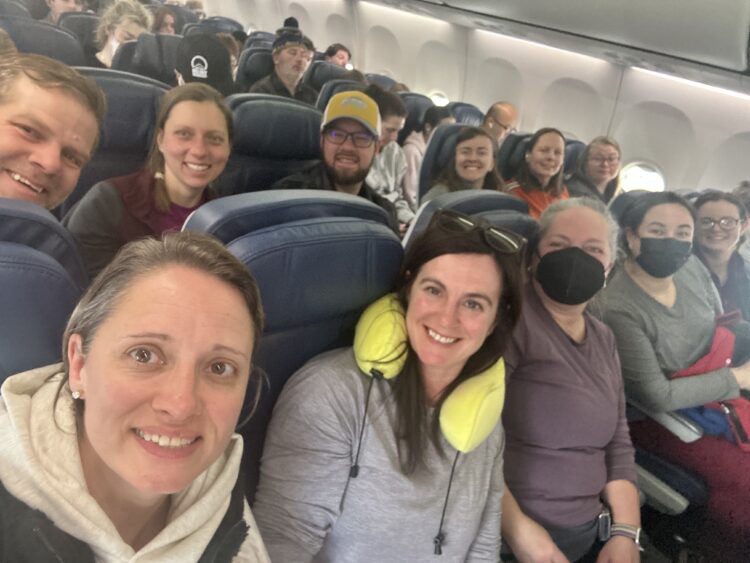
Our drive to the airport was snowier than expected!Heading out of Bozeman.
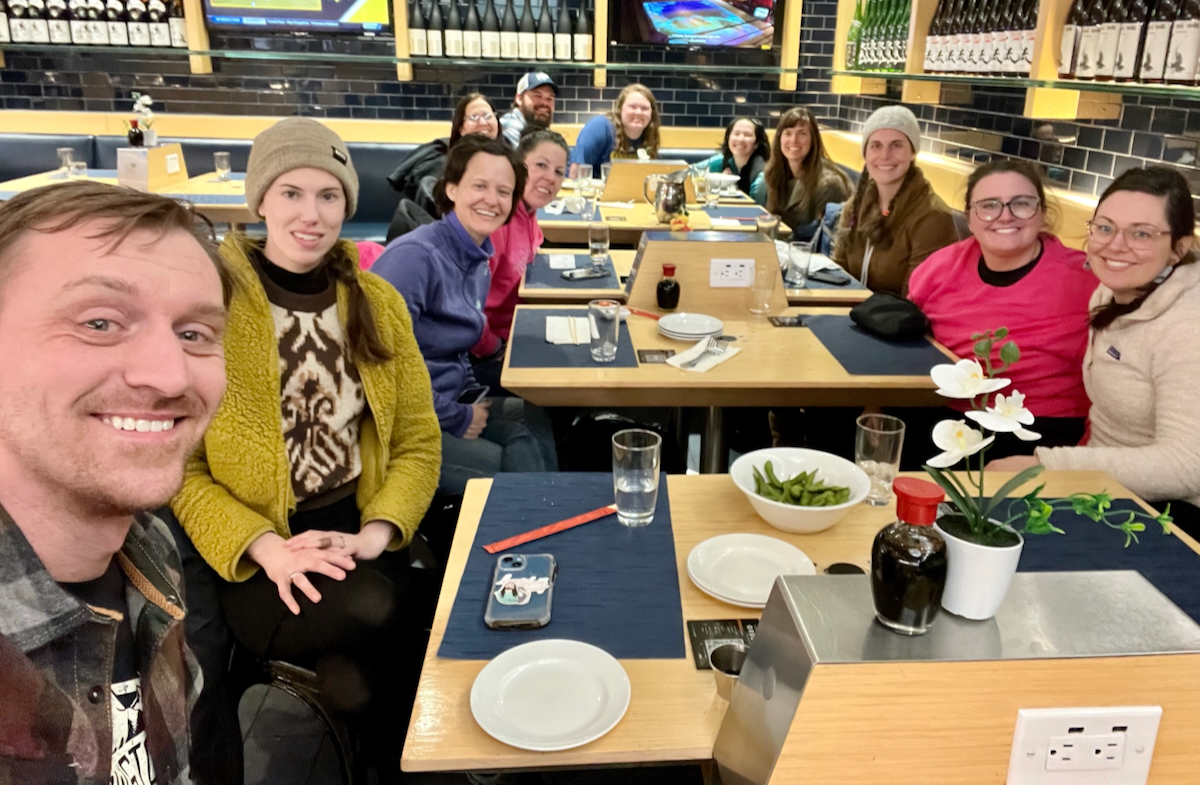
Our last dinner together provided an opportunity for us to reflect on our experience. We spent time revisiting the goals we set for the week:
To learn about the winter adaptations of Yellowstone’s wildlife.
To practice our wildlife observation skills.
To learn about the geology that shapes this park.
To develop or deepen our appreciation of Yellowstone and its leading role in conservation.
To be inspired by the severity and serenity of winter.
Although we did not see every animal on our checklist, we gained so much more knowledge, community, and beauty than we ever could have expected.
We all left behind a piece of our hearts in Yellowstone, yet we plan to bring back many things—a sense of wonder and curiosity, time for silence and serenity, an understanding of the importance of conservation and history, and the lifelong bond that links us together and also with Yellowstone.
We are so full of the many moments that built these bonds whether it was the laughter that connected us over silly moments or the intrigue we shared as we huddled to look through scopes to spot wildlife. Yellowstone is truly a magical place. Each and every one of us are excited to bring this connection back to our classrooms and communities. See you all soon!
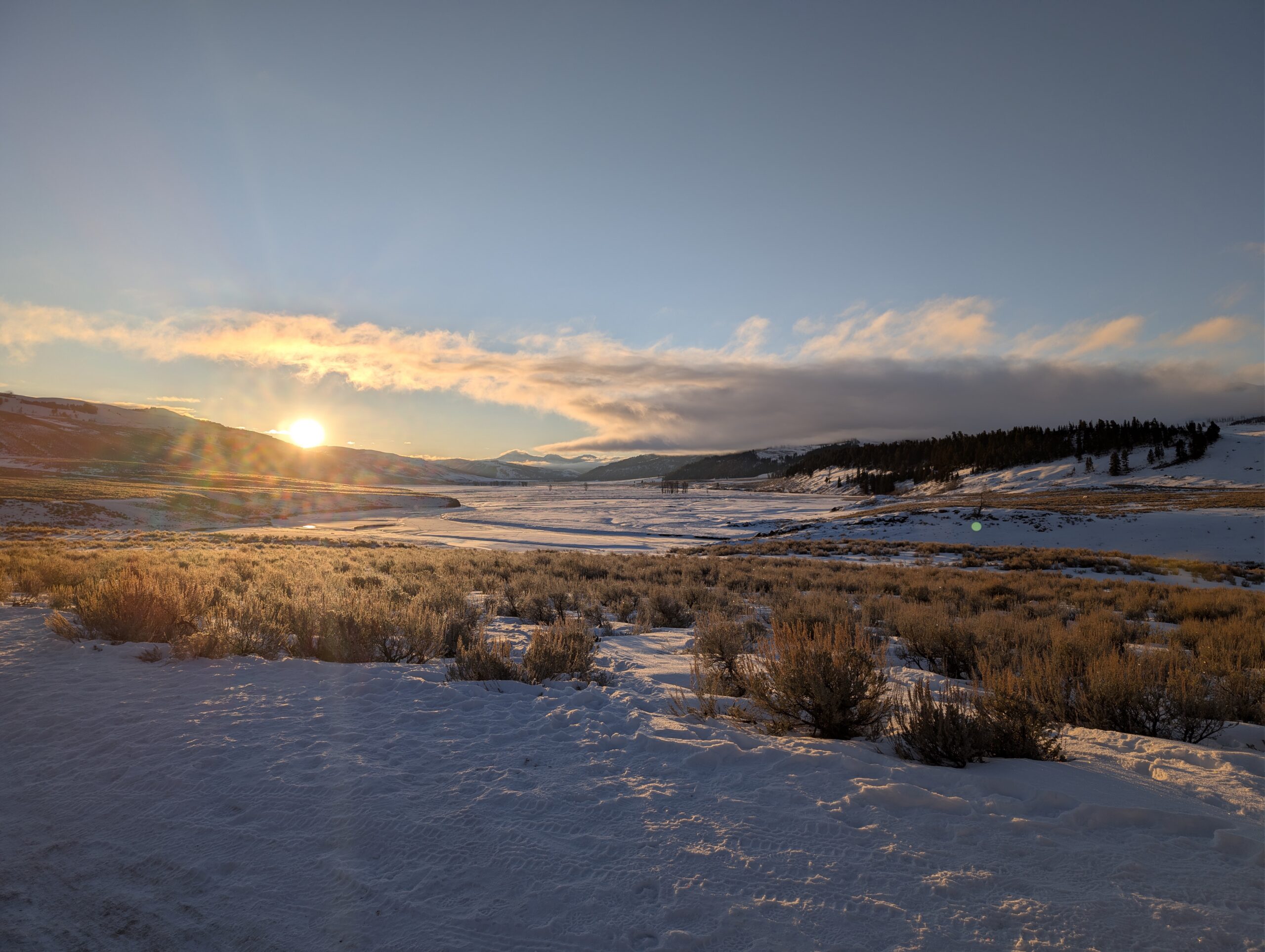
Today we got up early and headed out to the Lamar Valley to see what wildlife we could find. First we returned to the lookout point where we met Kira on Thursday to listen for the wolves. But, alas, it was a mostly silent stop. It’s amazing how loud cars sound when moving through a natural landscape instead of moving through the towns and cities we live in!
Sunrise over the Lamar Valley.
We made a few more stops before sunrise around 8:10 am. At one stop, Melissa pointed out the rendezvous point of the Junction Butte wolf pack, located by its proximity to the “Marge Simpson” tree (a tree that appears oddly similar to the shape of Marge Simpson’s hair). This area is used by the pack in the summer when their pups are growing, as it’s very close to their denning site.
We continued on our journey, singing the Disney tune “I’ll Make a Man Out of You” from Mulan. But instead of “let’s get down to business,” we created new lyrics to match our goal of sighting a wolf, and sang, “Is today the day that we spot a wolf?”
Today seemed colder than yesterday even though the sun was out. The actual temperatures hovered under 12 degrees Fahrenheit and our cold toes offered confirmation of the chill. By lunchtime it was warmer and we were able to eat without our gloves. The temperature soared up to a whopping 22 degrees Fahrenheit in the afternoon.
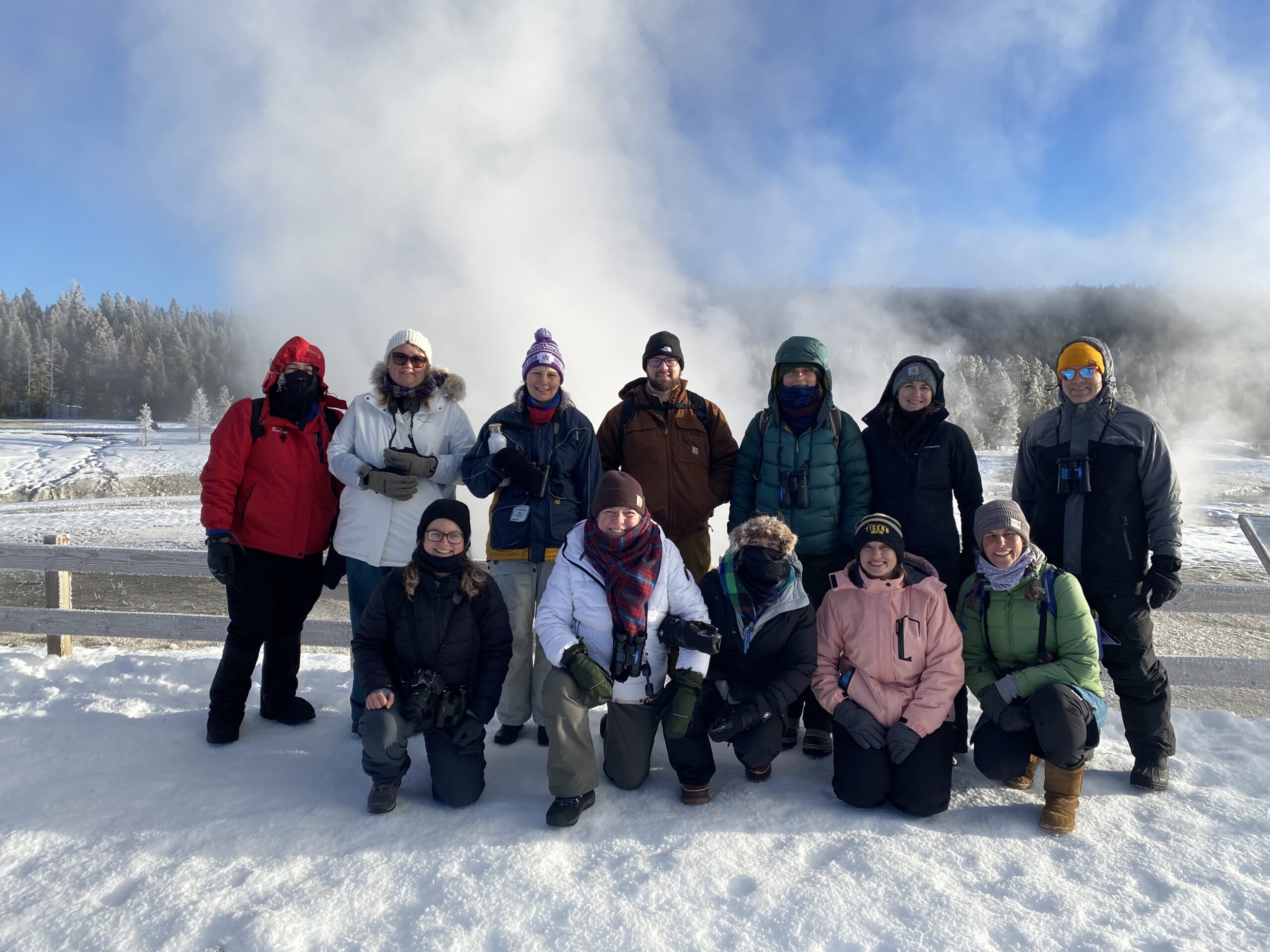
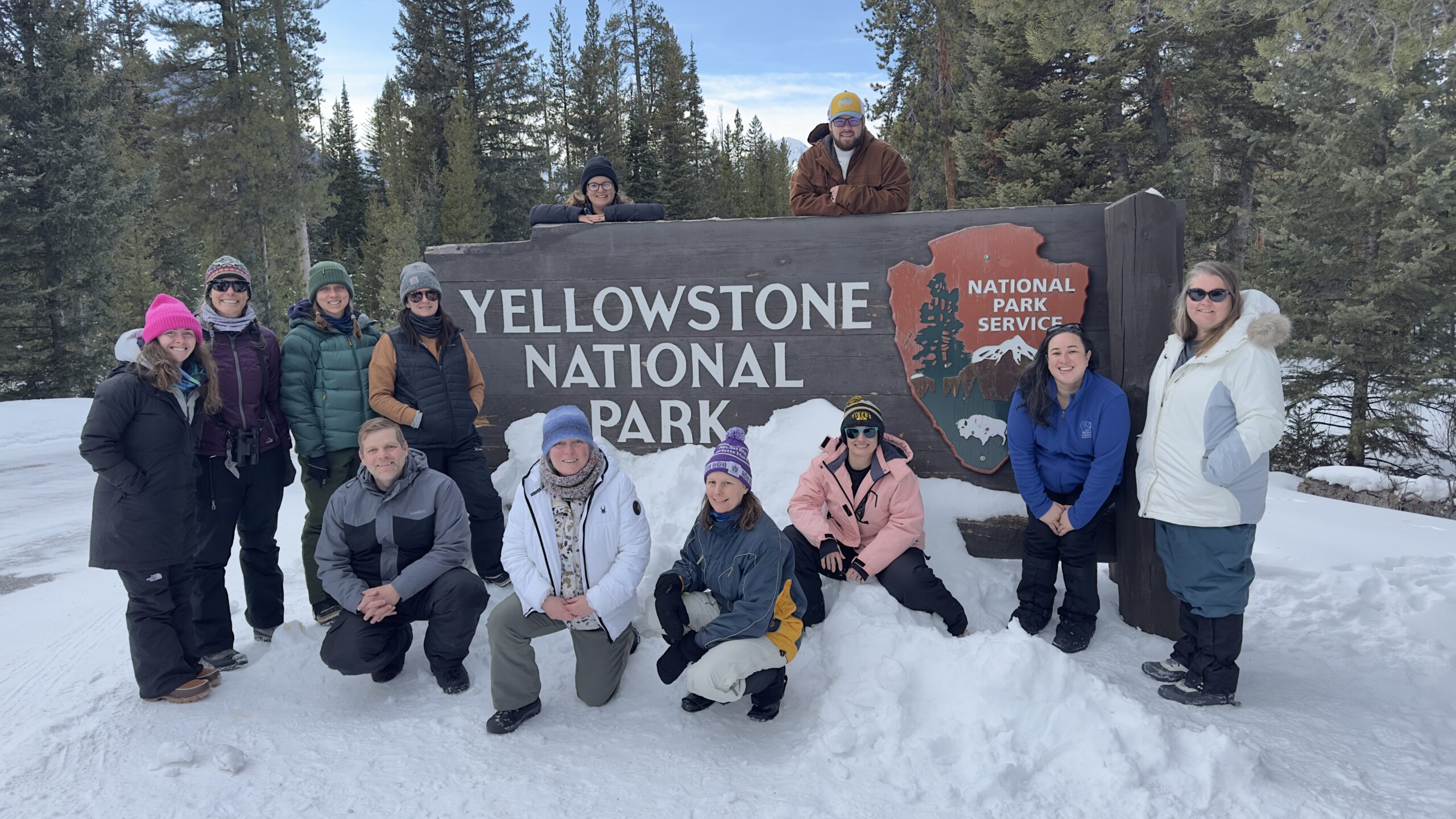
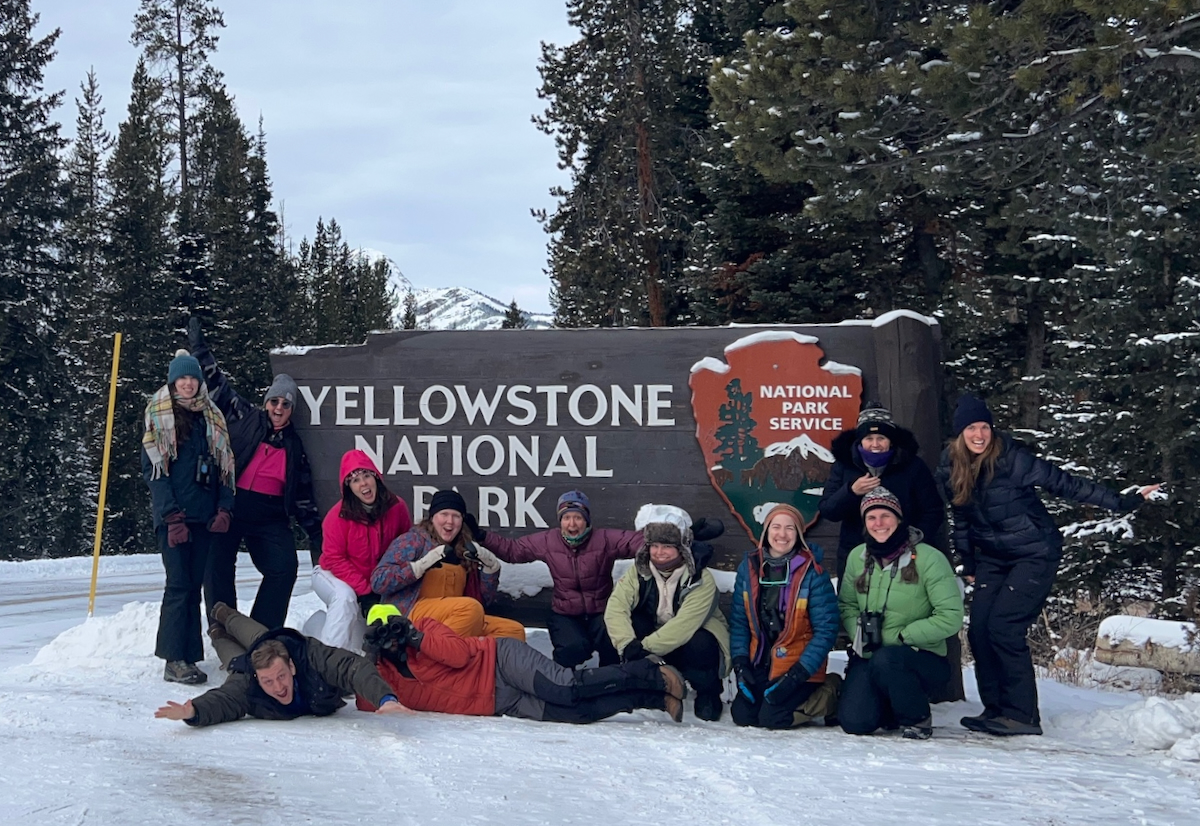
The group at the Northeast Entrance.
Throughout the day we searched for creatures large and small and helped each other find the animals using the clock method. The clock method is a way of helping each other locate wildlife by using the numbers on an analog clock face to indicate what direction we should look. We saw a golden eagle sitting on a branch and yawning. Close to the eagle were some American dippers standing in the icy water as they gathered food from below the shimmering surface. The ever-present bison nibbled on some grassy patches showing through areas of melted snow and occasionally wandered across the road in front of our cars. We saw bighorn sheep that kept their backs to our scope. Some camouflaged elk were barely visible under the trees east of the Roosevelt area. Six coyotes traveled across the frozen landscape, catching small prey and taking care of their “business” as all living things do. A moose tried to play hide and seek with us by standing behind a tree.
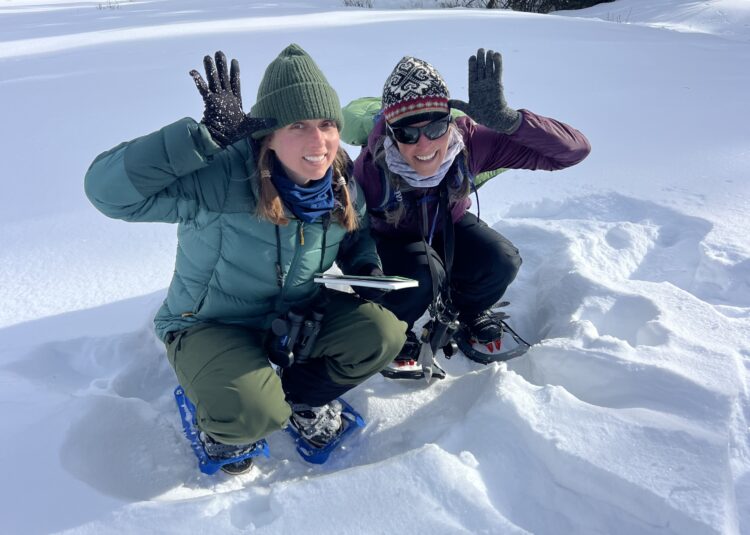
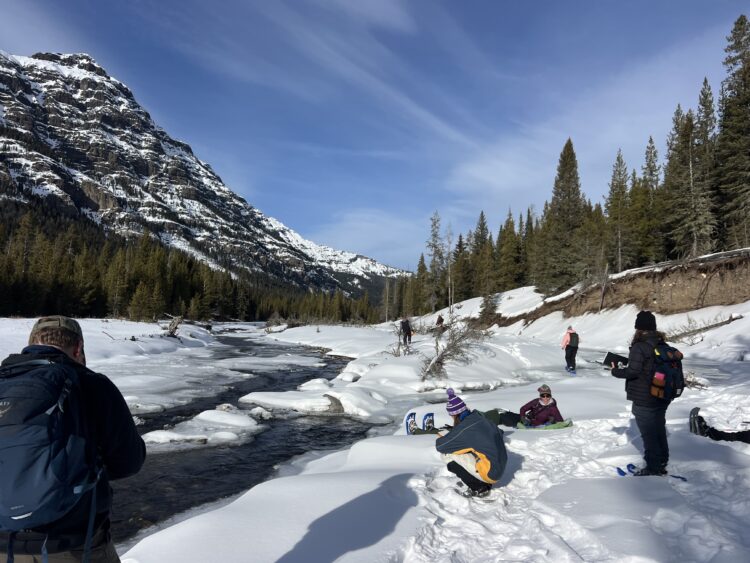
After lunch we visited sites along the main road looking for more wildlife before heading east through the park to find a good spot to go snowshoeing. We trudged through fresh snow and created our own path. The snow was waist deep and most of us stayed above ground, while Josh and Holly found ways to explore the subnivean environment. We found many tracks and even found a moose bed and bathroom.
We found a moose bed during our snoeshow hike.Taking a moment to nature journal by Soda Butte Creek.
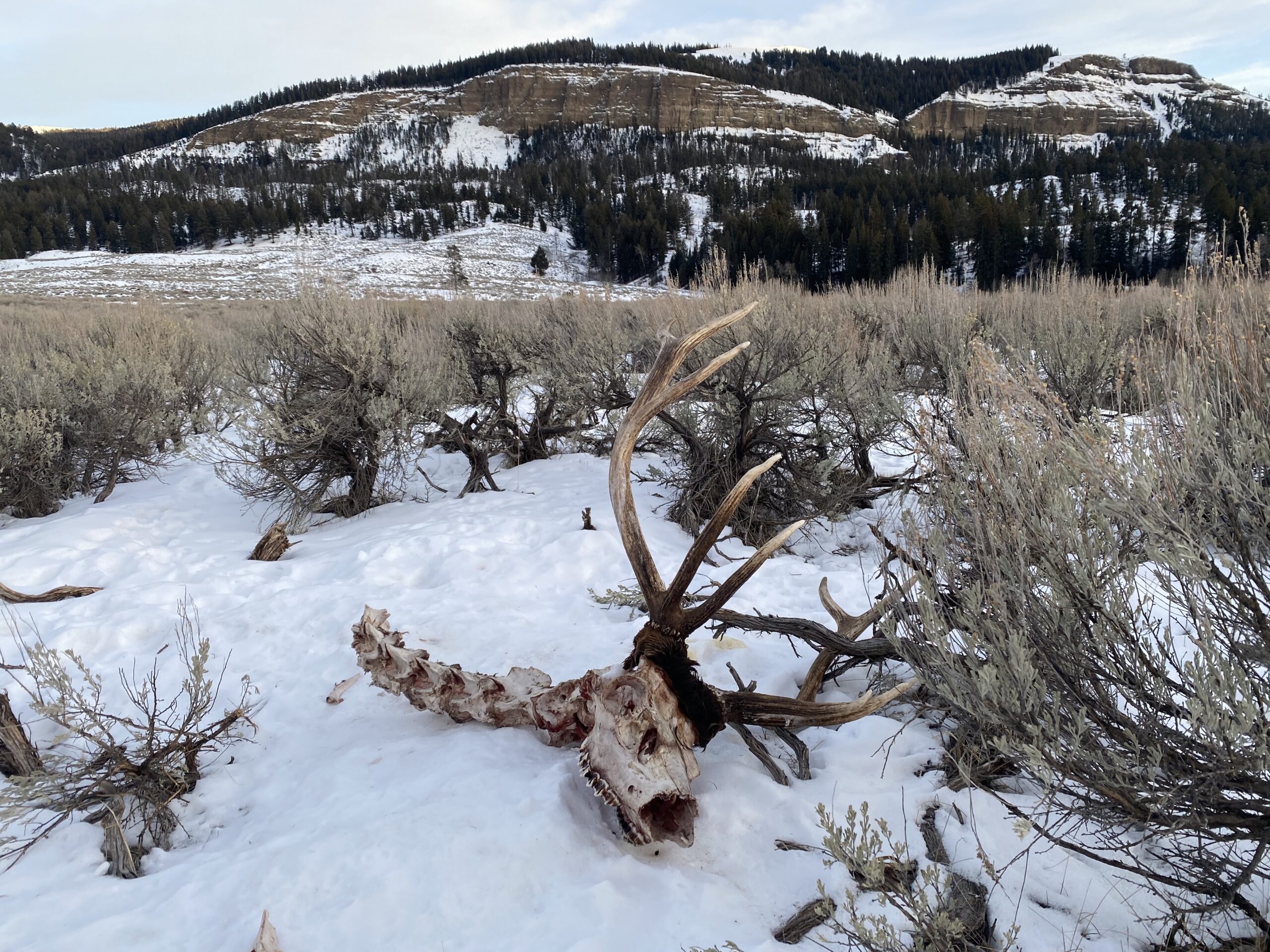
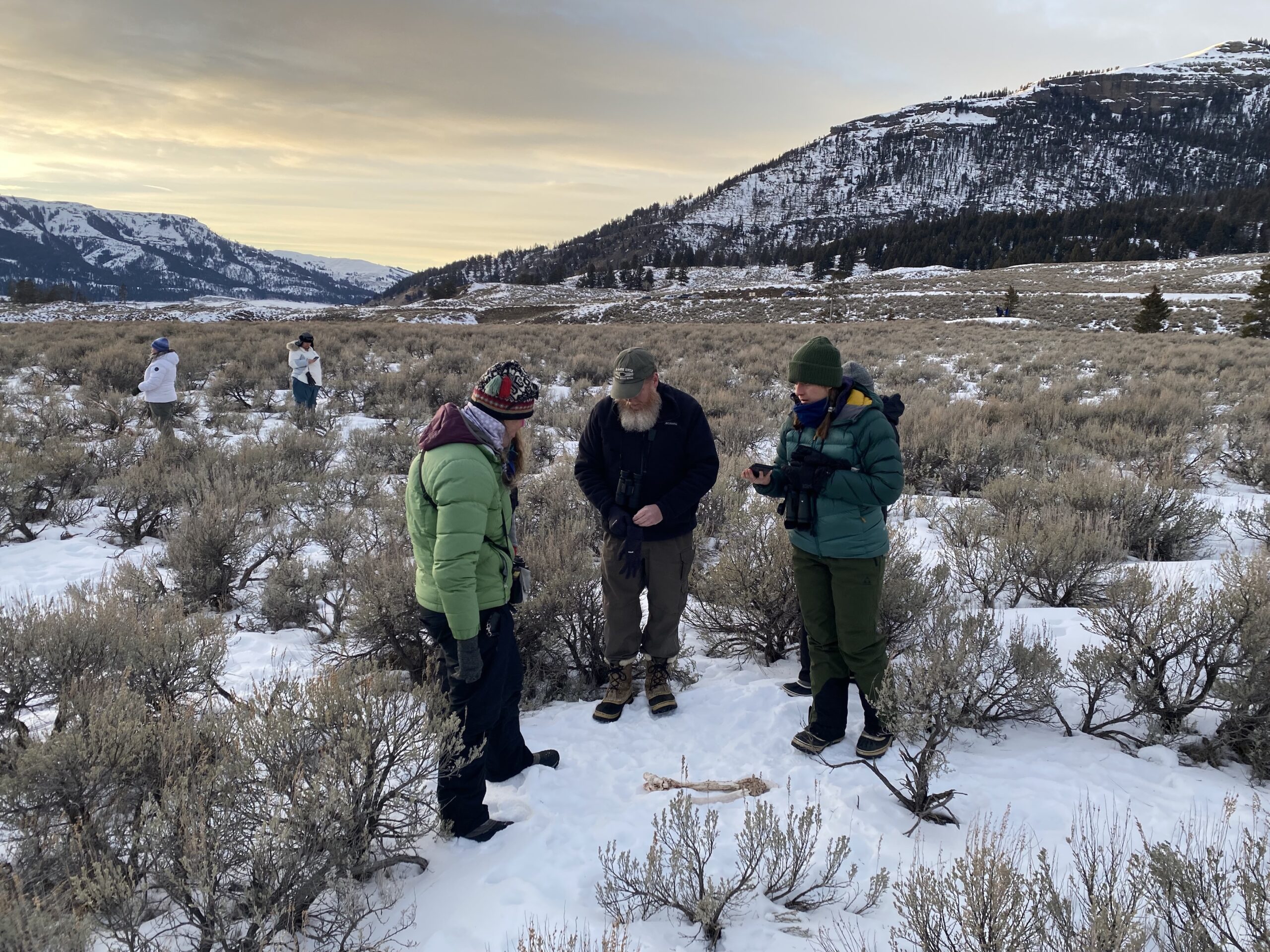
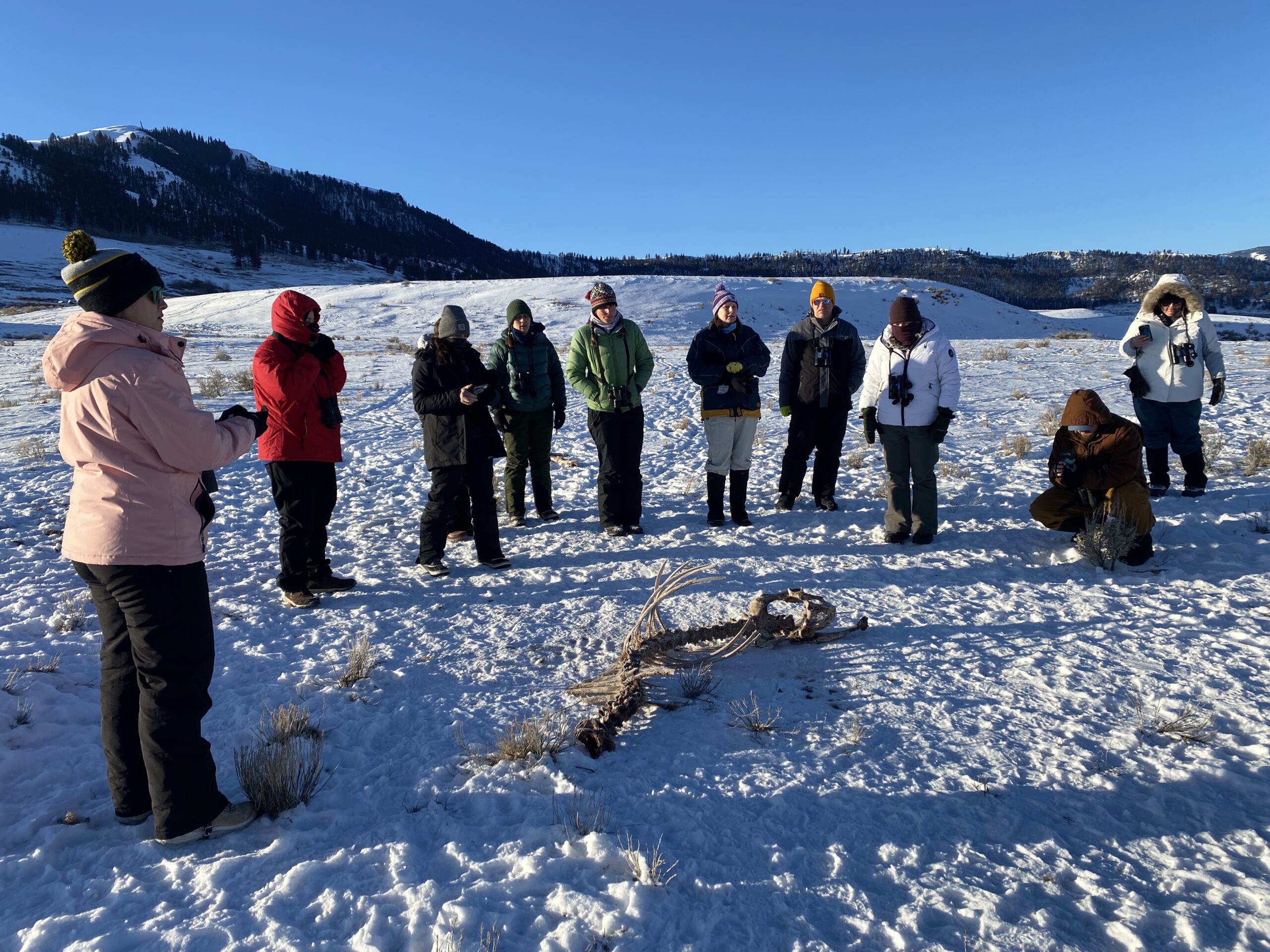
On the drive home we found an elk skeleton. We scoured the sagebrush for additional bones that were separated from the body by wolves. We found several bones and discussed the wolf behavior that resulted in this distribution of body parts.
Remains of a bull elk.Investigating elk bones.
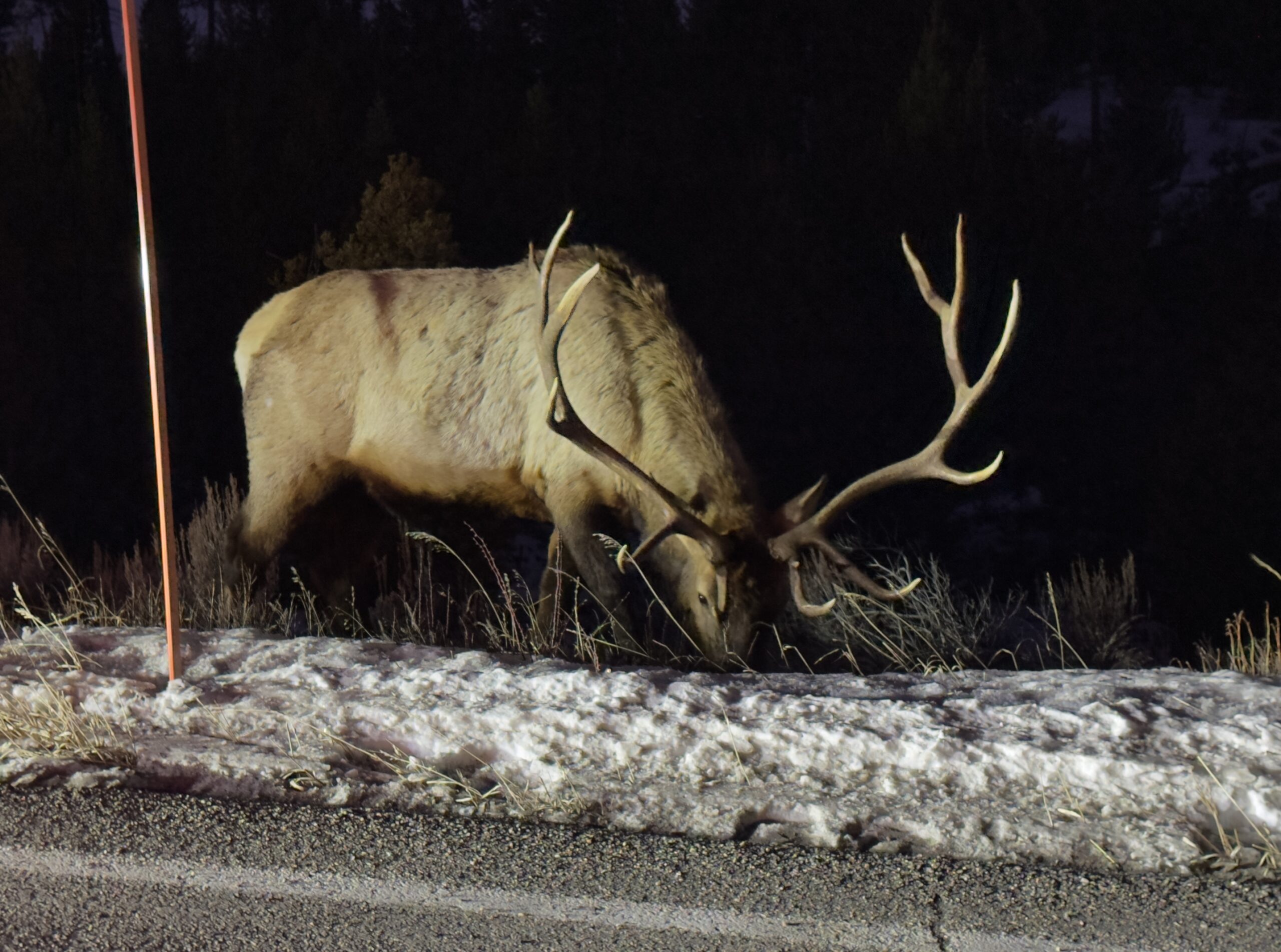
As we left the park tonight we encountered a surprise goodbye from a bull elk with 13-point antlers. Shoutout to Colton from Mr. Reed’s class – this is for you!
Our last wildlife sighting of the night was a large bull elk.
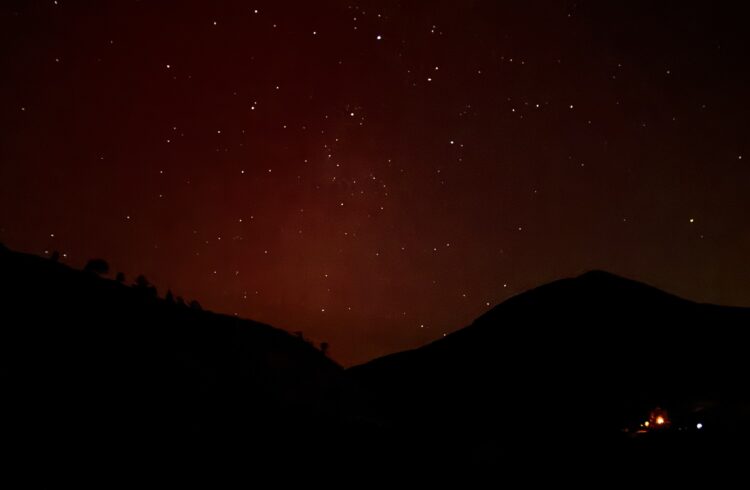
We arrived back at the cabin and found that the Aurora Borealis was shining overhead. It has been a fantastic last full day at Yellowstone – even if today was not the day for wolves.
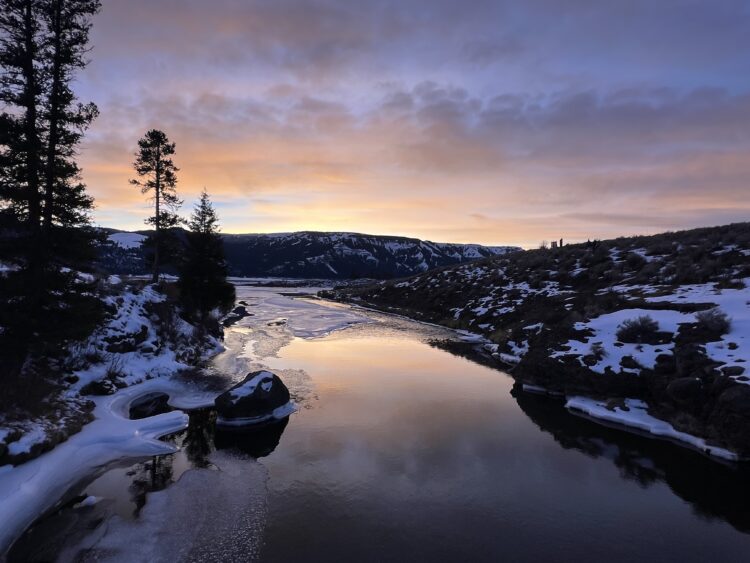
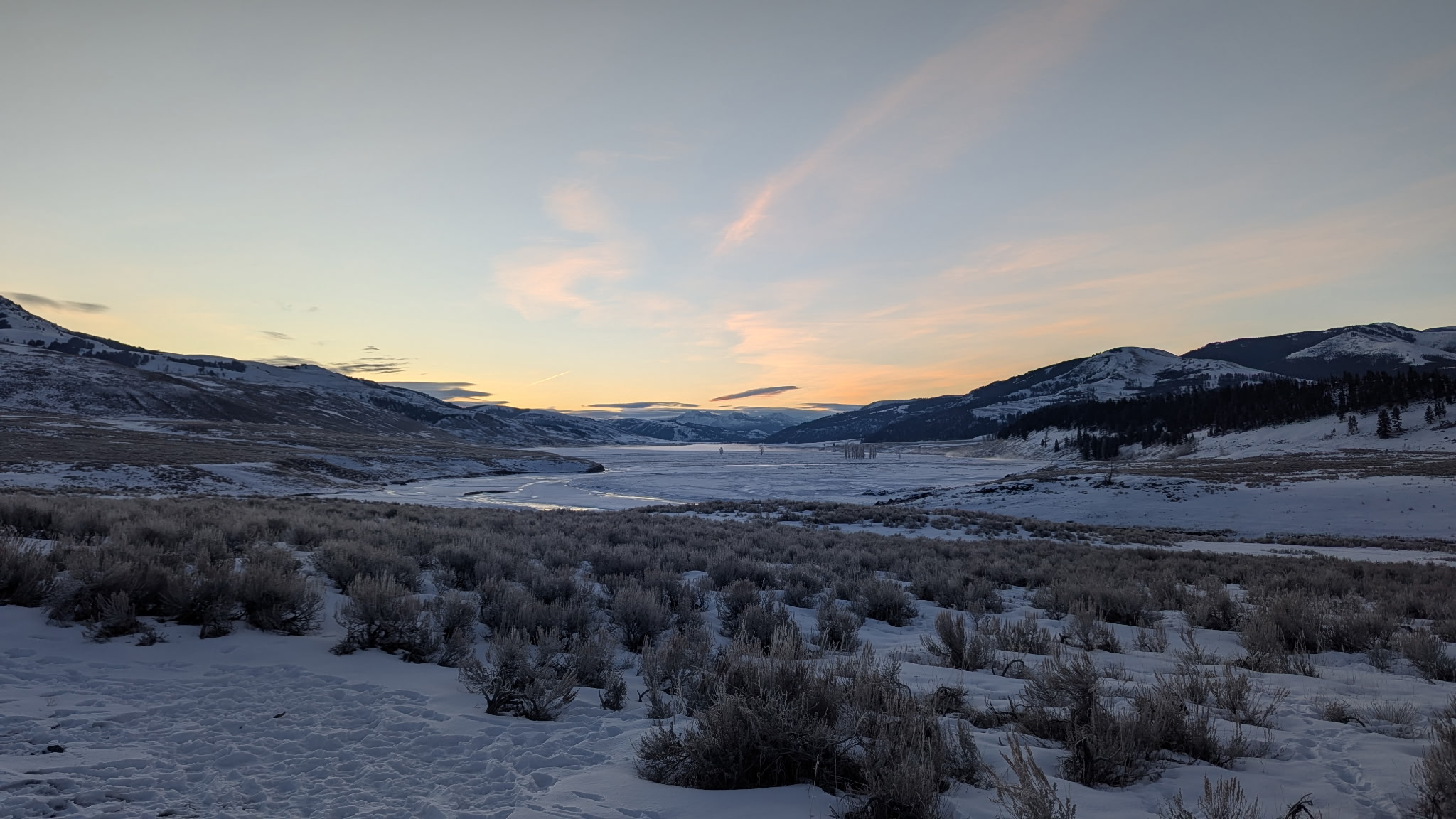
Sunset over Soda Butte Creek.Some reddish skies due to the Aurora Borealis.
Top three animals spotted by North Carolina teachers while traveling through Yellowstone in winter?
Survey says….
#1 Bison #2 Coyotes #3 Common ravens
Top three animals that North Carolina teachers want to check off their list while traveling through Yellowstone?
#1 – Gray wolves #2 – River otters #3 – The elusive ermines
Our day started with breakfast at 5:30 am and then a pass through the Roosevelt Arch before the sun was up.
Sunrise in Lamar Valley.
We have learned that spotting wildlife is not for the faint of heart — patience is definitely a virtue in this line of work! We made several passes through Lamar Valley looking for wildlife, spotting many coyotes along the way. But the real star of the show this morning was how the ice glittered across the valley as the early morning sun rose. Our most impressive find was a bison carcass that had been picked clean by predators and scavengers. Our group made passes across the area like crime scene investigators, looking at every bite mark and clump of hair. It was truly learning brought to life for us.
Group looking at bison carcass.
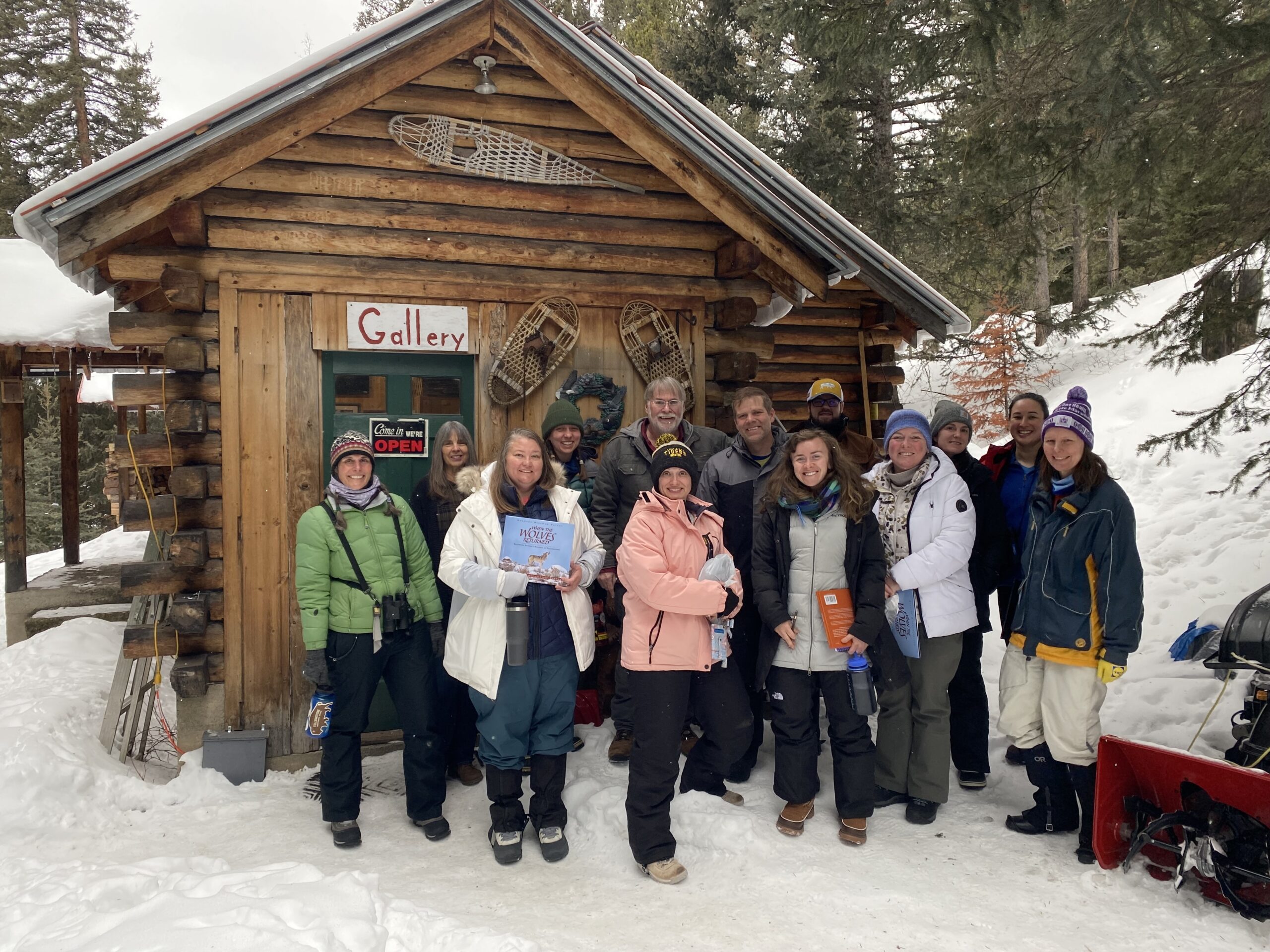
We moved through the park and made our way to Silver Gate to meet with acclaimed naturalists and wildlife photographers Dan and Cindy Hartman. Mr. Hartman spoke with the group about his work, especially photographing and filming great gray owls and pine martens. The group thoroughly enjoyed time bird watching around the Hartman’s home.
Enjoying a morning learning from Dan and Cindy Hartman.
We finished our day animal spotting. No luck with wolves, but we did catch another look of the mountain lion and her cubs on the side of Mount Everts and saw herds of pronghorns and bighorn sheep outside of Gardiner.
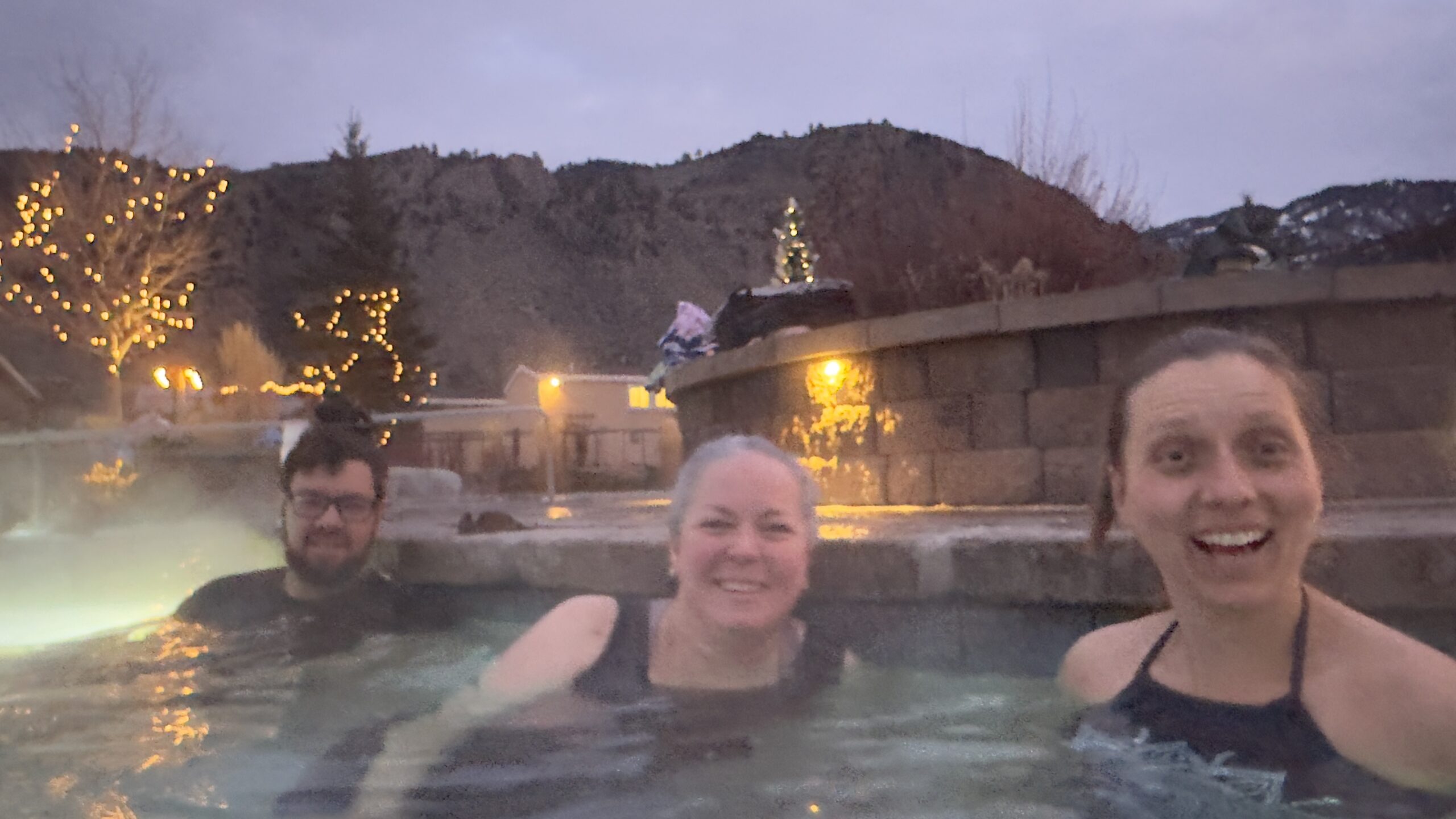
The group also took a dip in the Yellowstone Hot Springs, a local place that utilizes heated water from a hot spring in its pools. Another full day. Fingers crossed that we can mark more animals off the list tomorrow!
We woke up early from our home-away-from-home at the Old Faithful Snow Lodge. It was a frigid -3 degrees Fahrenheit as we waited, silently anticipating Old Faithful’s eruption. At 7:31 am Old Faithful made an appearance, spreading a sense of awe within the group. Today was filled with trees of rime ice, nature reflection, geysers, rainbows of colors, and so much more.
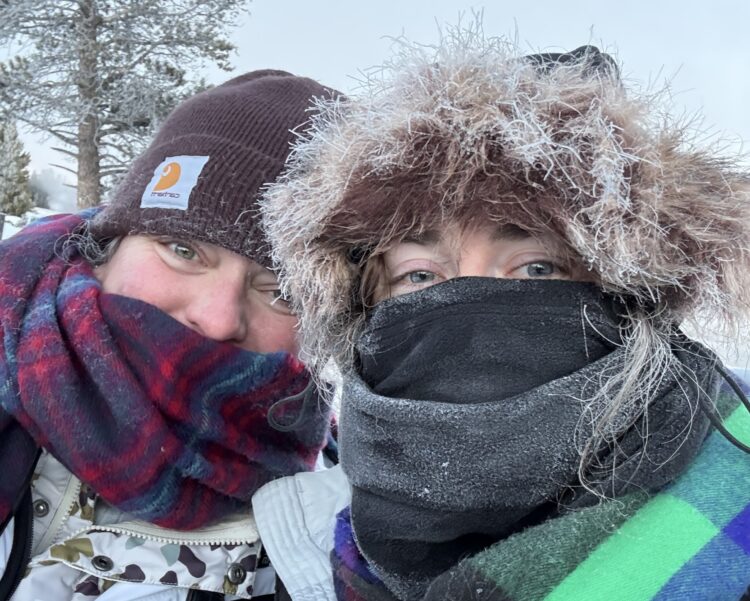
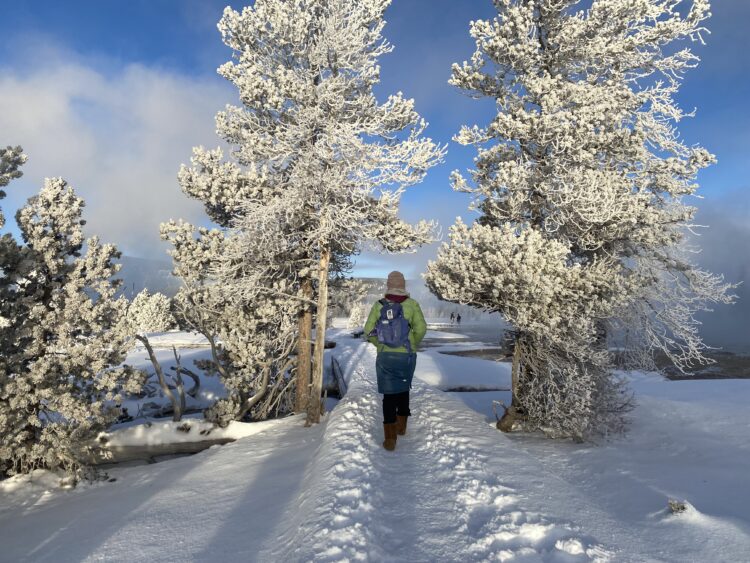
Our walk through the Upper Geyser Basin had so many surprises. We saw Grand, Beehive, and Castle geysers and ended up looking like some of the rime ice trees as our hats and hair froze around us.
Ice forming on our hats and scarves.Rime ice on lodgepole pines.
We listened for geyser gurgles, looked at the steam, and saw diamond dust. Anne Coe, an American contemporary painter, summarized the Geyser when she said, “It is the place where the center of the earth finds an exit and gives us a glimpse of its soul” (1998). As we turned every corner, the beauty of the landscape reminded us of the photos we’re used to seeing on our computer screens.
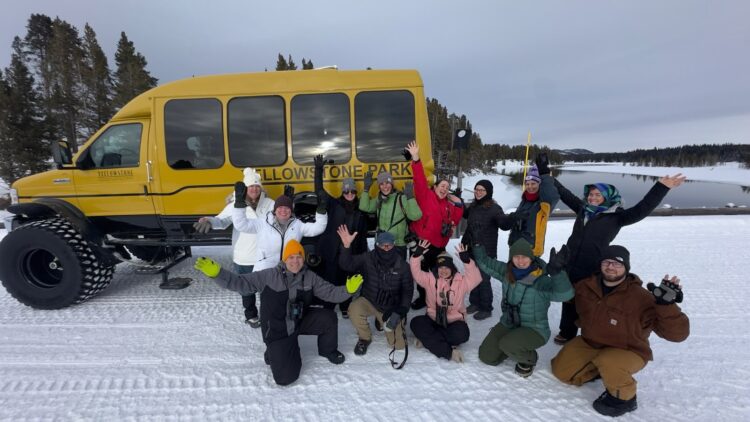
After the geyser basin walk, we loaded the snowcoach to continue our journey through geyser land. Only a few minutes down the road, we stopped to go for another hike. Sun shining on our faces, we made our way down the snow-covered trail to Thumper (also known as Black Sand Pool). We spent the moment reflecting on the sounds, colors, and feelings that Yellowstone has evoked in us thus far. We concluded that the uninterrupted beauty of Yellowstone has rejuvenated us all.
Taking a moment of stillness to reflect on our experience so far.
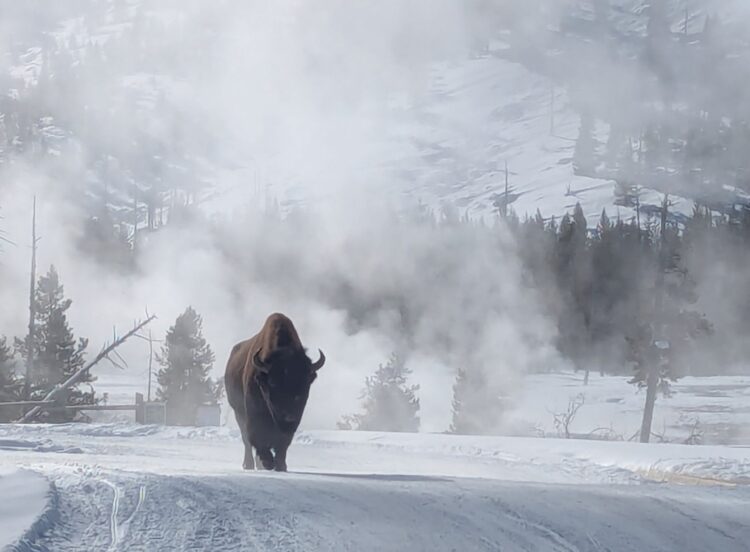
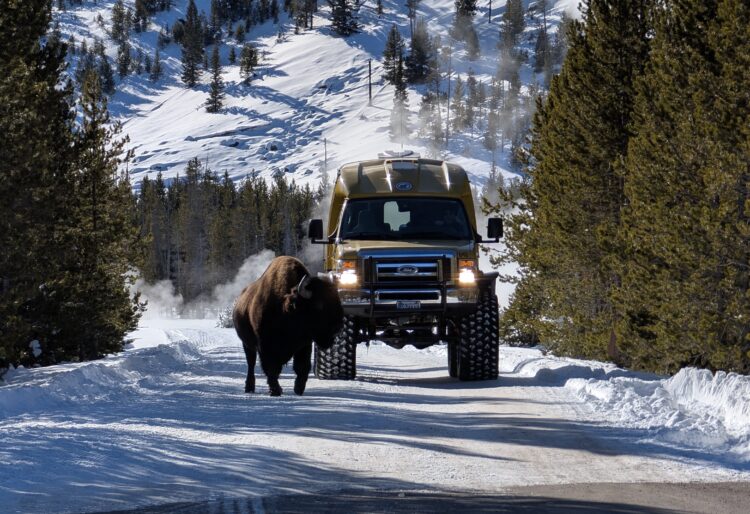
Coming back from the geyser, we found a large bull bison blocking our path to the snowcoach. Our fearless driver Norm went to get the snowcoach for us as we scurried quickly up the road, looking back over our shoulders constantly. We entered the vehicle quickly and breathed a sigh of relief to see the bison join another friend in a nearby meadow.
The bull bison waiting for us in the geyser basin.Two large Yellowstone icons: a bull bison and a snowcoach.
The Grand Prismatic Spring was not quite what you might imagine, as the famous photos show what an aerial view would look like and we viewed it from the boardwalks surrounding the springs. Through all the steam, we were stunned to see tiny beetles about the size of a pinpoint thriving in the runoff from a hot spring.
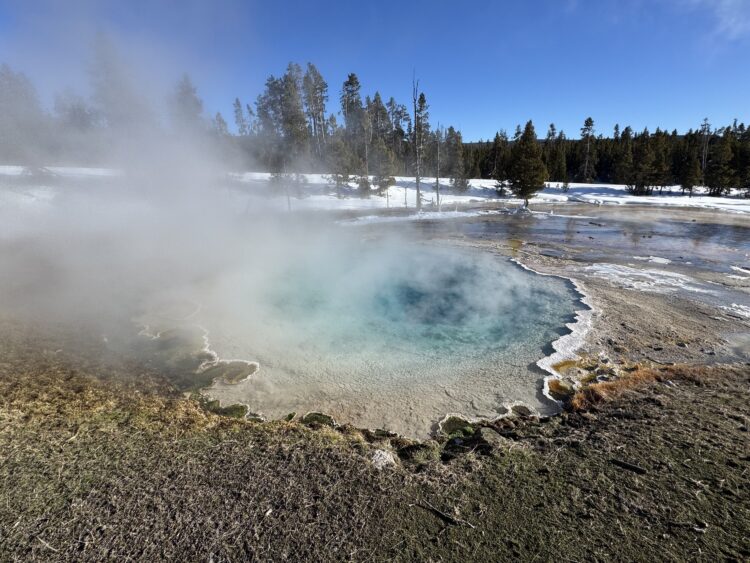
Silex Spring at Fountain Paint Pots had some of the most vibrant colors of the thermal features we saw. It made an artist’s palette pale by comparison, as different microorganisms give thermal features their beautiful colors. When we paused to take in the beauty, we noticed the steam makes an even more special effect: there was a radiant rainbow halo around our shadows when they were cast in a hot spring’s steam.
How many colors can you spot in Silex Spring?
After a brief delay as we waited for a red fox that seemed to enjoy sitting in the middle of the road, we arrived back at the lodge. After a long, busy two days, it was nice to settle into another cozy evening. We can definitely check the box off for geysers. Onto more wildlife tomorrow!
Today we were up and out of the lodge by 6:17am, picked up breakfast on our way to the Mammoth Hot Springs Hotel, and then loaded up in our snowcoach for the day.
Enjoying the views at Fishing Bridge with our snowcoach.
BRRR! Our first stop was Swan Lake where we checked air and ground temperatures using tools like a Kestrel and an infrared thermometer. Temps were hovering between -2 and 1 degree Fahrenheit.
Measuring temperature and wind chill at Swan Lake.
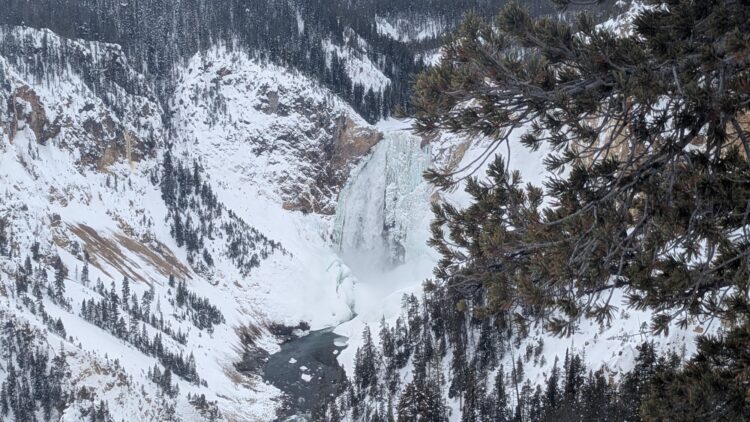
FALLING… As we continued our snowcoach journey, we moved to the next stop to view the Upper and Lower Falls in the Grand Canyon of the Yellowstone. We learned about the artist Thomas Moran, who panted visions of the falls and other nature scenes in Yellowstone. Ultimately, these paintings influenced enough support in Congress for Yellowstone to become our nation’s first national park in 1872 under President Ulysses S. Grant.
The Lower Falls of the Yellowstone River.
IN and OUT! Today’s trip involved the first flush toilets and running water we’d encountered inside the park. We enjoyed talking to the park rangers, seeing the skins of various animals (ermine, red fox, coyote, beaver) and seeing a bison skull up close.
CRITTERS GALORE! We watched a coyote and a red fox as they crouched and waited for their subnivean prey (aka a warm meal on a cold day) under the snow. Only the coyote was successful and they chomped their food as they went along the ridgeline. The trumpeter swans were seen floating in both water and air, stretching their long necks out.
A coyote catching prey through the snow.
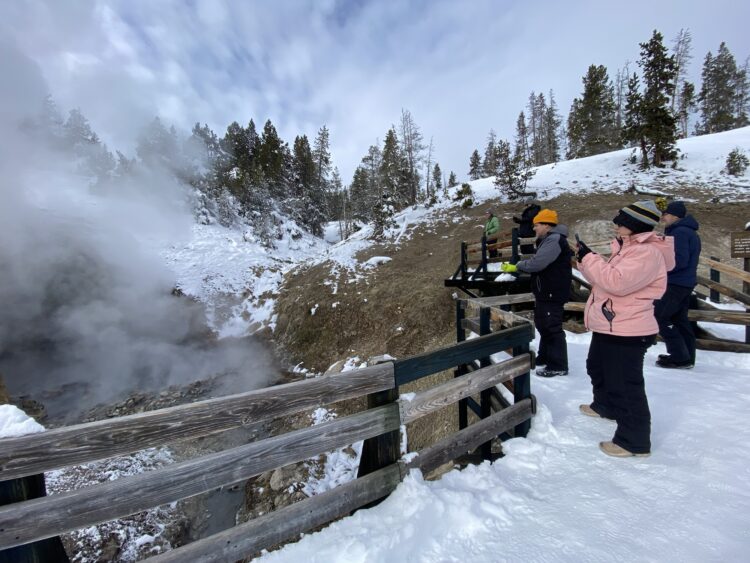
HOT, HOT, HOT!! We visited several geothermal features. The sulfur gas bubbled and troubled us much like we imagined the cauldron of Macbeth. The Dragon’s Mouth Spring rumbled and released an odor akin to the smell of rotten eggs. The temperature of the springs reportedly reached 170 degrees Fahrenheit but we cannot confirm or deny this info.
Listening to the gurgling and rumbling of Dragon’s Mouth Spring.
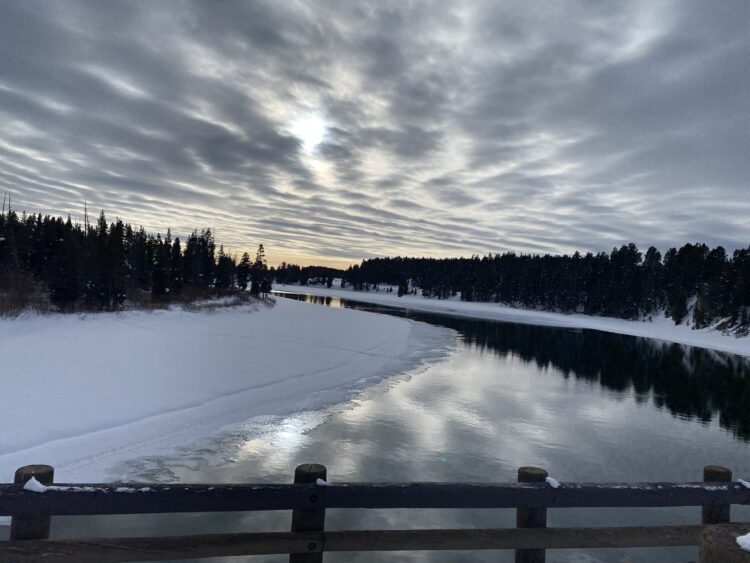
GOIN’ FISHIN’ – Our next stop was the Fishing Bridge on the Yellowstone River. We met Ranger Mary at the warming lodge where she maintains a fire to keep park visitors warm. Fishing Bridge was a place where we stood and simply looked up and down the river seeking the elusive river otter (alas, there were none) and enjoying the serenity of the moment.
The view from Fishing Bridge.
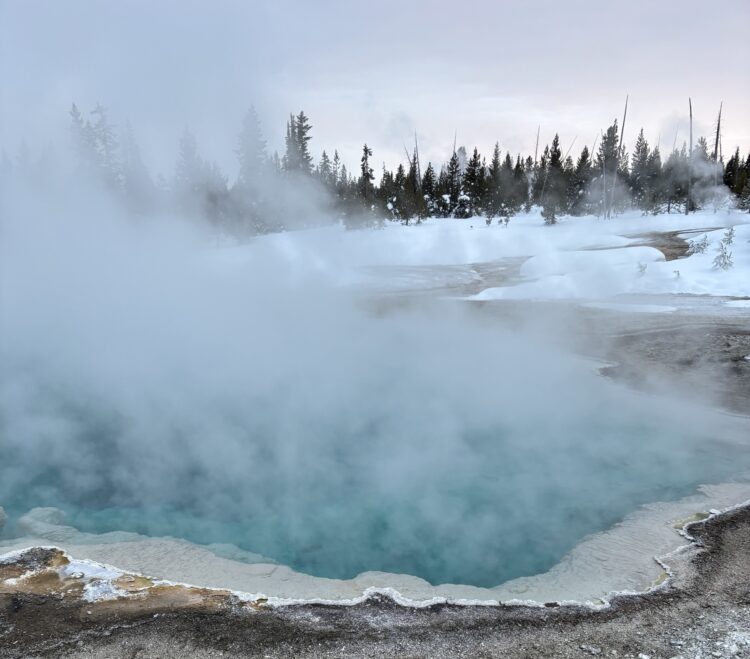
THUMBS UP! We drove and drove and drove, at 25mph, until we finally arrived at the West Thumb Geyser Basin on Yellowstone Lake. We walked out to the lake and saw more geothermal features. Norm, our driver, shared a lot of great stories and kept us entertained and informed about Yellowstone history.
Black Pool, one of several hydrothermal features in the West Thumb Geyser Basin.
ARRIVED! We had a nice dinner at the Old Faithful Snow Lodge before heading to bed. We’ll be up before sunrise tomorrow to watch the geysers put on a show!
Imagine a school day that starts before the sun comes up, where the dress code is wear as many layers as you can, and animal spotting tells you to move from place to place instead of the tardy bell; where teachers’ passion and enthusiasm for their subject matter is met with students eager to learn. If you can picture such a day and such a place, then you would’ve been with us today as we toured the Lamar Valley.
Our day started with a speedy pass through the Roosevelt Arch while the moon was still up. Our first “class” of the day was with Kira Cassidy, the program manager with the Wolf Project in Yellowstone. Surprise guest was Joe Madison with the Red Wolf Project in NC! No wolves spotted just yet…but we are holding out hope.
Wolf biologists Kira and Joe teach the group about their favorite subject matter.
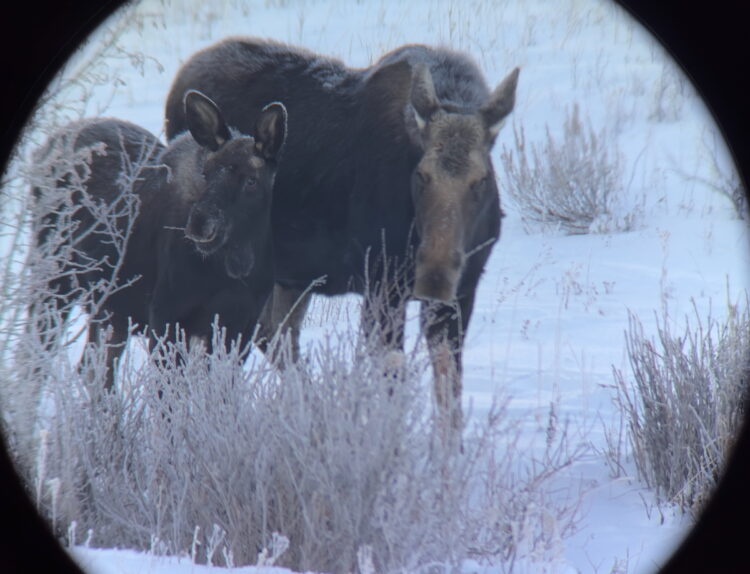
Second block was an Animal Science Field Trip. As we drove around Lamar Valley, sudden stops on the side of the windy roads were not uncommon. No….no one got car sick. We were on a scavenger hunt to spot the animals in the distance. With our binoculars at the ready, we got amazing views of an adult moose with a calf. Spotting bison was not a difficult task, especially when they were walking along the side of the road. A quick stop was made beside a river to catch a sighting of a majestic bald eagle flying over trying to catch up to the flock of mallards.
Lamar Valley revealed many hidden residents today- here, an adult moose with calf.
We stopped in Lamar Valley, with an overlook across the Lamar River for lunch and animal watching. A pack of coyotes joined us. The pack consisted of 6-7 coyotes? No, more like eight, which is an unusual number in Yellowstone.
PE today consisted of snowshoeing at Pebble Creek, where we spotted a couple of grouse and were quizzed on our animal track identification skills. Matt gave his expert topic speech when we spotted an American dipper! Our snowshoe trek ended in a race – can you guess who won?
Physical Education has a whole new meaning at elevation and in the snow- the group learned new skills and had fun while snowshoeing.
Instead of bus traffic holding us up from going home, we hit a bison jam!
After-school remediation consisted of reviewing tapes of eastern NC red wolf behaviors with expert Joe Madison.
We started the day by meeting at the Raleigh-Durham airport at 4am, which meant that most of us started much earlier than that. One team member taught all day and then drove through the night to get here. Over 12 hours later, we received exciting news: the possibility of seeing something never before seen on a Yellowstone Institute trip!
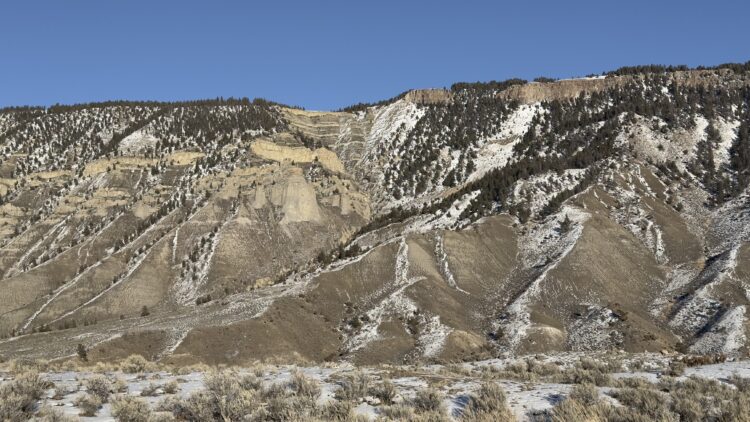
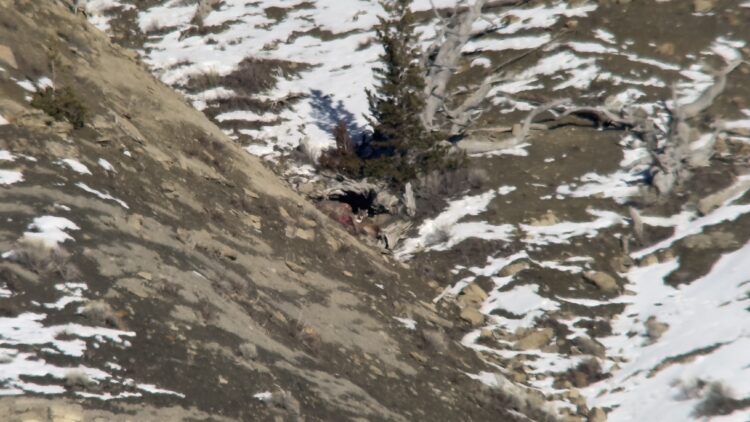
Our treasured sighting of the day is right near the top ridge… very far away!
Can you see it?
We all came to Yellowstone with different goals and ideas, but there was one constant: to take in the serenity and grandeur of the park. We spent time worrying about packing warm enough clothes, preparing lesson plans for our subs, and wondering how long each day would be before each night’s overnight rest.
With all of the planning ahead of our first day, we’ve already had to practice adapting to a new schedule. We’ve learned that WE don’t run our itinerary – Yellowstone and its wonders do.
Let’s try again, can you see it now?
Look right in the middle – it’s a mountain lion on an elk carcass!
That’s right, we saw a mountain lion! Feeding on a carcass!
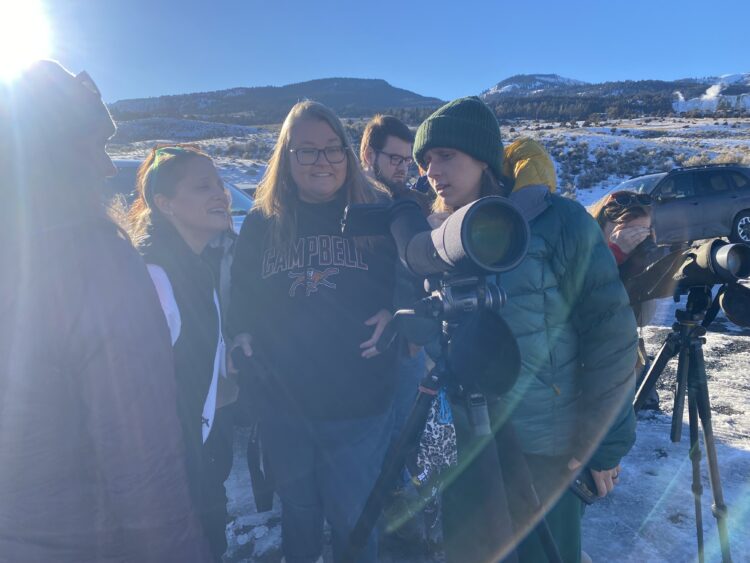
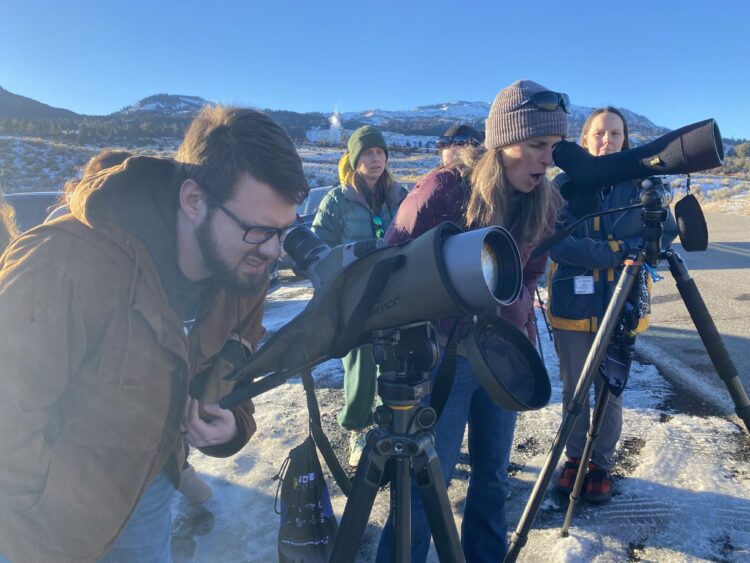
No matter how sleep deprived or ready to settle in we were, the mountain lion took precedence, and we got to see a once-in-a-Yellowstone opportunity. We gathered around the scopes to witness our first big moment of awe as a group.
Joy and delight at our first ever mountain lion sighting in Yellowstone by an Educators of Excellence group.
WOAH!!! Look at that mountain lion!
Our first day couldn’t have started any better. As we reflected on our day during our first full team meeting, it made us realize this is only the beginning. Stay tuned for our next adventure…but we’re off to finally hit the sack!
In only a few short days, the NC Museum of Natural Science’s Yellowstone in Winter Institute begins. With hopes of winter wonderland explorations, incredible wildlife sightings, and a rejuvenating and inspiring learning experience, our nine educators from across North Carolina are gearing up and preparing. Here are just a few of the ways they’re getting ready for the trip of a lifetime.
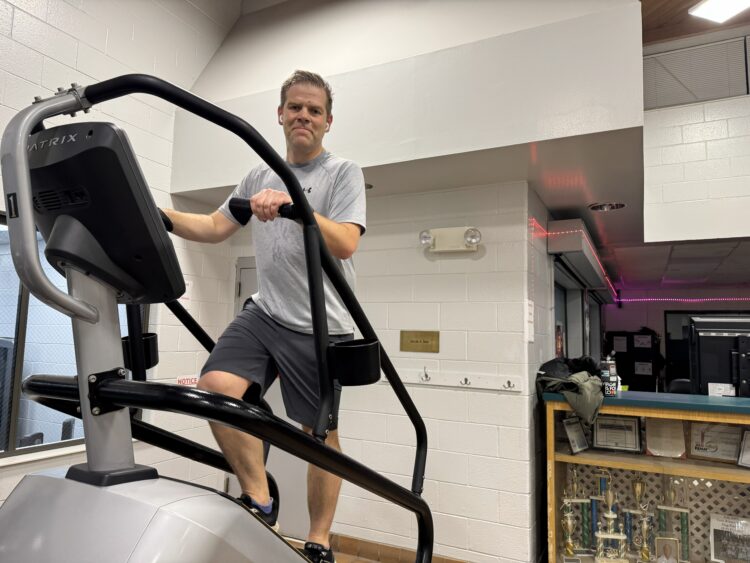
Matt: I have been staying active with regular runs, stretching, and have also added in the stair climber. I’ve been going through my winter gear to make sure that I have the necessary layers to keep warm and dry in my travels. In the classroom, I have been covering ecology with a special emphasis on the unique ecology and conditions at Yellowstone. I am most excited about the wildlife observations and the snowshoeing.
Matt building strength on the stair climber.
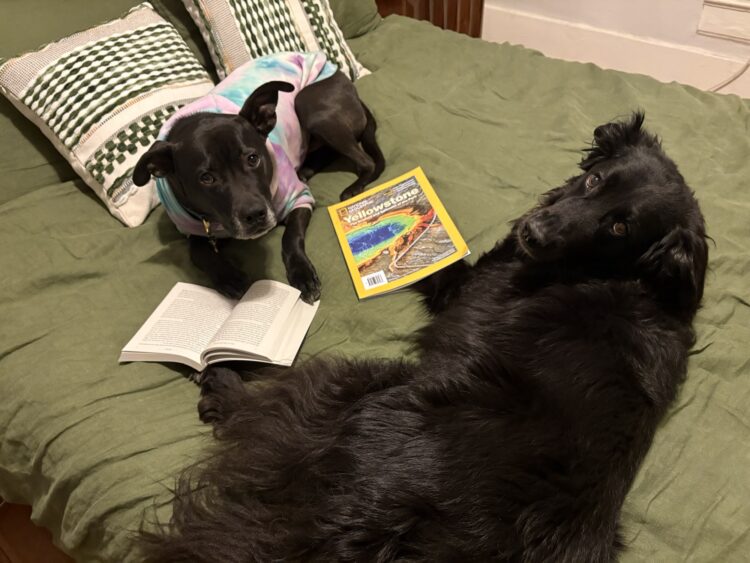
Laura: I’ve dug through my closet, borrowed some items, and secured a few necessary items as gifts from loved ones over the holidays as I’ve made my way through the packing list! My dogs are definitely wary of the large pile of clothes and gear I’ve been collecting in my bedroom and hope I won’t replace them with wolves. I’ve been scouring books, blogs, videos, and magazines to learn as much as possible about Yellowstone. I’m thrilled to know I’ll experience the magic of winter and wildlife so soon instead of just learning about it!
Laura’s dogs helping her study up on Yellowstone.
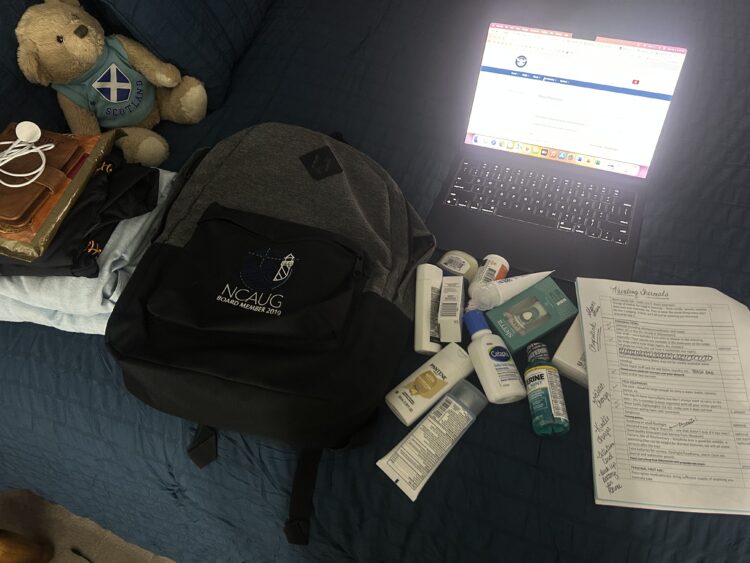
Lauren: It is hard to believe that in less than 2 weeks, we will be flying to Yellowstone! I have been so excited, yet so nervous (temperatures… brrrrrr)! I have been looking over the packing last so many times that I think I am having dreams about it! But it definitely helps! I have finished reading “American Wolf” and loved it. I recommend it to anyone, even if you aren’t traveling to Yellowstone.
As a mom, I have been trying to get everything lined up when it comes to leaving my 3 boys for a week. Not that my husband is not SUPER CAPABLE, but I am not used to being the one traveling from our kids. I have been telling them about where all I will be traveling and how they can use the blog to see all that I am seeing. They are not thrilled that I will not be home, but are so happy for the experience I will have.
As a teacher, I have been getting lesson plans, copies, seating charts, bell schedules, and anything else my sub will need all laid out. I do not like to leave my subs unprepared for anything! I will only get 5 days with my new roster of freshmen, so I will be extra diligent about my rules and expectations. As well as getting my classes familiar with the blog.
Lauren’s growing packing pile.
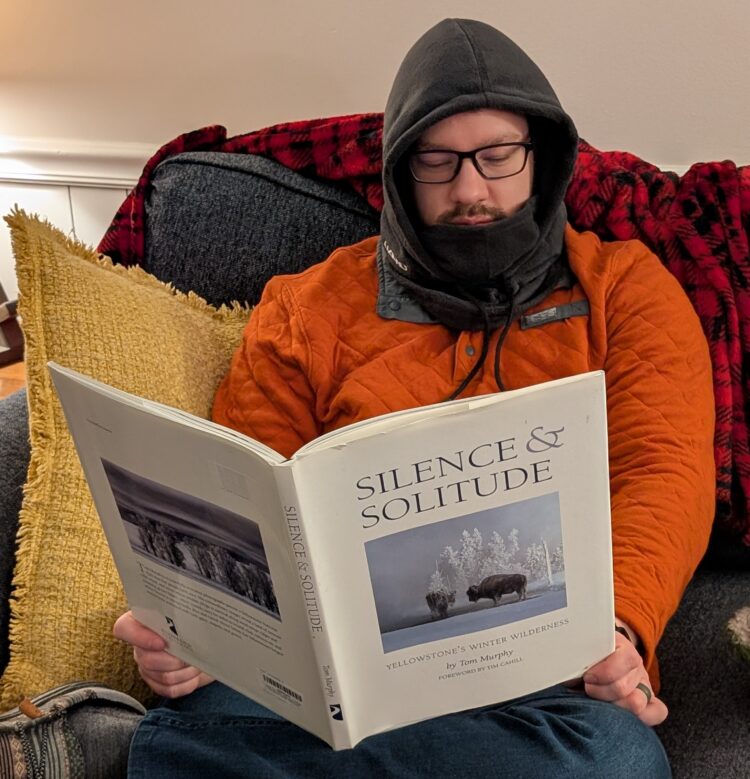
Josh: I showed PBS’s “Christmas in Yellowstone” to my classes before we left for the holidays. We previewed the winter ecosystem and discussed animals and the relevant adaptations that go along with what we’re doing in our science classes. I got a copy of “Silence & Solitude” which has some beautiful photos in it. I’ve also been focusing on leg workouts these past couple of weeks because I’m concerned about trekking through the snow.
Josh trying out his winter gear while learning about Yellowstone.
Holly: I’ve been getting ready for Yellowstone by learning the stories behind the landscape. I’ve been reading the book “American Wolf” and have been researching Thomas Moran whose paintings played a huge role in shaping how Americans first imagined Yellowstone.
Holly’s been diving into Yellowstone’s ecosystems with her students.
Cassie: I have been reading and watching information about the history of the Yellowstone wolves. So exciting! I have also been raiding my closet for warm gear and thrifting for some warm socks!
Ragan: I am trying to get 6-7 miles of walking in each day and used my trip to Disney before Christmas to clock 10-12 miles a day to help prep. I am so excited to see Montana and Wyoming in the winter!
Ragan preparing classroom lesson plans.
Betsy: I have been packing and repacking my bags!! Counting and matching my socks, underwear, shirts, pants, gloves/mittens, hats, etc. This week I shared the Yellowstone map with my students, showed them pictures of places at Yellowstone, and described the flight schedule on a United States map so they can envision the trip. Lesson planning and finishing up grades are next on my to-do list (the quarter and semester end while we are gone). I also checked off having the flu before winter break – so hopefully that will keep me healthy on the trip!
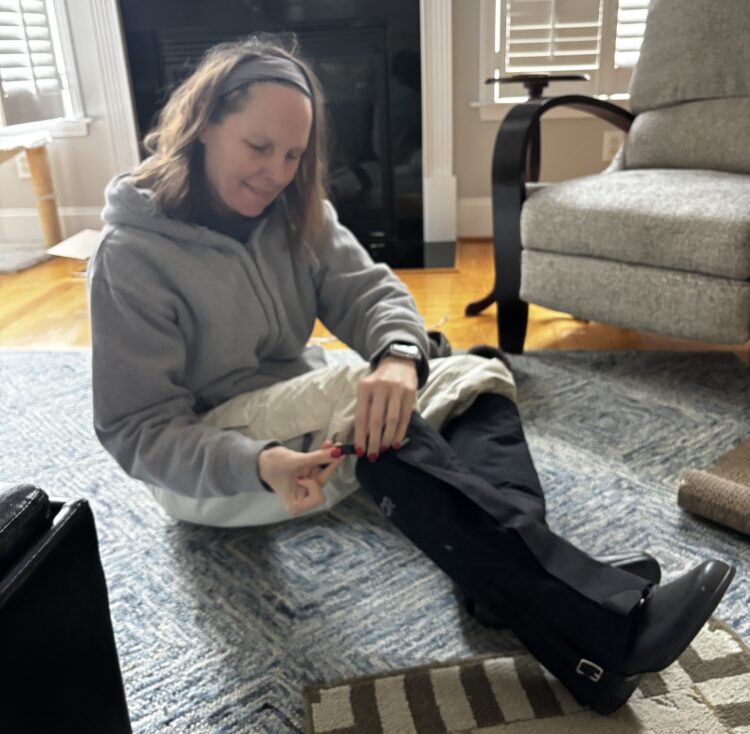
Jacqueline: Trying on my new gaiters. Preparing for the snow!
Jacqueline trying on her gaiters – a helpful item to keep snow out of boots!
Our group of teachers will depart early on Wednesday, January 14 and will post here daily with updates on the day’s journey. As our teachers share their experiences, please add comments and questions to each blog post – we’ll be checking comments periodically and sending replies as we can!
January 16, 2024
-
Comments Off on A Mammoth Ending
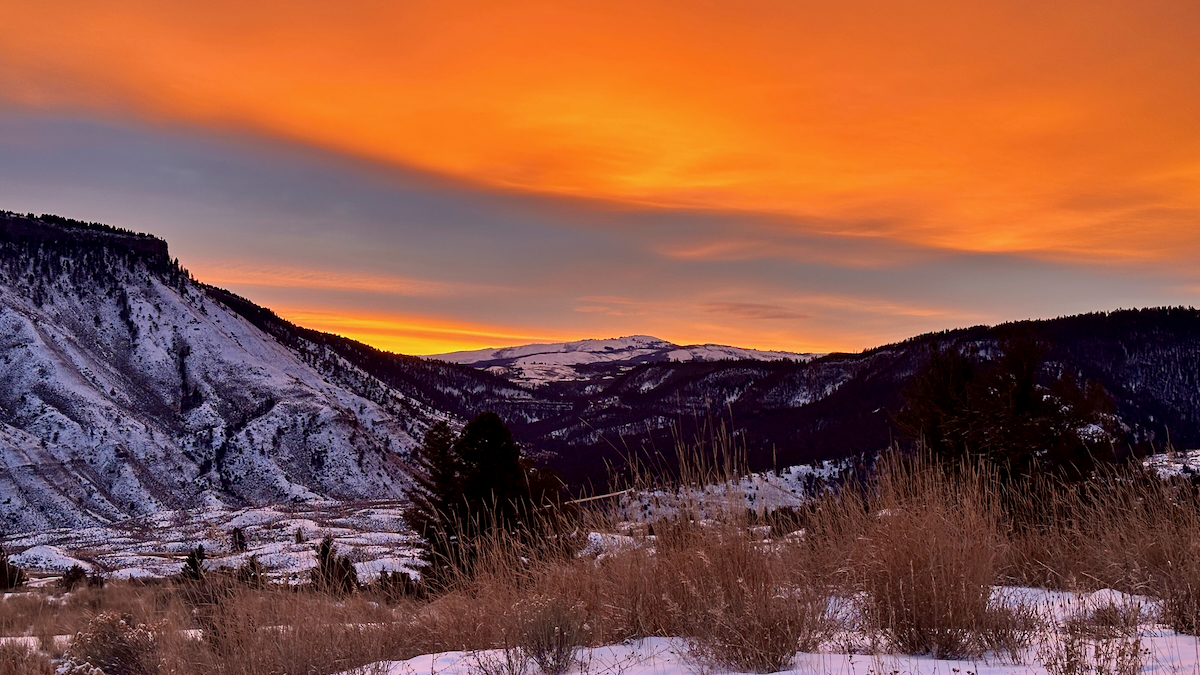
This morning Yellowstone treated us to another amazingly beautiful sunrise. We stopped to appreciate the beauty before heading to the Mammoth Hot Springs to meet with Erin and Kieran, two members of the park’s geology crew, and Mike Coonan, an education ranger for the park.
Sunrise from Mammoth Hot Springs
As we walked the boardwalk, we learned about how the geology of Mammoth Hot Springs differs from that of the geyser basins in the southern part of the park. The Mammoth Hot Springs form terraces made of travertine, which comes from hot water dissolving limestone. The dissolved minerals precipitate out of the water to form the travertine terraces. The terraces grow very quickly, sometimes more than a foot a year! We even saw trees that previously were growing in the dirt and are now being swallowed by the travertine.
Canary Spring at Mammoth Hot Springs, surrounded by dead trees
The park geologists also talked to us about some of their work in the park, ranging from piecing together the history of various areas of the park to being trained how to walk near thermal features in order to take measurements and retrieve trash that people lose in the hot springs and geysers, either accidentally or intentionally. A few decades ago, scientists working for the park occasionally took a small boat out on the hot springs to measure the depth. Erin and Kieran are very glad that they don’t have to do that anymore because many of the springs are close to the boiling point! The education ranger, Mike, reminded us of how special Yellowstone is. The 2.2 million acres of the park contain an intact ecosystem that is preserved and largely untouched by human development. Yellowstone’s wilderness today is very similar to how it was when the first indigenous peoples were using the area at the end of the last ice age approximately ~11,000 years ago.
After spending the morning at Mammoth Hot Springs, we packed up and headed to Bozeman to catch our flight back to North Carolina.
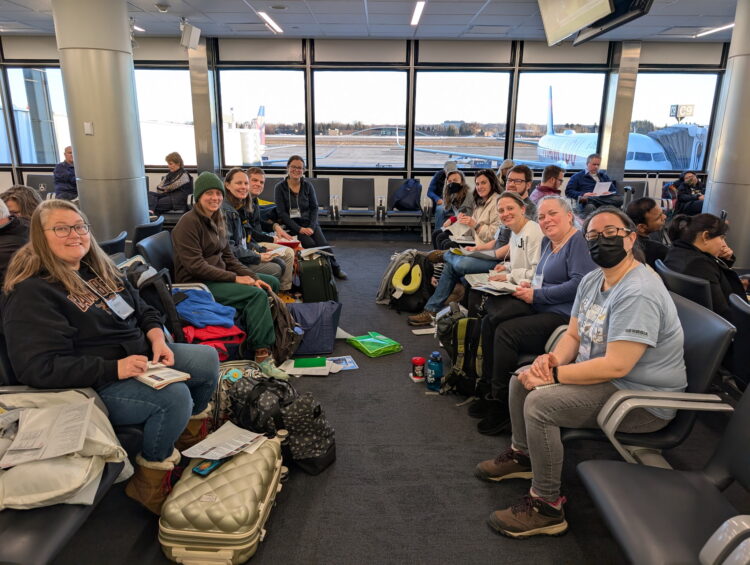
Group at dinner in the Minneapolis airport celebrating Tracy’s birthday tomorrow!
On this trip, we were pushed out of our comfort zones by challenging snowshoe hikes, extreme cold, and even by taking the leap to fly across the country with a group of strangers. We proved to ourselves that we can do hard things and even thrive in challenging situations. (Having the right gear really helps!) We are exhausted, rejuvenated, and in awe of Yellowstone’s vast magnificence. We are walking back into our classrooms full of excitement and ready to share all we learned about ecology, geology and history. We hope to share with our students the understanding that nature is interconnected, fragile, and important to conserve.
“In the end, we will conserve only what we love; we will love only what we understand, and will understand only what we are taught.”
January 16, 2024
-
Comments Off on -15°F? Oh, it’s warm outside!
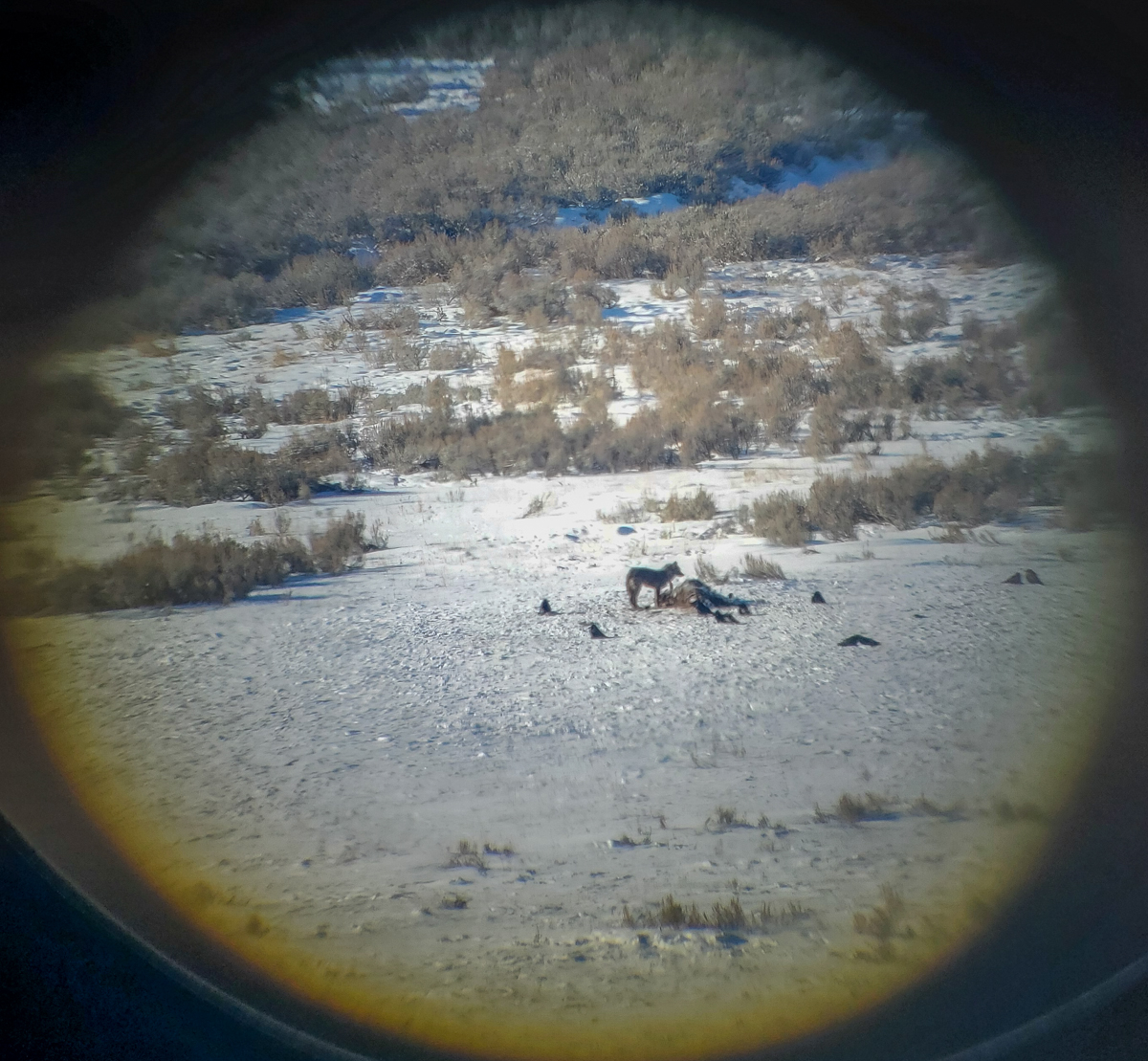
For our last full day at Yellowstone we had two things on the docket: to go snowshoeing and to see our last ungulate, the mountain goat. We got into the park before sunrise making our way to a bison carcass we saw yesterday. While there, we watched 3 coyotes feeding on the bison (and later in the day we saw a wolf feeding on the same carcass). After that, we made two passes through the northeast corner of the park looking for mountain goats, but saw nothing.
Wolf at bison carcass
Our morning was freezing while checking things off our docket. It was -28°F as we were heading into the park, and the highest temperature we experienced today was -4°F. Throughout this “negative” day, we (unfortunately) had to use pit toilets. The toilet seat was so cold our infrared thermometer couldn’t even give us a reading on the temperature! Surprisingly, several of us mentioned how much warmer today’s temperatures felt. If you’d asked us before this trip, none of us would ever have thought -4°F was warm. However, when experiencing temperatures around -30°F, -4°F really does seem warm! This trip has taught us the importance of layers of clothing; we added and took away layers as we moved throughout the day and got in and out of cars.
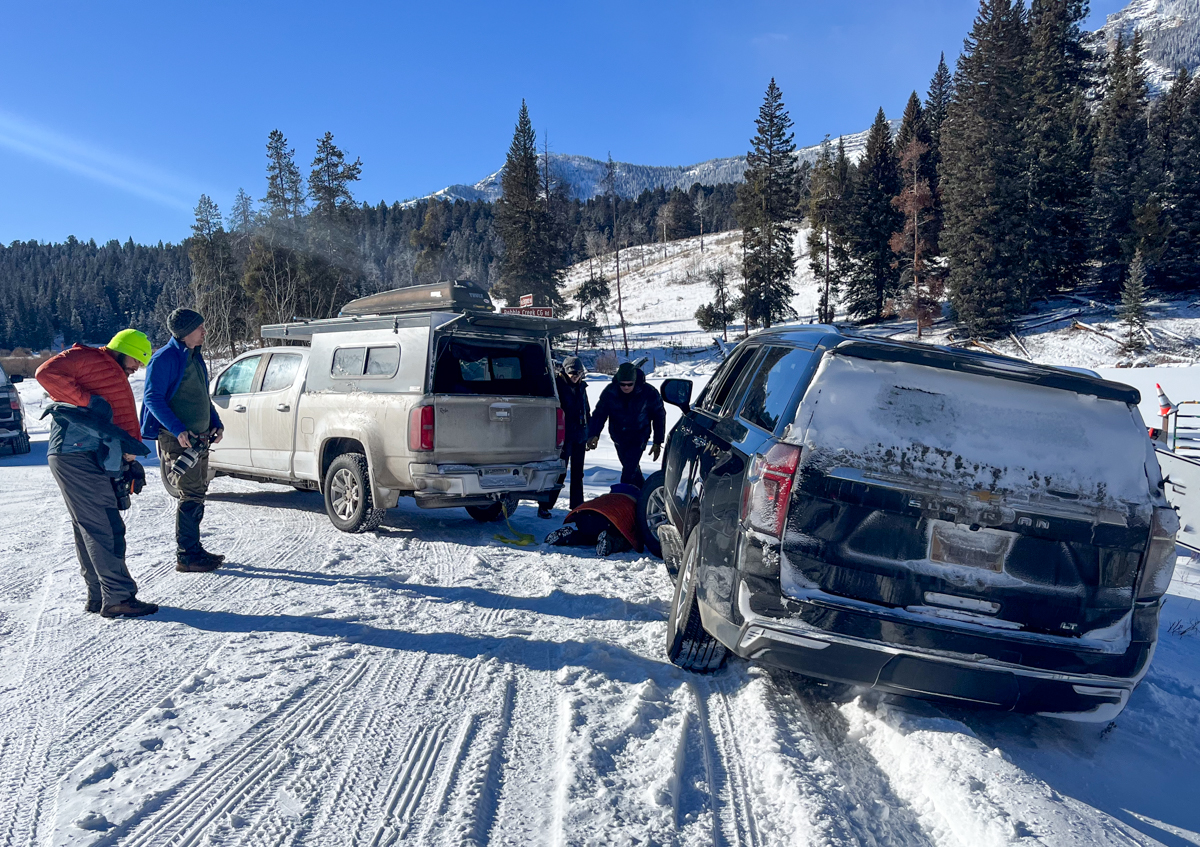
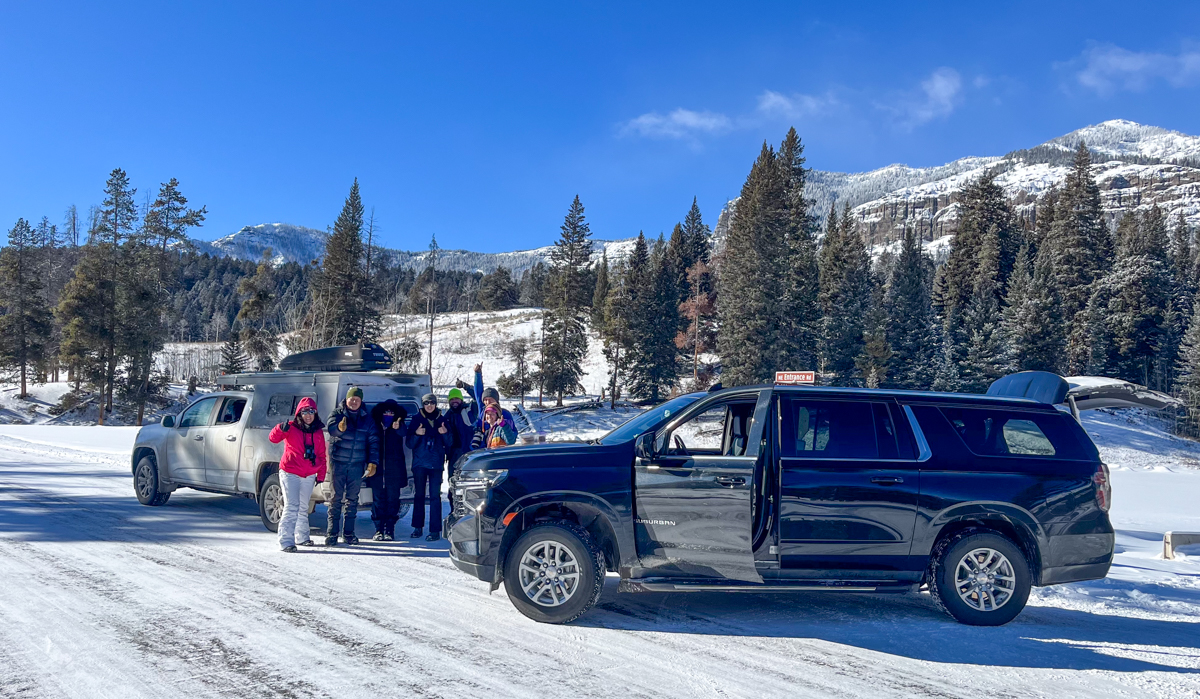
We made one more pass through Lamar Valley to spot a mountain goat but came up unsuccessful yet again. With the weather in the negative teens all morning, when we stopped in Cooke City, MT to get coffee at Cooke City Coffee we were thrilled. After warming ourselves with a hot beverage, we continued our search for the elusive mountain goat. This next pass was not without issues. One of our SUVs discovered the importance of friction, when it slid on a patch of ice and got stuck in deep snow on the side of the road. No sooner had we gotten out of our vehicle to investigate when help arrived. This “help” just so happened to be Dr. John Winnie, ecology professor for Montana State University, in his truck with a tow strap! Within just a few minutes he was able to pull us out. We thanked him and offered him some baked goods (which he declined), and we exchanged information (never pass up the opportunity to network).
Before
After, with our new friend John
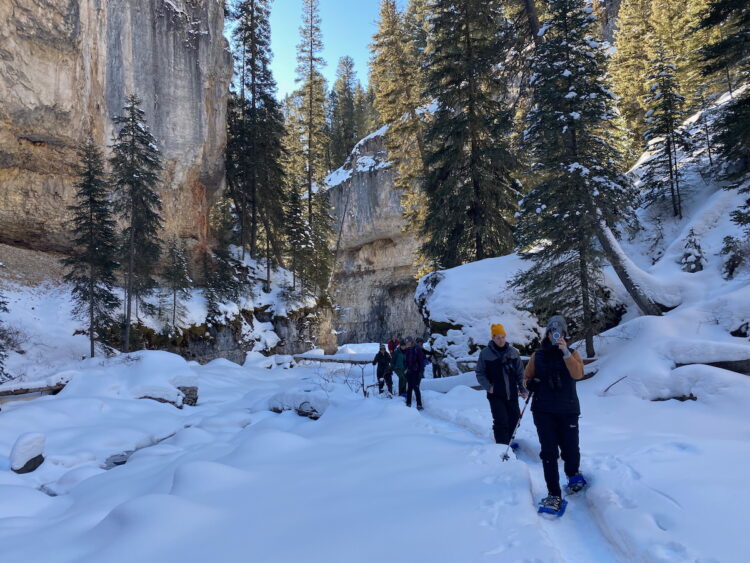
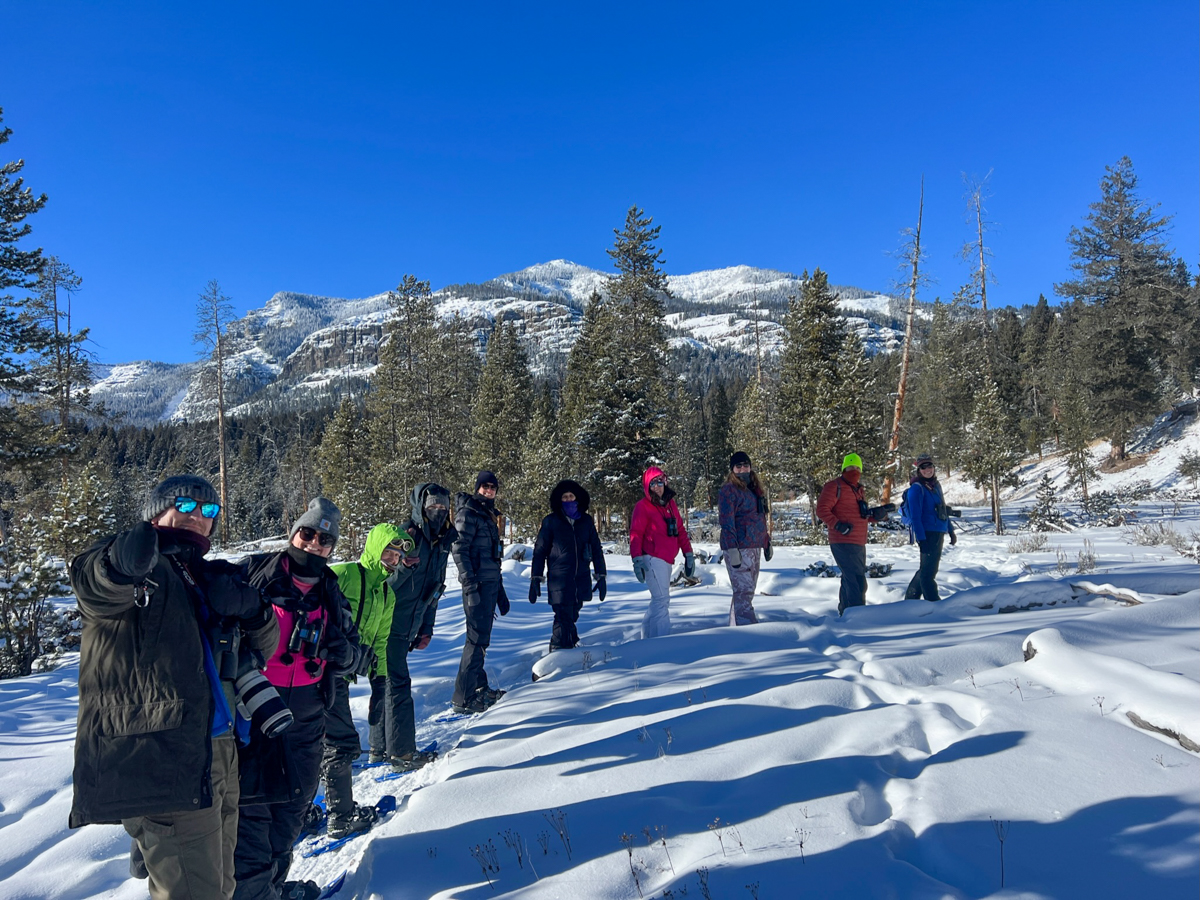
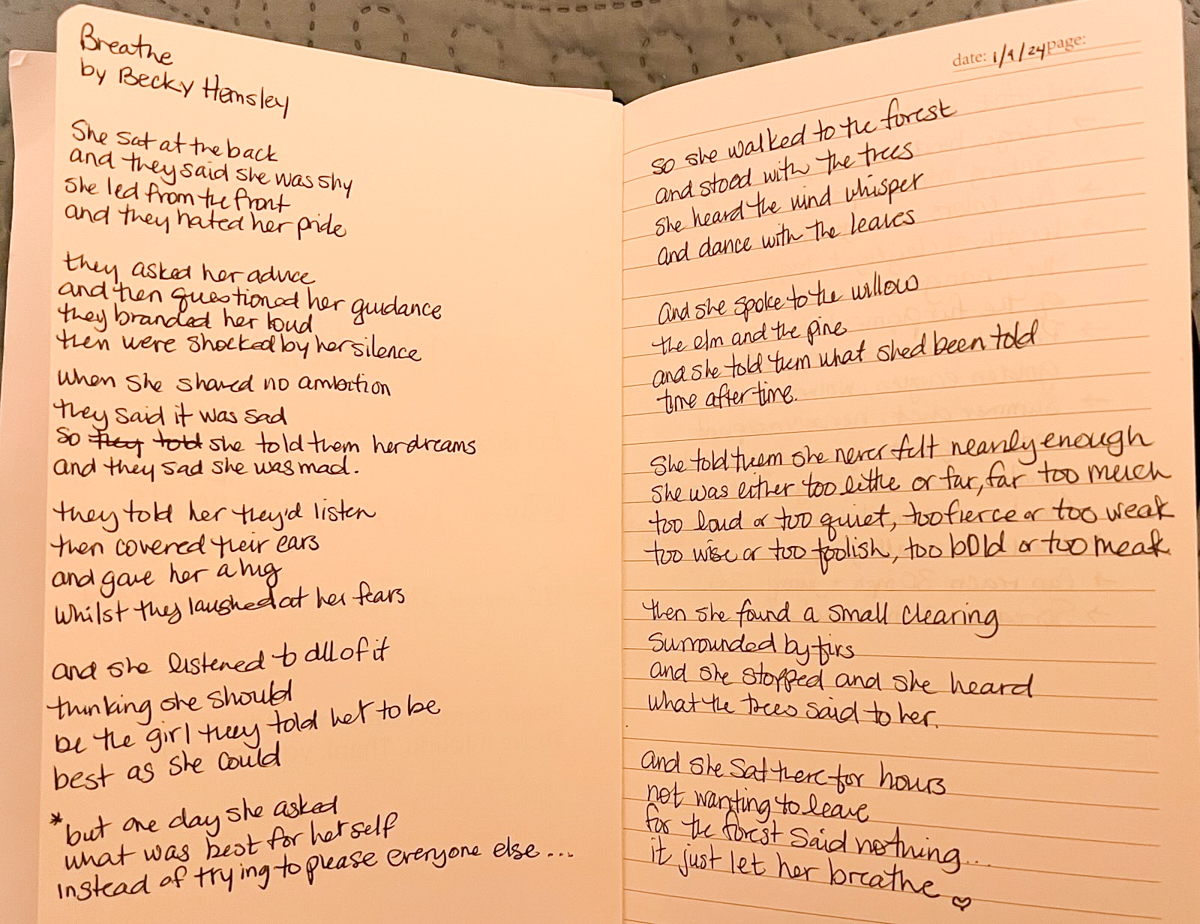
With our crisis averted, we moved on to our last snowshoe hike along the beautiful Pebble Creek. The trek was simple but the beauty was breathtaking. This area was devastated by the floods of 2022, and we saw evidence of this devastation on the landscape – downed trees, tangled picnic tables, and freshly eroded rocks. Our group observed canine and moose tracks along with an American dipper nest (see our earlier post for more on this amazing bird). Our group was blown away by the beauty, history and geology found within this small box canyon. While there, Klara shared a beautiful poem with our group. Everyone of our group members gained something different out of this snowshoe experience.
We ended our day in the park with one last look for a mountain goat, with no luck. We headed out of the park and made one last stop to take in a magical Yellowstone sunset!
Group on snowshoe hike
As we wrapped up our final group meeting, we realized we all managed to fulfill all the goals we set at the beginning of the trip from learning about geothermal features (Tracy) to experiencing moments of stillness (Sallie) to adopting a science point of view (Landon, our history teacher). The group shared their experiences and the many takeaways from our time in Yellowstone. We are pumped about meeting with the Yellowstone Geology Crew and an Education Ranger in the park tomorrow to further our knowledge and look for ways to bring this experience back to our students.
Our time in Yellowstone is almost up, but we all feel so thankful to have experienced this magical place with each other!