TOP
Yellowstone

“Badgers, Bison, and Beers”

June 17, 2019

“Between every 2 pines there is a doorway to a new world” ~John Muir

Our ”new world” started with a hearty breakfast at the Log Cabin Cafe. The coffee was flowing and the eggs were frying to finish our stay at the Grizzly Lodge. We left for Lamar Valley to try our luck at sighting more wolves, but to no avail.

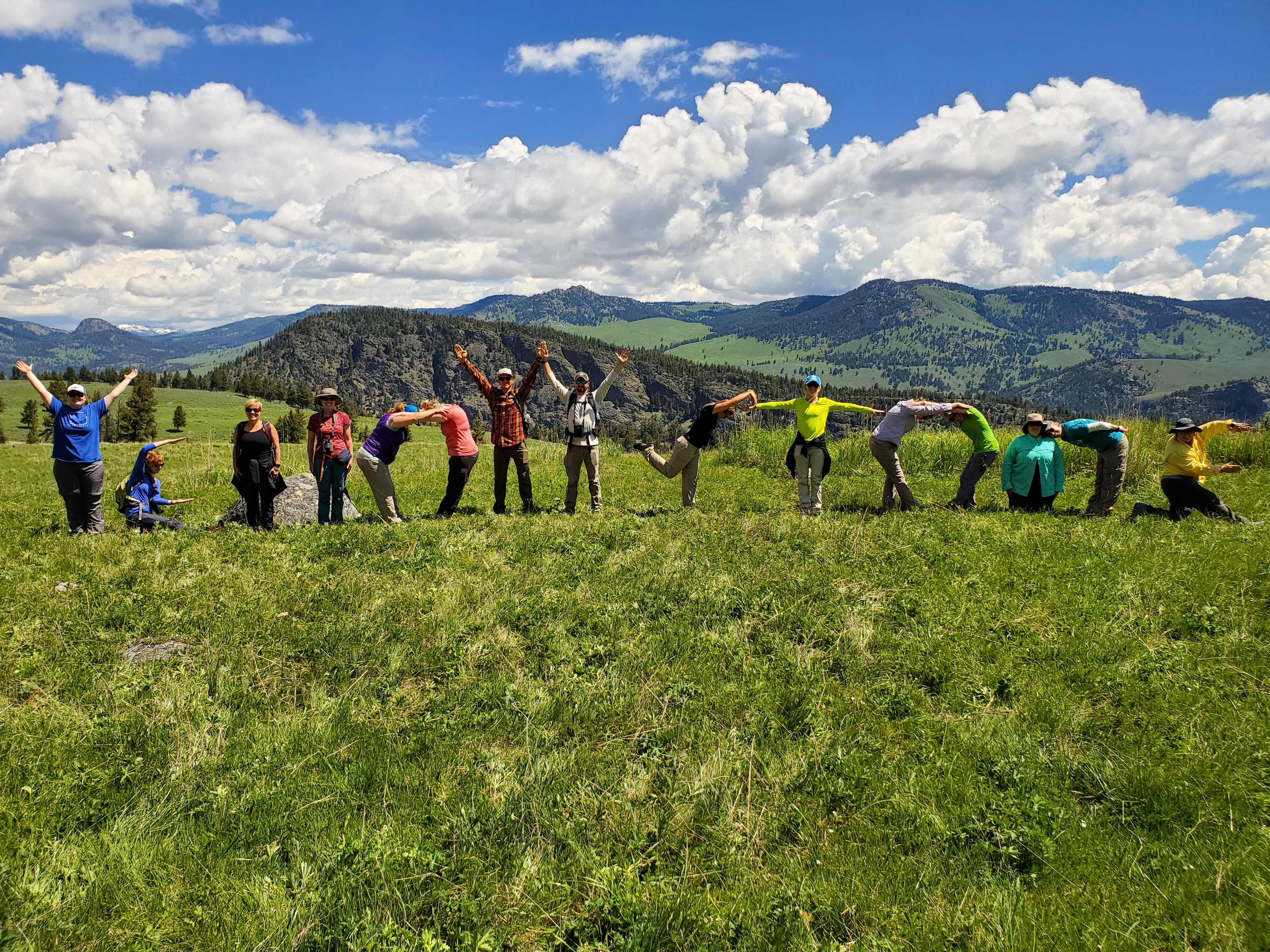
Today’s creature of the day is the Pika (not a Pikachu)- a small animal kin to rabbits. Ranger Matt and Ranger Michael talked to us about a citizen science project that helps collect data to study the impact of climate change on pika presence and absence in various parts of the park. Pika are a great indicator species for monitoring climate change— the pika’s normal body temperature is about 104° F but if they are exposed to temps above 80° for more than 2 hours it will raise their body temperature into a deadly range. Pika live on talus slopes, which are rocky slopes often formed by eroding old lava flows. When it gets too hot, they hide under the rocks to find cooler temperatures. Our job involved helping the rangers collect data by searching for pika sightings, looking for scat (poop) and “haystacks” (their caches of food) under the rocks, and taking temperature readings around the rocks to monitor the environmental conditions under which they can be found. During our survey we successfully saw pika, scat, and haystacks! Our hike to the pika survey site ended with two unique firsts: the Y-e-l-l-o-w-s-t-o-n-e picture and Kali’s discovery of a set of elk antler sheds.
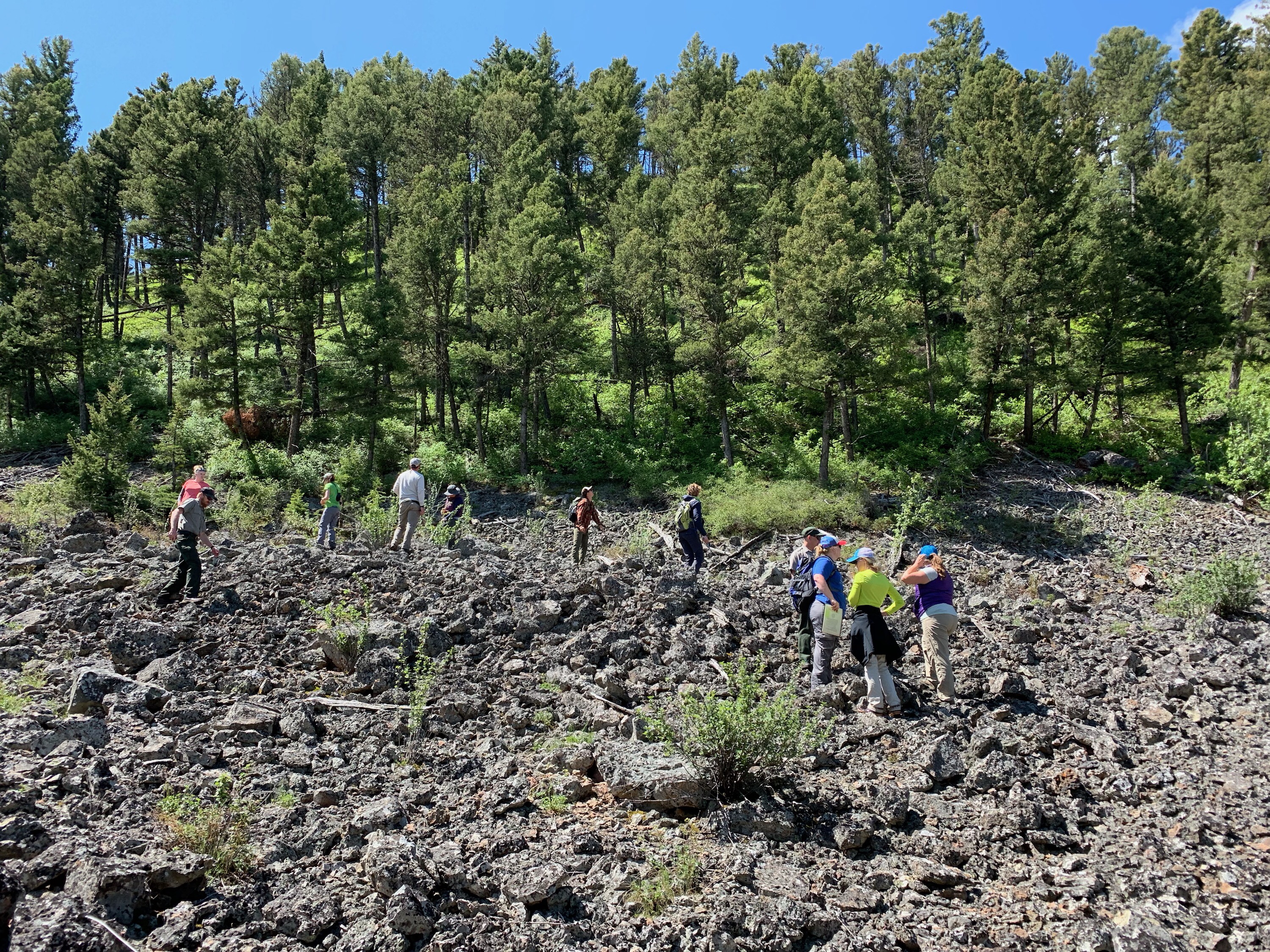
Group surveying for pika

The group surveying for pika

Group spelling out YellowstoneOur group, spelling out Yellowstone

Early in the afternoon we took the Howard Eaton Trail to view the upper Mammoth Terrace Hot Springs. Although it was mostly uphill (and we were breathing heavily) it was well worth the journey to view the Upper Terrace. The rain held off long enough for us to make it through the boardwalk and view the different colors of the hot springs. Emily gave a great presentation of her expert topic on bioprospecting. We learned that the presence of archaea – “thermophiles”- is what causes the different colors in thermal areas. After the Terrace hike, we had some down time to eat and walk around the Mammoth Hot Springs area.
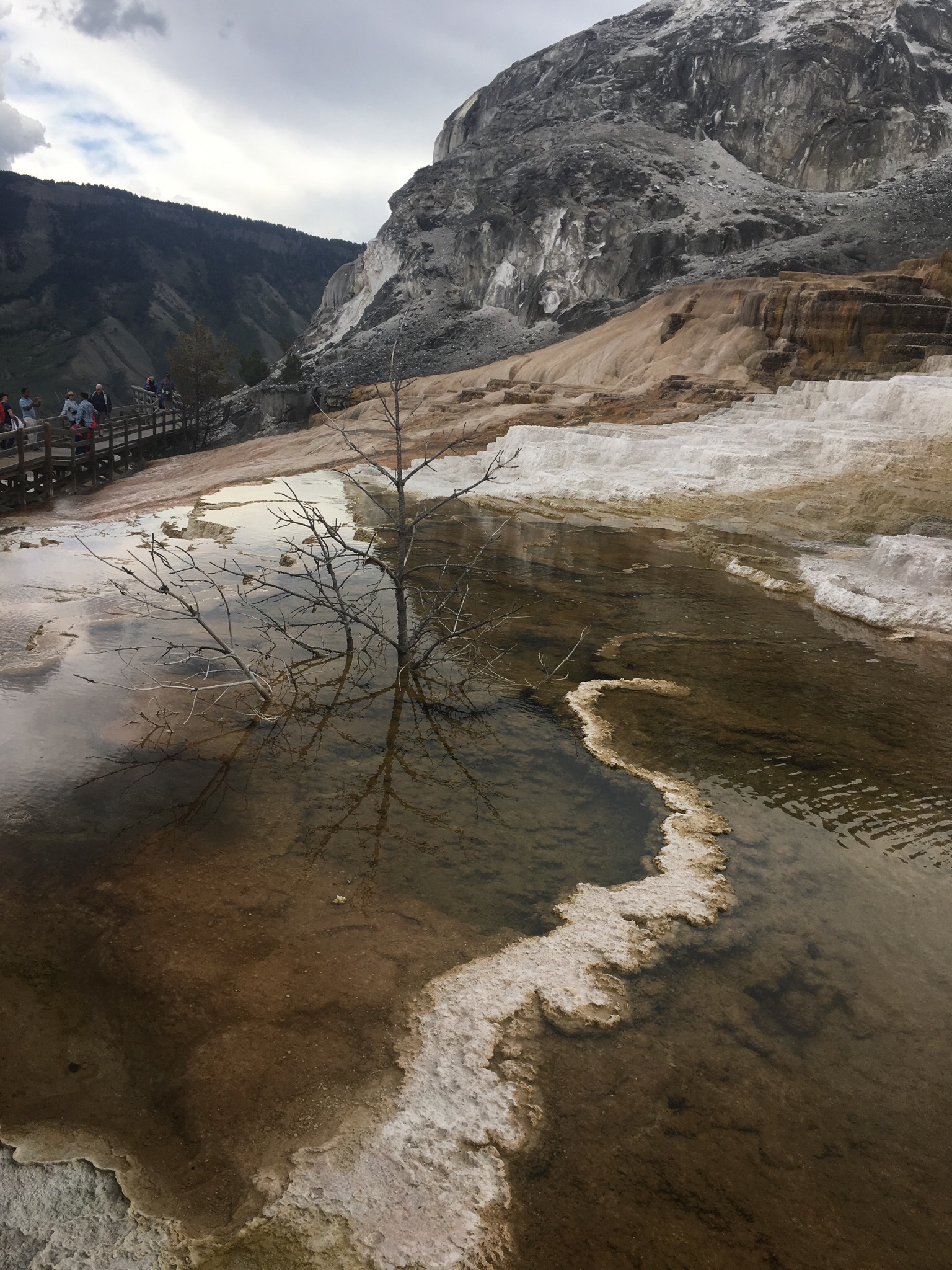
Mammoth Terraces

On our drive to the “Hitching Post” (hoping for more wolf sightings), we stopped at a pond to observe ducks enjoying the sunshine. There were ringnecks, ruddy ducks and the good ole American coot enjoying an afternoon swim. We were thrilled when Casey spotted a badger scurrying along the pond. Badgers are known for being quite vicious and will fight predators such as bears and wolves. While we did not observe an encounter with a predator, we did see the badger enjoying his supper, a tasty Uinta ground squirrel. Luckily, everyone was able to see it!
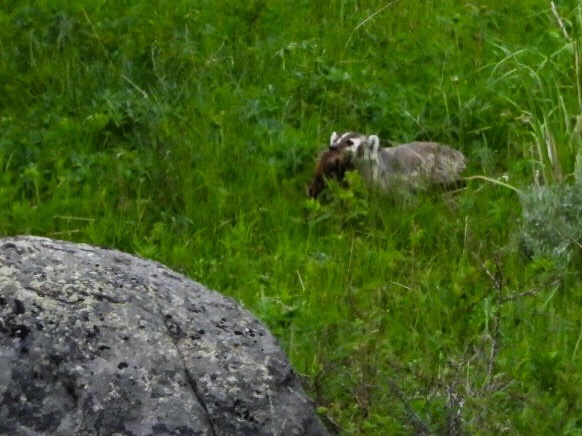
Badger with a uninta ground squirrel it caught

Badger with the Uinta ground squirrel it ate.

A double bear sighting was a good way to finish up our day of wildlife observations. We saw what folks out here call a “cinnamon bear” (a brown colored black bear) VERY close to the road and a black bear hiking up the side of the Yellowstone River were seen within 5 minutes of each other!

With luck on our side, we get to finish up the night early at the Roosevelt Rough Rider cabins. This day has been nothing short of badgers, bears, and beers.

Till next time,

Kali, Casey, Michele

P.S

Poo-pourri makes a great air freshener for the car!
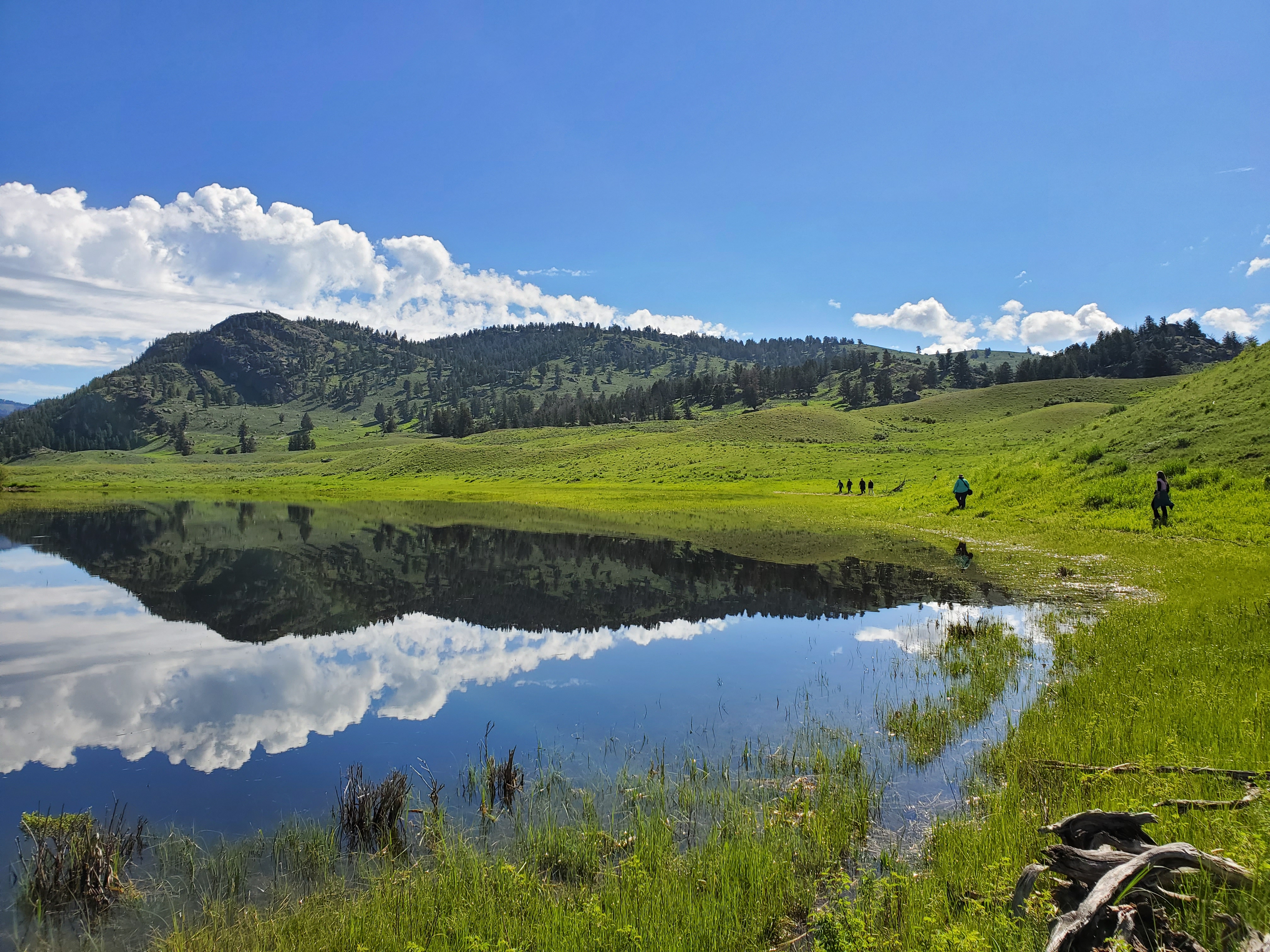
Yellowstone

“A Lesson in Safe Selfies”

June 16, 2019

“For the strength of the wolf is the pack, and the strength of the pack is the wolf.”

Today was incredible. Our first full day of adventure began at 5am this morning. Our first sighting was a young, but large bull moose who hadn’t yet started regrowing his freshly shed antlers. While mesmerized in our “moose moment” we heard someone say, ‘Bear!’ and after quickly turning around we saw a black bear rounding up its morning breakfast. As some of us watched the bear, and the moose, we also simultaneously saw mountain goats grazing on the side of steep cliffs above us! Needless to say, the first 30 minutes of the day was full of exciting, extraordinary nature. Many of us believed that our trip couldn’t possibly get better than this.

Boy, were we wrong.

As we’ve continued on our travels, we have become increasingly good at identifying contrasting colors on the landscape through our wildlife watching. This is a skill perfected by the professionals and one admired by many. Because, let’s be honest, when you’re as excited as we are, traveling in the park looking for critters- everything (rocks, bushes, shadows) looks like something. But, good news! As the sun rose over the mountainside, we peered into the breathtaking Lamar Valley. We observed playful “red dogs”, as the baby bison are called out here, their stocky parents, sandhill cranes and pronghorn. The beauty here is breathtaking, and each landscape is different, making you forget that you began your day this morning at 4am.

Late morning, we sighted a wolf den and also saw a grizzly feverishly digging for grubs after his long hibernation. Around 8 o’clock we met with Kira Cassidy, a wolf biologist at the park. She holds an important and somewhat envious position in Yellowstone, researching the behavioral aspects and overall influences of the various wolf packs on the park. With Kira, we hiked down to a cluster of wolf collar points to see if we could determine why these canines spent time in the area. Unfortunately with the recent rainfall, the water level in the creek nearby was too high, and we weren’t able to reach what was likely the remains of an elk carcass. But Kira entertained us with wolf stories – including the tale of wolves that were helping to care for pups but if they couldn’t find any food to bring back to the den, would instead find and bring back humorous souvenirs such as sticks to chew on, lost tourists hats and even a traffic cone for the new pups to play with! How funny!

Kira told us an interesting story about two female wolves who keep trading roles as alpha female in the Junction Butte pack. Both wolves denned at the same time and the beta wolf, the alpha’s sister, and other subordinates attacked the alpha and her pups. Kira states that this is only the 10th or 11th time this has occurred over the last 24 years. However, the alpha then went on to raise the beta’s pups, as if nothing had ever happened! The politics of the wolf hierarchy far surpass anything originally thought.

Wetland walk

Walking through the beautiful Slough Creek drainage with wolf biologist, Kira Cassidy

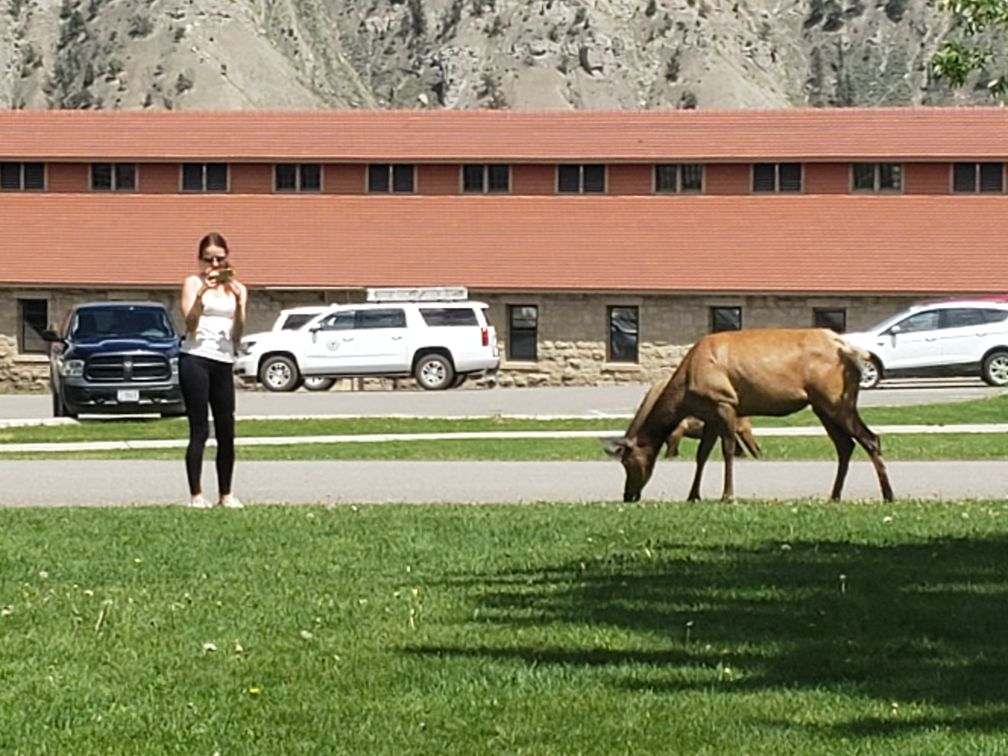
After our big wolf excursion, we continued observing wildlife and went round-trip to Mammoth where we saw some amazing and disturbing things. And here we’d like to take a moment to discuss taking ‘safe-selfies’ as a much needed (based on today’s observations) public service announcement….When you next vacation to Yellowstone, or anywhere you might see wildlife, especially the wildlife that is faster and larger than you (i.e. wolves, elk, bison, bears, large birds of prey, etc.) do not get within 75 to 100 feet. Be aware of how fast things can change when these animals become stressed. They do not not want you there, the selfie isn’t worth it. Please get out and experience nature, conserve and educate others about it. But, be safe doing it.

Person standing too close to an elk.

What NOT to do.

To end our day, we drove to the Lamar Valley hitching post pull-off for our evening group meeting. As we unloaded for our short walk to a better view, a car of five unloaded and began jogging very quickly towards us. We stopped to look around, ‘They’re here, right there, right there!’ in hushed but forceful tones. We looked at each other. What is there? Where?

Wolves.

Binoculars snapped upwards, some ran to the van to pull out the spotting scopes. We quickly scanned the ridges ahead of us and helplessly tried to see what we had been waiting for. ‘Look between the conifers, on a game trail, they’re walking,’ they said. And they were. Two very large black wolves and off to the right, a grey wolf. Suddenly barking, loud yelps, brown masses began to emerge on the ridge much smaller than those already in our eyesight. Their cries echoed between the hills. These coyotes, another, smaller species of the dog family, were not happy with the proximity of the wolves to what was likely their den. Pronghorn turned up to face the action, flight animals, ready to run. For what seemed like forever, the coyotes barked and we traced the ridges following the pack, watching them weave between tree clusters. Satisfied with their work, the wolves strolled over the ridge, unaffected by the uproar they caused. Frantically, we asked others if they could see them, we moved locations to find the pack but they were gone. Silence.

Without a doubt, today is a day we will never forget. We had an octo-ungulate morning, seeing all eight hoofed animals in Yellowstone National Park, all before 10:30 am. That alone has to be a record. Finally, after hearing all that Kira had to say about the infamous park wolves, our encounter was that much more meaningful. We wake up each morning to a beautiful sunrise, each day a new journey. Everywhere you look you see God’s creation thriving in an incredible piece of history. We sleep tonight knowing that more adventure awaits tomorrow.

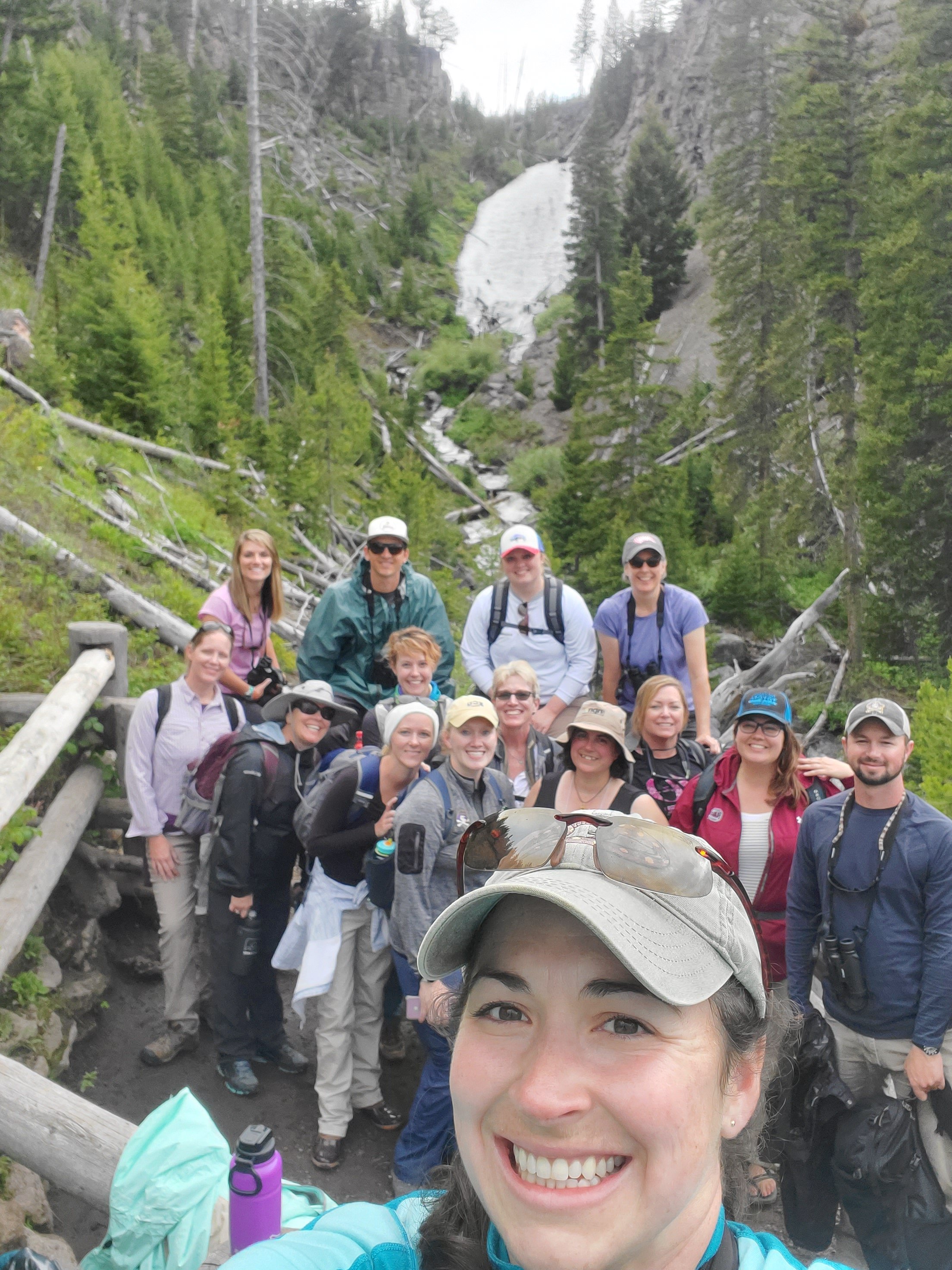
Group in front of a waterfall

A very wet spring meant that Wraith Falls was very powerful!

Fun facts:

⁃ Black bears are generally smaller here than ours in eastern North Carolina.

⁃ Bison will sometimes run towards their predator which acts as an intimidating trait.

⁃ The ungulates in Yellowstone are: bison, pronghorn, moose, mountain goat, big horn sheep, mule deer, white-tailed deer, and elk.

Warmly,

Mandie, Kristen and Emily

Yellowstone

“Entering Wonderland”

June 15, 2019

Our day has consisted of a 5am start, a 2 hr time zone change, and an excursion through Walmart followed by the Yellowstone wilderness. Here are some highlight of today’s events:

– We survived the hour-long TSA security line that almost spanned all the way out the door of the airport

– Bayleigh and Kristen got their “wings!” It was their first time on a plane!

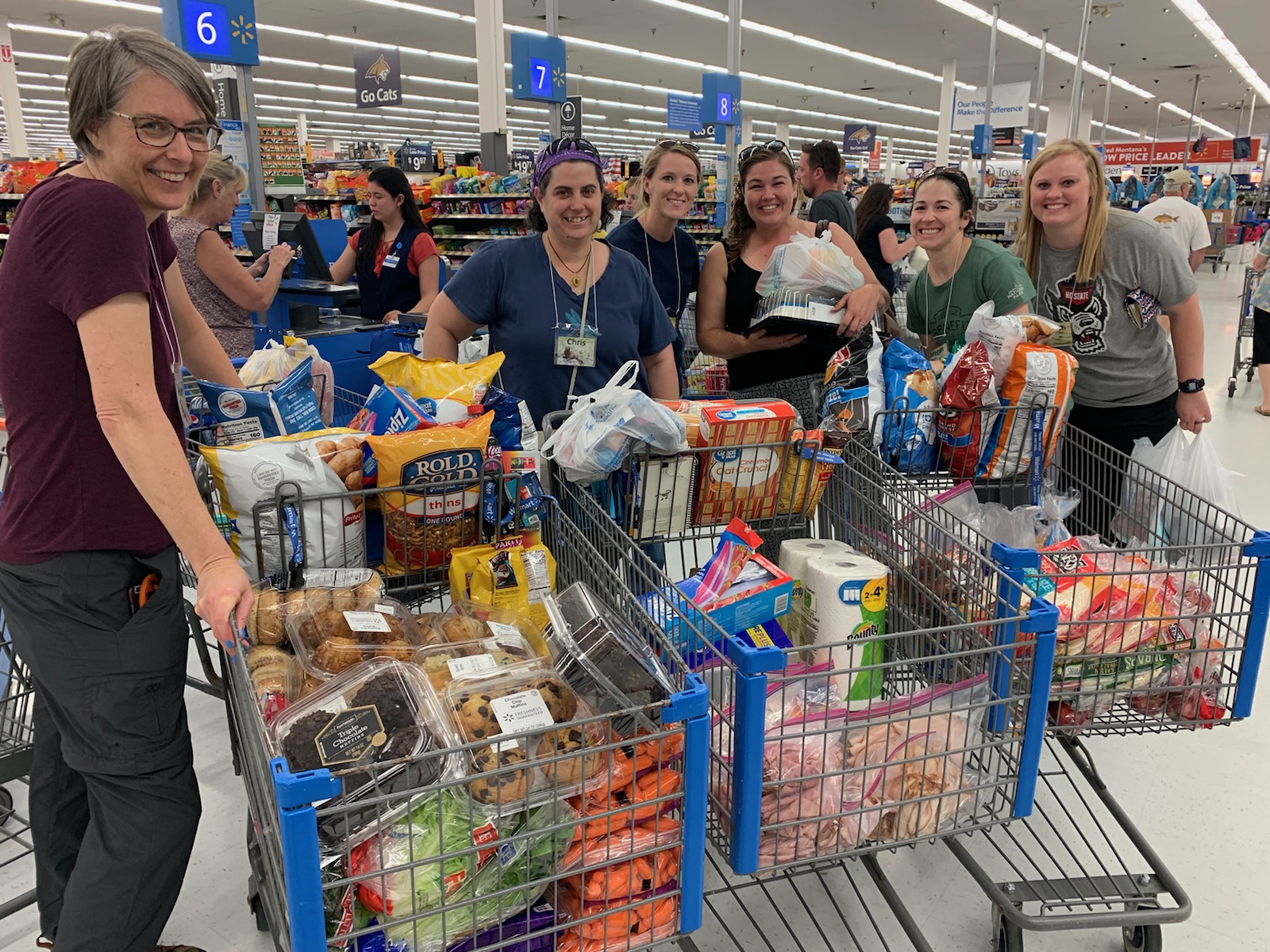
– We completed an ultra-efficient, lightning-speed “Supermarket Sweep” at Walmart. We left with 3 carts filled to the brim.

Full grocery carts

The results of the great “supermarket sweep”- enough food for field breakfast and lunches for 10 days!

– As soon as we entered the park, we were accosted by wildlife. Just beyond the Roosevelt arch, we saw elk and pronghorn. By the end of the day, we added bighorn sheep, bison, moose, magpie, osprey and eagles to the list (no bears YET).

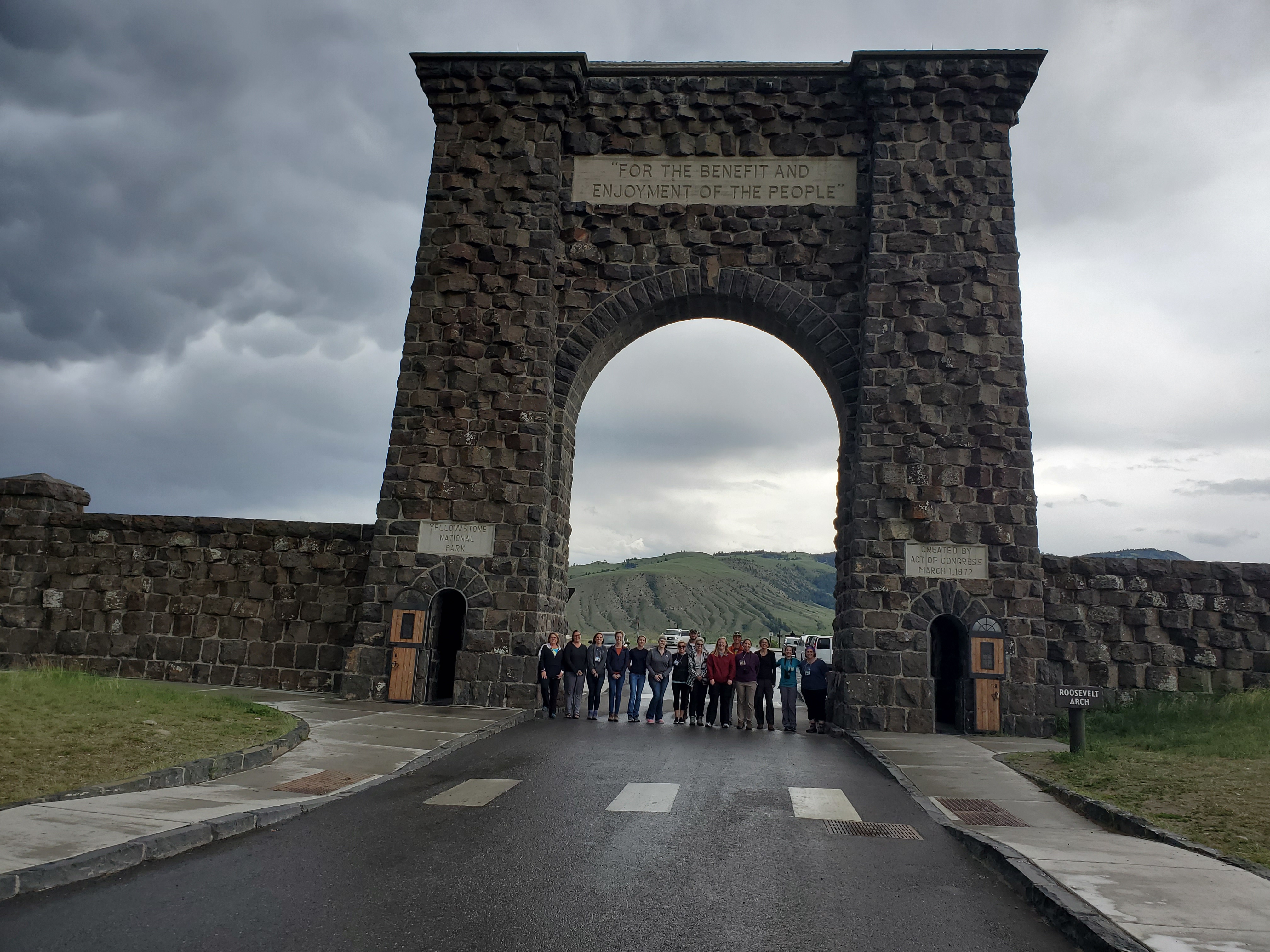
– We literally touched history as we walked through the majestic stone entryway arch dedicated by President Theodore Roosevelt in 1903.

The grand north entrance to Yellowstone National Park- the Roosevelt Arch

– We heard ground squirrels squealing their high-pitched warning calls to the rest of their family group.

– We heard the word “ungulate” uttered more times today than ever before in our lives.

– Everyone sang “happy birthday” to Bayleigh at the Mammoth Terrace Grill.

In all, Megan summed up our experience on Day 1 well when she described Yellowstone as “a journey through Wonderland.” We are already in awe of this place. Our souls were touched by the vastness of the magnificence of God’s creation surrounding us, Yellowstone National Park. We are excited for more adventures in the days ahead! Signing off for tonight, the Hot Springs group.

Yellowstone

“A time of transition”

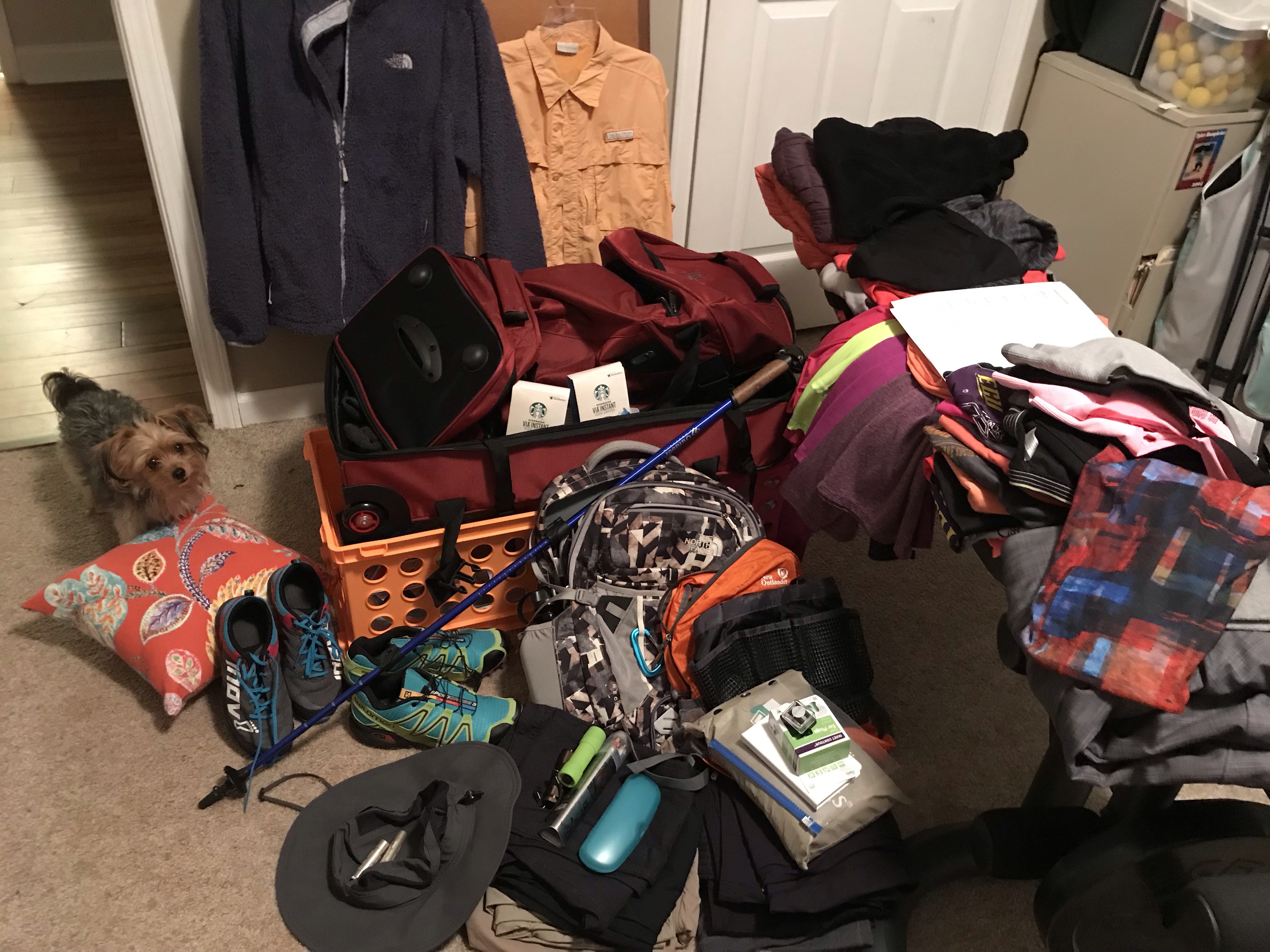
Pile of clothes and gear

The pile of gear needed for a 10-day adventure in Yellowstone can be quite overwhelming, especially for a small dog…

This week has been a time of transition for many of us. Some of us have been out of school for weeks, some of us were still teaching students yesterday, and all of us are excited to be traveling to Yellowstone today!

Tropical Ecology

“The last full day”

July 31

Our last full day in Belize!

Woke up after last night’s tropical rain to a cool, refreshing breeze. The sunrise was beautiful as evident in the pictures taken by the early morning kayak crew. After breakfast we discussed the sadness of having to return to the real world and the absence of a cook/chef, wait staff, and Nathan to guide us through the day.

We visited Carrie Bow Caye Smithsonian Research Station to get an up-close view of the work being done on corals along Belize’s barrier reef. We learned that the researchers are anxiously awaiting the annual coral spawn and are hoping it will occur tonight (the 31st). The coral spawn is being used to study the effects of ocean acidification on coral polyps. Zach, the station manager, showed us two nesting sites for Hawksbill Sea Turtles that were made last night! Babies should hatch in 60 days.

Originally we had planned to snorkel in the Mangroves, but last night’s rainstorm stirred up too much sediment. Not wanting to miss our 5th snorkel opportunity, we traveled to another patch reef to see what we could see. Despite some serious chop, everyone was excited about the diversity of corals, as well as seeing a large stingray, barracuda, many spiny sea urchins and a Nurse Shark.

Our last night began with hilarious group “presentations.” Each team reflected on our experience in a creative skit. The skits began with the leaders’ brief presentation and ended with “The Beast,” a tradition since 1987.


Tropical Ecology

“Night snorkel”

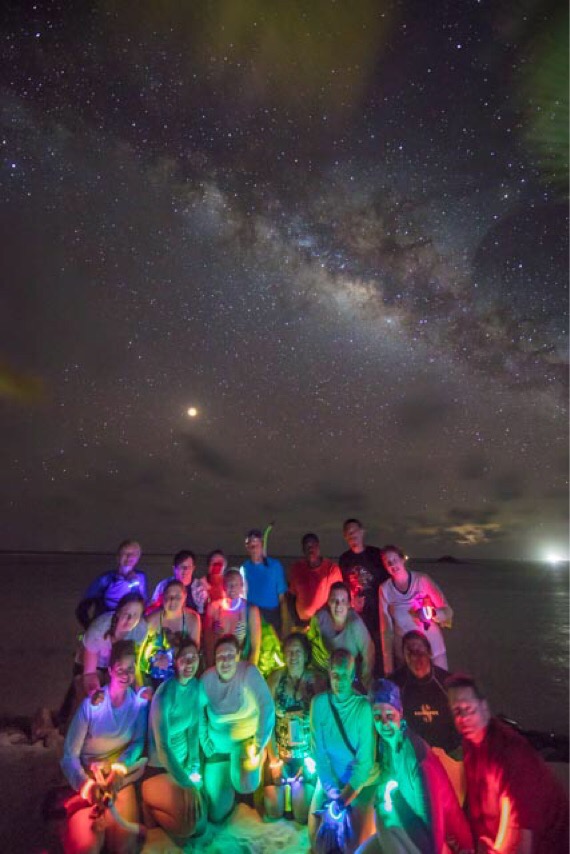
night snorkel

Thank you Tony Rath photography!

We had a fabulous night snorkel and are grateful to Tony Rath photography for capturing our group under the Milky Way!

Tropical Ecology

“Paradise”

We awoke on the island at South Water Caye with the breeze drifting in through the open door and palm trees. A handful of us adventured out early before our full day to enjoy a quiet morning kayaking to enjoy the sunrise. We spotted cormorants feeding and a rainbow to greet us as we started our day.

After a breakfast of creole bread (similar to sourdough), eggs, breakfast sausage, and fried beans, we took a short walk around the island. All of our educators were assigned expert topics before we arrived in Belize, and we were able to hear about conch shells, pumice, mangrove trees, coconuts and the Magnificent Frigate birds found on the island. Nathan demonstrated how to remove the tough husk from a coconut by impaling it on a stake and then using a machete to get to the coconut meat on the inside. Only the brave of heart tried to do the same!

We headed out for our first of three snorkels of the day to the Aquarium Reef, a pristine part of the Belize Barrier Reef. The Belize Barrier Reef is the second largest reef in the world, and the the largest living reef. It is estimated that close to 90% of the reef is healthy, as evidenced by the vibrant colors of the coral and biodiversity we witnessed. On the reef, we saw stingrays, schools of fish and a few of us even spotted a Hawksbill Sea Turtle swimming! We saw squid, and held conchs and touched a sea cucumber.

After lunch, we snorkeled closer to the island and paired up, trying to observe a particular fish’s activity. We came back together in the evening where we shared about our first day on the island and then mentally prepared ourselves for a night snorkel. We broke into small groups with dive flashlights and glow sticks and slowly snorkeled, looking for octopuses, lobsters and sleeping fish. The reef is just as breathtaking at night.

A friend on the island took a picture of our group where the Milky Way and stars were bright in the background. The sight of the countless stars and sounds of the storm rolling in lulled us all to a restful sleep and another beautiful memory of Belize.

Tropical Ecology

“Last Day in the Jungle”

During our last night in the Jaguar Preserve we took a short walk to find Jason’s Favorite Bug — the Dragon Head Bug. It is only found on one species of tree, and spends the day in the canopy before coming down the trunk at night. Sure enough, we found it on the tree where Jason had spotted it last year!

A morning boardwalk to the South Stann Creek started our day. We were really excited to see Keel-billed Toucans. While they were a little distance away they were easy to see with binoculars and a spotting scope. Plus they have a really distinctive silhouette that looks like a “crow pushing a banana.”

After a delicious breakfast that included johnny cakes, we set off for the Ben’s Bluff Waterfall. We enjoyed hiking through the jungle, marveling at the buttress roots, huge philodendron, and beautiful tropical heliconias. The waterfall was beautiful. We were able to swim back to the little grotto created by the force of the water. Back there we found a small bird nest with two eggs. We think it is a Cave Swallow nest. We then took turns posing under the cascade, with Nathan kicking it off posing like a weightlifter!

Our hike back down was fast because we were looking forward to heading to the coast, but we slowed to a stop when Nathan spotted a Coral Snake. This was the first snake in the wild we have seen. Nathan made sure everyone got a chance to see it.

We headed back down the road to Maya Center where we stocked up on chocolate products at Che’il. We were all excited to buy the products we had learned how to make after our chocolate tour the day before — YUM YUM YUM!

At Pelican Beach Hotel in Dangriga we enjoyed a beautiful view of the Caribbean as we relaxed over lunch. Our luggage filled the bow of the boat, and we sat towards the back for our ride to Pelican’s Pouch at Southwater Caye. We were shocked when we had an hour of free time to get ready for our first snorkel.

We met on the beach to try out our snorkel gear. After making sure that everyone’s  masks fit, we swam over the Turtlegrass to our first reef. We saw lots of fish including Stoplight Parrotfish, Fairy Basslet, and a Nurse Shark! We stayed with our buddies and spent nearly an hour “oohing and aahing” into our snorkels before it was time to get back.

Our evening meeting was with a view of the sunset, and after dinner we spent a little time stargazing and identifying constellations. We saw at least three shooting stars, too!

We are enjoying this transition from jungle to sea.

Tropical Ecology

“From the Zoo to the Reef”

Our last day at DuPlooy’s started off with breakfast burrito and a huge THANK YOU to the staff who took such wonderful care of us during our stay. It was hard to leave, but the Belize Zoo and our hero, Sharon Matola, awaited us and we did not want to be late! Only two hours separated us from some of the most amazing animals that we would ever see. Can we go on permanent vacation in Belize? 

We pulled up to the zoo, parked and made our way inside to be greeted by Queen Green, the resident boa constrictor. Each of our group members was able to take a once in a lifetime photo of themselves with the boa. Even those of us who were scared of snakes could not resist the Queen. She had just shed her skin and her light blue shimmer was eye-catching, to say the least. As we made our way through the zoo, we were in awe of everything from the hand-painted signs to the opportunity to go behind a “Staff Only” fence and give a crocodile a foot massage. 

We loved seeing Chiquibui, the Jaguar, who was a surprise to the zoo after her mom joined the family, carrying a little surprise stowaway with her! Our favorite visit was with Indy and Sparks, the tapirs. Tapirs are the national animal of Belize, but were once plagued by myths regarding their supposedly aggressive behavior, although you could have fooled us! Indy and Sparks were friendly, playful and kind. We even were able to feed Indy his favorite snack of carrots and scratch his back, which he loved. 

The most incredible part of the Belize Zoo, however, was being able to meet the heart and soul of the zoo: Sharon Matola. She is a hero to many of our group members and, likewise, people around the world. What she has done for the people and animals of Belize is nothing short of a lifetime achievement.  She left us with the idea that “no animal is unteachable” and we could not help but agreeing and will carry that sentiment with us into our classrooms.  

From the zoo, we visited the market in Belmopan to grab some unusual fruits for an exotic tasting. Have you heard of craboo or soursop? We hadn’t either! 

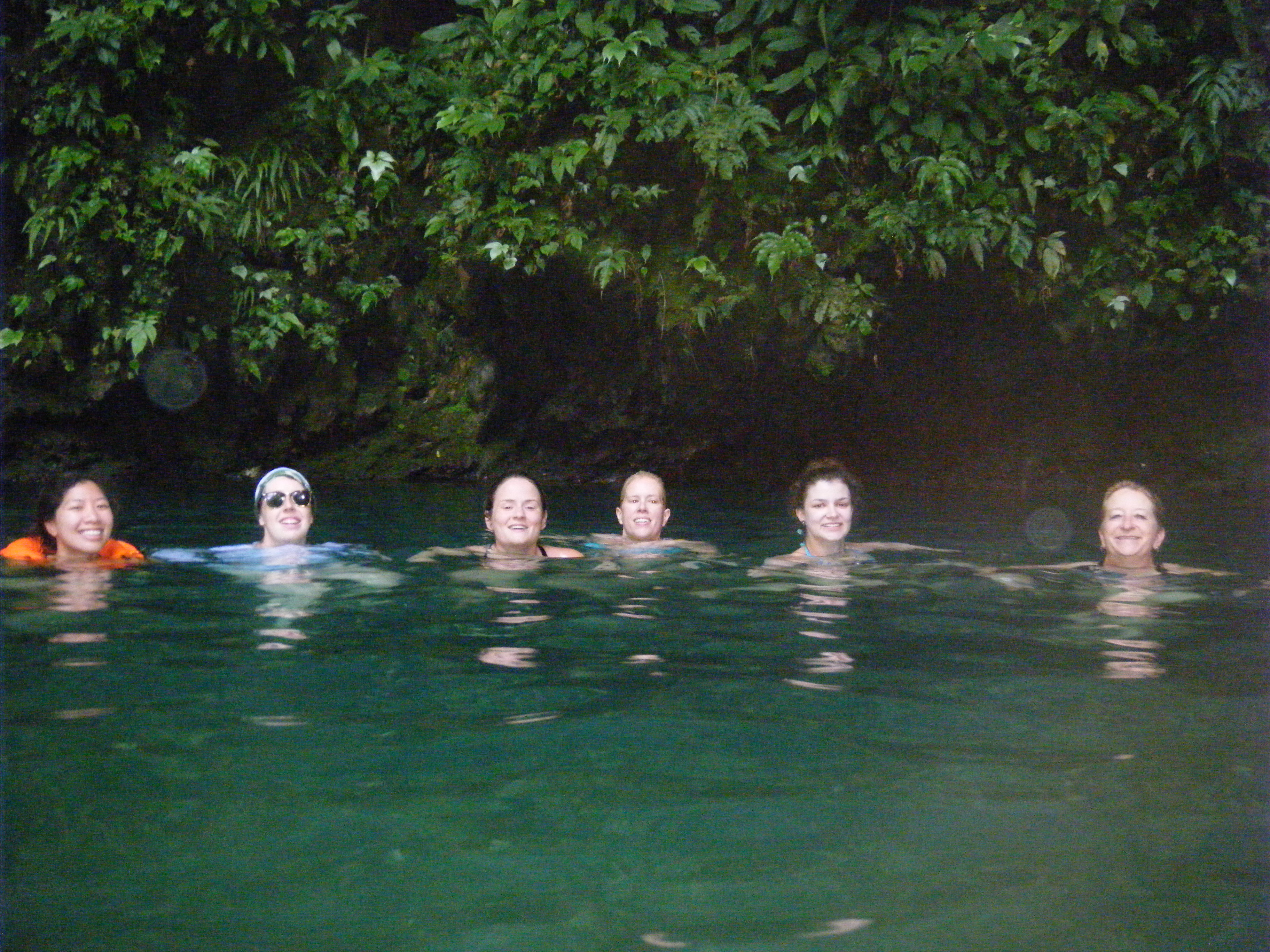
The next stop was the Blue Hole, a crystal clear pool of blue water tucked into a rocky cliff. There was even a cave only accessible by swimming and you know we had to check that out. It was as solid as the rock we stood on to take a group picture. A quick dip was all we needed to recharge before we headed to the Jaguar Reserve and the Mayan Center. We arrived just in time to head out in search of tarantulas and scorpions, which we found immediately. 

After an early morning bird walk on Saturday, we headed off to the remote village of Monkey River to meet the people and interact with the students. Our teachers planned engaging activities to challenge the minds of these young learners while getting to know them and their culture better. A delicious lunch prepared by former students of Monkey River school hit the spot and we hopped on the fishing boat to cross back over to the mainland, but not before catching sight of a gar fish! 

On the way home we stopped at the Mayan Center to get a personal chocolate making lesson from Julio, whose family has been living on that land for over 100 years. We were able to make chocolate from cacao seeds and it was the best chocolate we have ever tasted. Julio even gave us a lesson on the history of Mayan culture and how the Jaguar Reserve has affected the Mayan people. Ecotourism is the livelihood of the village and the community is thriving. 

We are in love with Belize; so much. Now, on to the sea turtles.