TOP
Yellowstone

“A Yellowstone Verse”

A wolf, osprey, and bison jam

as we made our way to meet Dan.

Two black bears walked through the meadow just in front of us

Along with seeing two bull moose which was definitely a must.

Then in the stream

You never would have guessed what we’ve seen.

It was a moose cow and calf standing by the the stream

We were so excited we all had silent screams.

Cow moose with her calf partially hidden in the willows

Dan Hartman, wildlife photographer, was the man

He sees things that no one else can.

In the Shoshone National forest he took us on a hike.

We walked with all our might

In the alpine forest we saw an owl, woodpecker, rough grouse, and prints of paws.

We searched and searched for wildlife and wild flowers as we meandered in awe.

Group with Dan Hartman
Hiking with all our might!

Winding roads of Beartooth Mountain to 10985 feet high

Marmot and pika were everywhere… oh my!

Beartooth Butte

A visit to Cooke City for dinner and shopping

Pebble Creek canyon was next but for sure… no hopping!

Finally winding down for the day

We say…

“Goodnight from us and the mama coyote, coyote pups, and our final glimpse of the Junction Butte black wolf.”

Lakan, Megan, and Evan

Yellowstone

“Forging of a Family”

Our day started early at 5 a.m. It was a little rainy, but not an absolute downpour.  The lightning in the sky was spectacular as we scanned the mountains.  We kicked off the day looking at wildlife in Slough Creek.  We didn’t see any wolves near the den we were scouting, but further down the path we were able to see a golden eagle and her two eaglets, as well as a black bear.  Once we left that area we entered the Lamar Valley where we saw tons of bison, a few grizzlies and their cubs, and probably most exciting of the morning, seeing coyote pups.  We were able to watch them play together around their den entrance. 

herd of bison
Bison herd primarily composed of cows and calves (the orange ones)

After a quick yet delicious brunch in Silver Gate at the Log Cabin Cafe near the Northeast Entrance to Yellowstone, we were able to sit down and have an engaging talk with Dan Hartman.  Dan and Cindy are local wildlife photographers and expert naturalists. Dan showed us some of his video clips of owls, bears, and other animals that have been featured in National Geographic, BBC, as well as his own videos.  While we were finishing up at the Hartman’s we got side tracked by a red squirrel and a goldenrod spider, which led to Dan queuing up another video of a goldenrod spider capturing a hover-fly.  

After our visit with the Hartmans, we wound down with some huckleberry ice cream, and a journaling break by the Soda Butte Creek. We spied on an American Dipper coming in and out of her nest.

Svetlana, James, and Laura W. looking at mountain goats on a dramatic cliffside

While the animal life is most exciting, it cannot overshadow the expansive landscape and the beautiful plant life of Yellowstone. Some of the most notable (and loved by our group) would be the phlox, lupines and prairie smoke. Another favorite is the sagebrush. It is nearly impossible to walk by it without rubbing its foliage between our hands, then inhaling the scent from our hands. This powerful and relaxing scent is something we all wish we could take home with us. 

Dinner was at the Roosevelt Lodge on the historic property. We finished up this beautiful day looking for more wildlife near Slough Creek, in the Lamar Valley, and with an evening hike at Trout Lake. Admittedly, we are all hoping to see more wolves, which the park is known for, and more importantly continuing to grow as a group.

group in front of lake and mountains at sunset
The group at Trout Lake as the sun was setting

Allyson McFalls, Laura Walkup, and James Blake

Yellowstone

“A Steamy Friday”

The day started at 6:25 AM at Mammoth Dining for breakfast. After breakfast, we took the road less traveled to take a look at the backside of Mammoth Springs. Mammoth Springs, one of Yellowstone’s geothermal vents, is comprised of many smaller springs that produce steam, amongst them Narrow Gage, Canary Falls, Prospect Terrace, and Mound Springs. Yellowstone has the largest collection of geothermal features in the world as a result of underground volcanic activity. 

A group of people standing and looking at hot springs.
Our group was absolutely AWED by the diversity of geothermal features in Mammoth Hot Springs.

After a 2.5 mile hike around Mammoth Springs, we headed down to meet two park rangers and hear their stories from the past 30 years in the park. Ivan Kowaski works in backcountry permitting and training for visiting park goers. Bob Fuhrmann is director of Education at the park and works with the Youth Conversation Corps. 

During a short break, we had a chance to see the visitor center, a family of Great Horned Owls in the tree outside the visitor center, and had wraps for lunch. After lunch, we were joined Ranger Michael who works with teachers, students, and citizen scientists in the park. He led us on a hike to spot pikas for a citizen science project called Pikas in Peril. While spotting a pika, we also spotted a very cheeky golden-mantled ground squirrel.

Small mammal among the rocks.
Can you spot the pika hiding among the rocks? Our educators listened and watched for these small mammals today while collecting data for the citizen science project, Pikas in Peril.

After dinner at Cowboy’s Lodge and Grill in Gardiner, Montana (just North of the park), we set off for an evening nature drive. Evening animal sightings on our drive included: elk, Ruddy Duck, our first bison, our first black bear, a cinnamon colored black bear, two bachelor mule deer, a coyote, Sandhill Cranes, pronghorn, and most notably gray wolves from the Rescue Creek Pack.  

We ended day 2 with a group meeting by a herd of bison with many calfs and took the opportunity to discuss our first impressions of Yellowstone and our favorite moments so far.

We are so grateful for our first full day at Yellowstone to have been jam packed with so much awe and new knowledge!

Laura Martinez, Jessica Pichan, and Dave Williamson

Yellowstone

“The Adventure Begins”

We started bright and early in Raleigh and ended up (still bright) but later in Yellowstone National Park! We checked into our cabins, hiked to a scenic cliff where we revisited our goals and set our new ones for the trip.

Some of our goals for this trip

We bonded over our excitement to leave behind a school year, the demands of being needed and responsible for so much, and our desire to live in the moment, be present and take it all in as we begin this journey together!

Group meeting on a ridge above the Gardner River

To top it off…. We saw lots of elk in the sagebrush, playing in the road, and grazing the lawns in Mammoth, where we are staying tonight.

Elk on the sidewalk in the town of Gardiner, MT (taken from our vehicle)
Yellowstone

“Ten Days Till Yellowstone!”

As the school year winds down, our group of 12 intrepid educators is getting ready for an educational adventure: our 2024 Yellowstone Institute. Early on June 13, we will board our first flight towards Bozeman, Montana, arriving in the park later that day. We’ll spend ten days taking a deep dive into Yellowstone’s ecology, geology, and history as we rise early to watch wildlife, explore some of the park’s many trails, and learn from experts and each other.

At the Museum, our staff leads have been finalizing the schedule, packing binoculars and spotting scopes, printing stickies for everyone’s journals (including maps, our itinerary, and daily team assignments), and cramming just a little bit more Yellowstone knowledge into our brains.

Some of our participating educators have shared how they’re preparing, too…

From Jessica Pichan: “Once May comes, things get a bit hectic at school with the EOGs quickly approaching, so it has been nice to have our Yellowstone trip as a light at the end of this tunnel! I am getting ready for Yellowstone by making sure that my family goes hiking each weekend. Last weekend our hike was one that created core memories because it involved a quest to find cicadas. I am going to make sure that I start walking on the treadmill at the gym with increased elevation again during the week… I started out the year strong in preparation, but have fallen off a bit.

teacher smiling at camera while holding a bug

Jessica Pichan with a periodical cicada

“Yellowstone has been on my bucket list for a long time and I cannot wait to soak in the views and to learn things that I would not if I were to go with my family alone. Our youngest daughter (5) has Type 1 Diabetes, so I worry about something happening while I am so far away, but I know that she will be safe and in the most capable hands with my husband. I realize that I cannot pour from an empty cup and I know that this adventure will recharge me in ways that I cannot even begin to put into words. I am so incredibly grateful to have been chosen to be a member of this Yellowstone cohort!”

toiletries on a surface

Laura Walkup has already started packing: “I’m getting ready for Yellowstone, so I’m taking stock of my toiletries by making a list and checking it twice! I’ve also gathered my journal, art supplies and writing materials. So excited to see new sites with my new friends!”
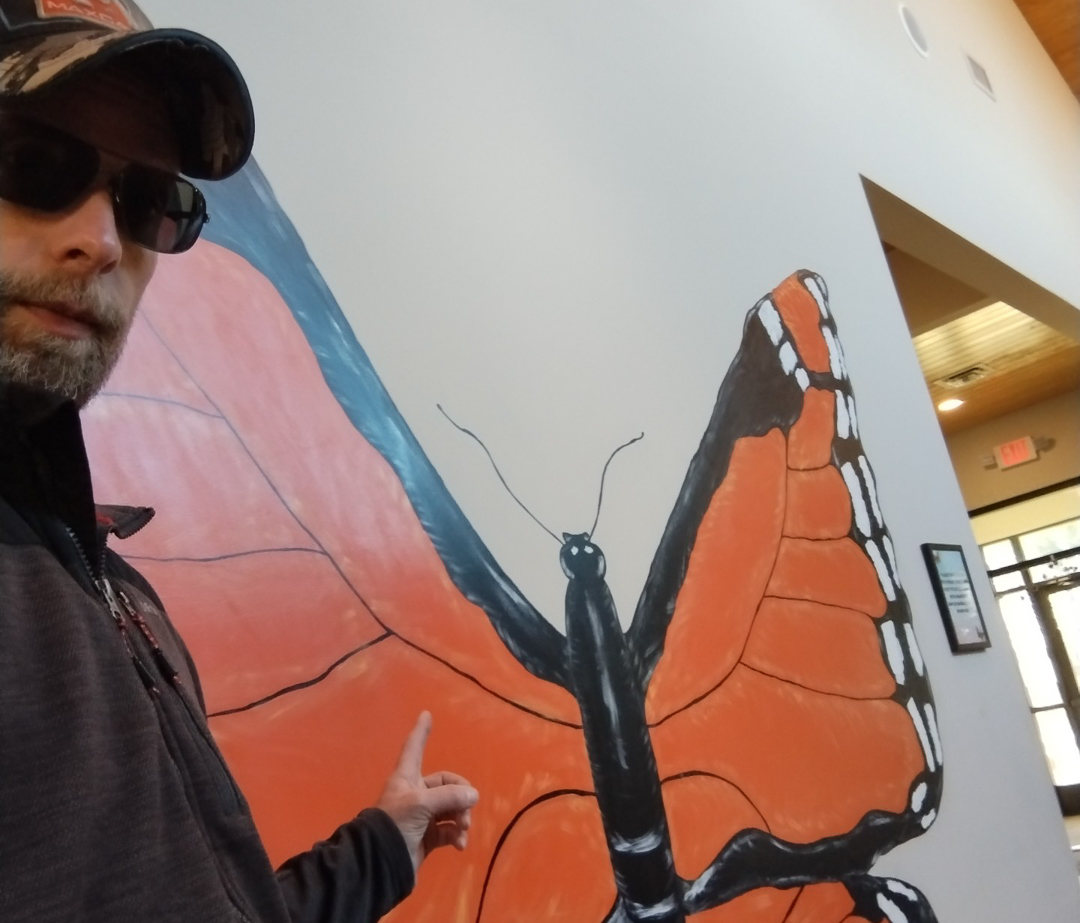
Allyson McFalls shared how she’s combining Yellowstone prep with a field trip for her students!

teacher and 3 students on a fire tower

Allyson and students on a fire tower

From Allyson: “As part of my Yellowstone training, as well as an effort to get our students out of the school while other grades were testing, my teammate and I took our sixth grade class hiking at Moses Cone along the Blue Ridge Parkway. The weather looked dicey all week (at one point forecasts were calling for hail and high winds!), but thankfully the morning of our hike, things were just overcast. We completed the 5 mile hike with 30+ students in under two hours, including climbing to the top of the fire tower for some incredible views of the Blue Ridge Mountains. My hiking boots seem well broken in, and over 20,000 steps later, I’m sure that all the kids slept well that night. I’m looking forward to the new terrain and challenge of the Yellowstone trails, as well as all the new plant and animal species we’ll see along the way.”
We hope you’ll follow our adventures as we post blogs on our Yellowstone Institute from June 13-22. Send questions our way by leaving comments on our posts, and we’ll do our best to get back to you!


Yellowstone in Winter

“A Mammoth Ending”

This morning Yellowstone treated us to another amazingly beautiful sunrise. We stopped to appreciate the beauty before heading to the Mammoth Hot Springs to meet with Erin and Kieran, two members of the park’s geology crew, and Mike Coonan, an education ranger for the park.

Sunrise from Mammoth Hot Springs

As we walked the boardwalk, we learned about how the geology of Mammoth Hot Springs differs from that of the geyser basins in the southern part of the park. The Mammoth Hot Springs form terraces made of travertine, which comes from hot water dissolving limestone. The dissolved minerals precipitate out of the water to form the travertine terraces. The terraces grow very quickly, sometimes more than a foot a year! We even saw trees that previously were growing in the dirt and are now being swallowed by the travertine. 

Canary Spring at Mammoth Hot Springs, surrounded by dead trees

The park geologists also talked to us about some of their work in the park, ranging from piecing together the history of various areas of the park to being trained how to walk near thermal features in order to take measurements and retrieve trash that people lose in the hot springs and geysers, either accidentally or intentionally. A few decades ago, scientists working for the park occasionally took a small boat out on the hot springs to measure the depth. Erin and Kieran are very glad that they don’t have to do that anymore because many of the springs are close to the boiling point! The education ranger, Mike, reminded us of how special Yellowstone is. The 2.2 million acres of the park contain an intact ecosystem that is preserved and largely untouched by human development. Yellowstone’s wilderness today is very similar to how it was when the first indigenous peoples were using the area at the end of the last ice age approximately ~11,000 years ago.

After spending the morning at Mammoth Hot Springs, we packed up and headed to Bozeman to catch our flight back to North Carolina. 

Group at dinner in the Minneapolis airport celebrating Tracy’s birthday tomorrow!

On this trip, we were pushed out of our comfort zones by challenging snowshoe hikes, extreme cold, and even by taking the leap to fly across the country with a group of strangers. We proved to ourselves that we can do hard things and even thrive in challenging situations. (Having the right gear really helps!) We are exhausted, rejuvenated, and in awe of Yellowstone’s vast magnificence. We are walking back into our classrooms full of excitement and ready to share all we learned about ecology, geology and history. We hope to share with our students the understanding that nature is interconnected, fragile, and important to conserve. 

“In the end, we will conserve only what we love; we will love only what we understand, and will understand only what we are taught.”                   

– Baba Dioum


Yellowstone in Winter

“-15°F? Oh, it’s warm outside!”

For our last full day at Yellowstone we had two things on the docket: to go snowshoeing and to see our last ungulate, the mountain goat. We got into the park before sunrise making our way to a bison carcass we saw yesterday. While there, we watched 3 coyotes feeding on the bison (and later in the day we saw a wolf feeding on the same carcass). After that, we made two passes through the northeast corner of the park looking for mountain goats, but saw nothing.

Wolf at bison carcass

Our morning was freezing while checking things off our docket. It was -28°F as we were heading into the park, and the highest temperature we experienced today was -4°F. Throughout this “negative” day, we (unfortunately) had to use pit toilets. The toilet seat was so cold our infrared thermometer couldn’t even give us a reading on the temperature! Surprisingly, several of us mentioned how much warmer today’s temperatures felt. If you’d asked us before this trip, none of us would ever have thought -4°F was warm. However, when experiencing temperatures around -30°F, -4°F really does seem warm! This trip has taught us the importance of layers of clothing; we added and took away layers as we moved throughout the day and got in and out of cars.

We made one more pass through Lamar Valley to spot a mountain goat but came up unsuccessful yet again. With the weather in the negative teens all morning, when we stopped in Cooke City, MT to get coffee at Cooke City Coffee we were thrilled. After warming ourselves with a hot beverage, we continued our search for the elusive mountain goat. This next pass was not without issues. One of our SUVs discovered the importance of friction, when it slid on a patch of ice and got stuck in deep snow on the side of the road. No sooner had we gotten out of our vehicle to investigate when help arrived. This “help” just so happened to be Dr. John Winnie, ecology professor for Montana State University, in his truck with a tow strap! Within just a few minutes he was able to pull us out. We thanked him and offered him some baked goods (which he declined), and we exchanged information (never pass up the opportunity to network).

Before

After, with our new friend John

With our crisis averted, we moved on to our last snowshoe hike along the beautiful Pebble Creek. The trek was simple but the beauty was breathtaking. This area was devastated by the floods of 2022, and we saw evidence of this devastation on the landscape – downed trees, tangled picnic tables, and freshly eroded rocks. Our group observed canine and moose tracks along with an American dipper nest (see our earlier post for more on this amazing bird). Our group was blown away by the beauty, history and geology found within this small box canyon. While there, Klara shared a beautiful poem with our group. Everyone of our group members gained something different out of this snowshoe experience.

We ended our day in the park with one last look for a mountain goat, with no luck. We headed out of the park and made one last stop to take in a magical Yellowstone sunset!

Group on snowshoe hike

As we wrapped up our final group meeting, we realized we all managed to fulfill all the goals we set at the beginning of the trip from learning about geothermal features (Tracy) to experiencing moments of stillness (Sallie) to adopting a science point of view (Landon, our history teacher). The group shared their experiences and the many takeaways from our time in Yellowstone. We are pumped about meeting with the Yellowstone Geology Crew and an Education Ranger in the park tomorrow to further our knowledge and look for ways to bring this experience back to our students.

Our time in Yellowstone is almost up, but we all feel so thankful to have experienced this magical place with each other!

The poem Klara shared

Yellowstone in Winter

“Our Children are Our Future”

We entered Yellowstone again in complete darkness and experienced the night sky. The number of stars far exceeds what most of us experience in North Carolina. From there we entered Lamar Valley just in time to view the sun coming up over the Absaroka mountains. It was the most spectacular view.

Lamar Valley at sunrise

As we continued into the park, we spotted a bison carcass being scavenged by a juvenile bald eagle and approximately 25 ravens. Maybe 50 yards east were 2 bedded wolves, lying in the snow across the valley. We wondered if maybe they had fed on the carcass which would explain their satisfied, docile behavior.

Afterwards we continued on to Silver Gate, MT to the home of Dan and Cindy Hartman but before we arrived we were blessed to find 2 moose, a cow and a calf, having a morning meal of willow plants. Dan and Cindy, who are wildlife photographers and naturalists, shared with our group some of their recent work creating movies about nature. Our feature film today was called “Harvest,” which was his new film on the impact of the loss of whitebark pine trees on a multitude of animals. This film was based on his study of middens, which is a cache of pine nuts made by red squirrels. After the video we talked about the invasive species, pine bark beetle which is killing off many of these tress and affecting the ecosystem. He shared with us that his mission is to encourage others to respect and appreciate nature through a deeper connection with all living things. One of our team asked Dan what we could do to help protect whitebark pine. His response: “It’s going to be up to our children to save them.” As we were leaving the Hartmans we were thrilled to see a beautiful fuzzy pine marten, a member of the weasel family, scampering up a snag outside his cabin. In addition, we saw numerous birds including some Clark’s nutcrackers, Steller’s jays, mountain chickadees, pine grosbeaks and a red-breasted nuthatch.

Pine marten at Dan and Cindy Hartman’s house. Photo by Adam Smith.

The other animals we spotted today include: lots of bison, more dippers, ducks, pronghorns, eagles, elk, ravens, a ferruginous hawk and two red foxes. We ended our day by exiting the park during daylight hours so that we could see the Roosevelt Arch.

Group at Roosevelt Arch

Even though it was a mere 3 degrees, we rewarded ourselves by taking a relaxing dip in the Yellowstone Hot Springs, a private spot outside of the national park where hot groundwater is used in manmade pools to create a lovely spot. This was much needed after the frigid week we’ve had. Our bodies should be ready for more park action tomorrow after soaking in the mineral rich geothermal waters which will help with our aches and pains from the physical activity we have endured.

Yellowstone in Winter

“How to Survive at -27 F: Hand Warmers, Keep Moving, Surprise Hot Chocolate”

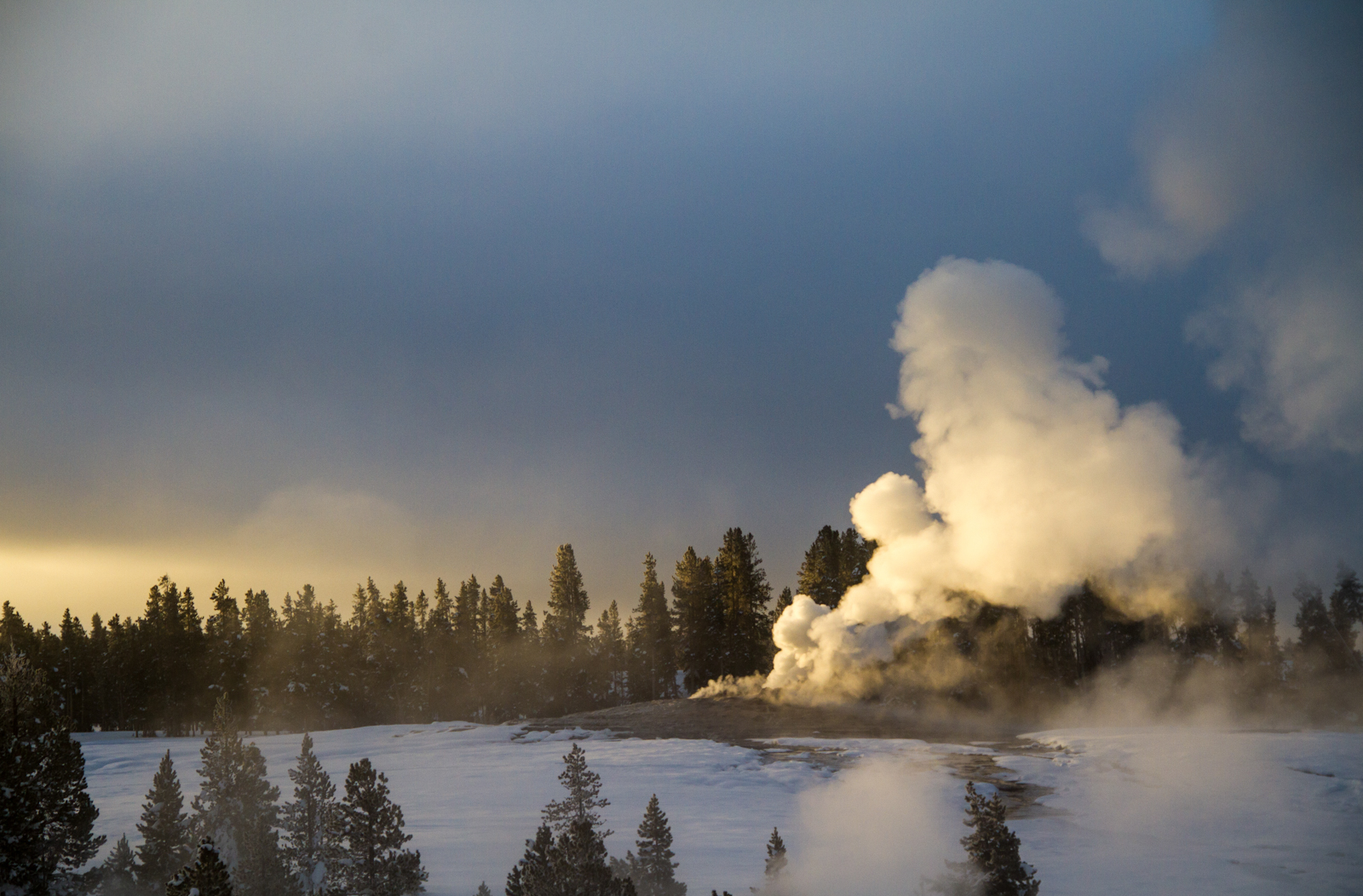
Our day began with a sunrise hike to Old Faithful and Upper Geyser Basin. It was an absolutely beautiful morning with pre-dawn light tinting the sky blue and pink. We were graced with an eruption of Old Faithful at 7:47 am against that spectacular background.

Old Faithful eruption just before dawn

As we walked across the Firehole River to Geyser Hill, we measured a temperature of -27°F. We made short stops to look at geysers and hot springs, but kept ourselves moving so we wouldn’t get too cold. As we walked past Lion Geyser, we were surprised as it started to erupt! We turned around, and in the opposite direction, we watched as the sun peaked out of the far ridgeline between lodgepole pine trees. In temperatures this cold, whenever we walked through steam from a thermal feature, the moisture in the air froze to our hair and clothing, and even our eyelashes.

Angie’s hood provided the perfect site for rime ice to form!

Shortly after departing from Old Faithful in our snowcoach, we stopped to hike to Black Sands Pool through about a foot of snow. Near the rim of the spring, where heat from the hot water below had melted any snow away, we laid down on the obsidian gravel covered ground. We were able to feel thumps in the ground below us caused by small steam explosions underground.

Our next stop was Midway Geyser Basin, where the huge amounts of steam produced by Excelsior Geyser coated the trees in rime ice. The lodgepole pines looked like the trees in Whoville! We took another weather measurement and the temperature was 2.1 degrees Fahrenheit while the wind chill was -17.5 degrees Fahrenheit, quite balmy after our frigid morning!

Ice-covered trees at Midway Geyser Basin

As we traveled north towards Mammoth, we got to stop at a warming hut where they served hot chocolate and snacks. We even got to use the bathroom in a heated building (every other bathroom up until this point had been in a pit toilet which had no heat or light).

Styling and profiling while waiting in line for the pit toilet

The brief moments of warmth and luxury still paled in comparison to the splendor we experienced among Yellowstone’s most famous geothermal features. Tomorrow, we head to the Lamar Valley again to look for more of Yellowstone’s other most famous features, the wildlife.